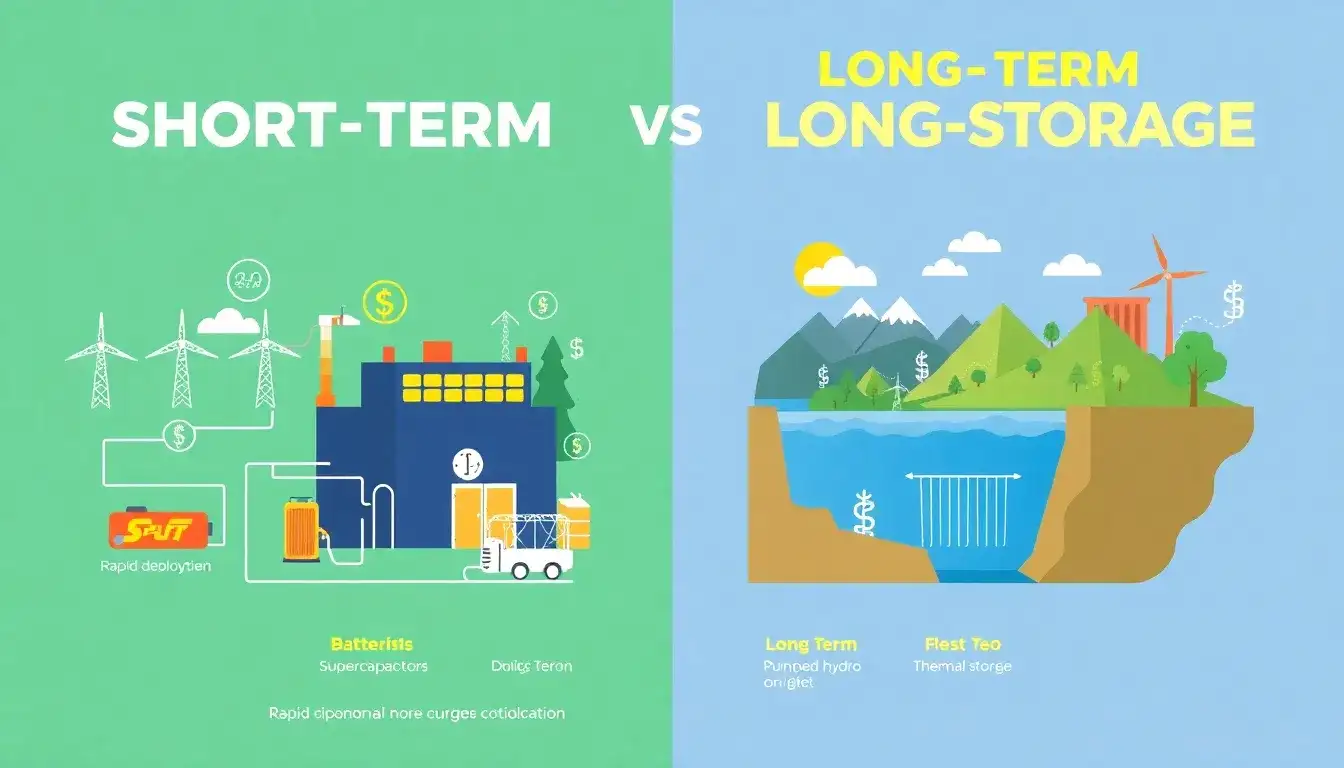
The economic value proposition differs significantly between short-duration and long-duration energy storage primarily due to their distinct roles, applications, and cost structures within the electricity grid.
Short-Duration Energy Storage Economic Value
Short-duration storage (typically minutes to a few hours) mainly targets applications such as:
- Providing ancillary services like frequency regulation and voltage support.
- Managing peak demand through demand charge reduction.
- Enabling rapid response to fluctuations in renewable generation.
- Participating in wholesale markets for energy and capacity.
The economic value here largely arises from incremental revenues earned by selling these services or saving costs via demand charge management and avoiding peak energy purchases. Short-duration storage can also help defer transmission and distribution (T&D) upgrades by smoothing short-term grid stress.
Cost-wise, shorter-duration storage technologies (e.g., lithium-ion batteries) generally have higher power-to-energy ratios and are more optimized for frequent cycling with fast response times, fitting well in markets with high demand charges and dynamic pricing structures. These systems provide value primarily through operational cost savings or ancillary market participation rather than bulk energy shifting.
Long-Duration Energy Storage Economic Value
Long-duration storage (several hours to days or more) serves different needs:
- Enabling bulk energy shifting to balance supply and demand over longer periods, especially for integrating high shares of variable renewables.
- Deferring or avoiding investments in generation capacity by providing backup or firm capacity.
- Reducing reliance on fossil-fueled peaker plants through sustained discharge capability.
- Enhancing grid resilience and reliability during extended outages or low renewable output periods.
Economically, long-duration storage delivers value through avoided costs associated with generation capacity investments and fuel consumption, capacity market revenues, and supporting deeper renewable integration by shifting large amounts of energy from excess production times to high-demand periods.
Long-duration systems typically face higher capital costs and lower cycling frequency but produce value in cost deferral and strategic energy management over longer time horizons beyond typical demand charge windows.
Summary Table
| Aspect | Short-Duration Storage | Long-Duration Storage |
|---|---|---|
| Typical discharge duration | Minutes to a few hours | Several hours to days or more |
| Key economic value sources | Ancillary services, peak demand charge reduction, frequency regulation, real-time energy market arbitrage | Bulk energy shifting, capacity deferral, firm capacity, long-term renewable integration |
| Cost structure | Optimized for fast cycling, high power-to-energy ratio | Higher capital cost, optimized for sustained discharge |
| Market focus | Fast revenue streams via frequency regulation, demand charge management | Long-term cost avoidance, capacity support, fuel savings |
| Role in grid | Grid stability, quick response services | Energy balancing, generation capacity replacement, resilience |
In essence, short-duration storage is economically beneficial where quick, frequent cycling and grid services drive value, while long-duration storage captures value through sustained energy management and capacity cost savings over extended periods.
Original article by NenPower, If reposted, please credit the source: https://nenpower.com/blog/how-does-the-economic-value-proposition-differ-between-short-duration-and-long-duration-energy-storage/