

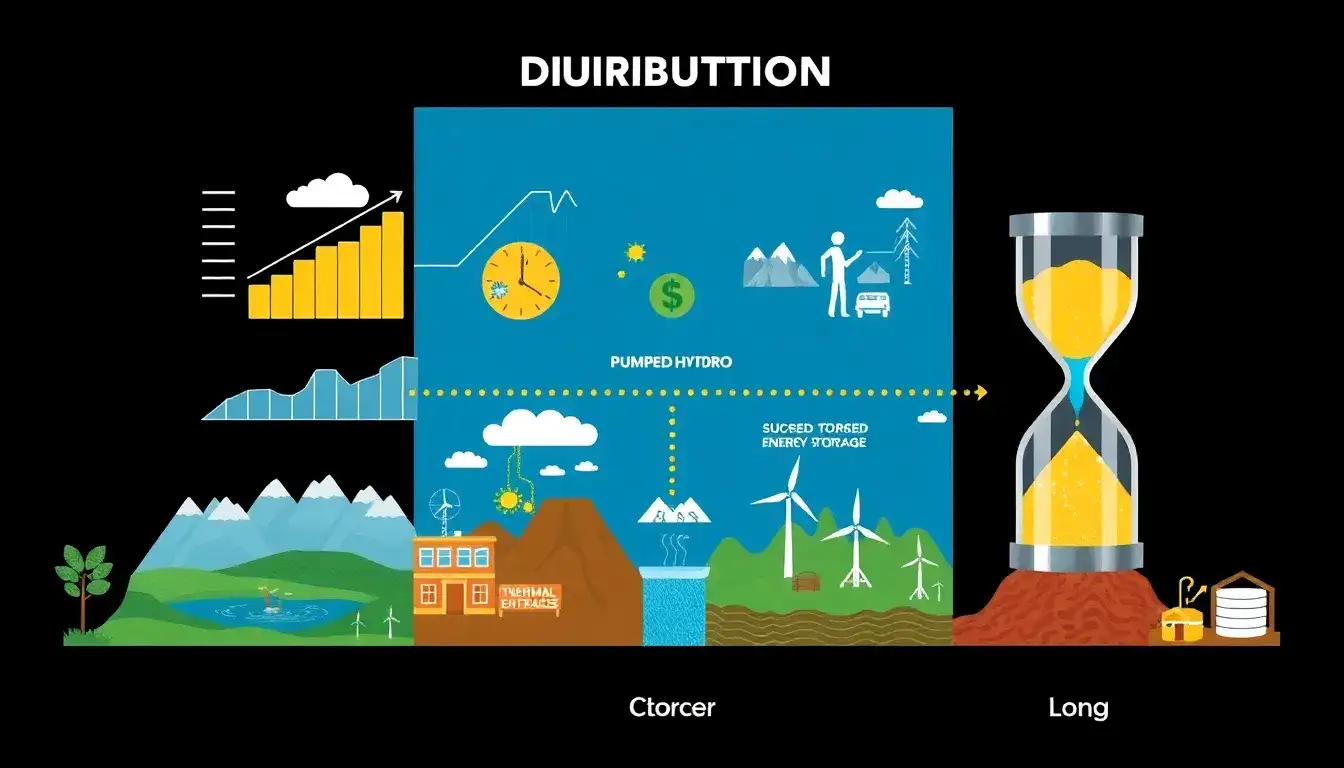
The duration of energy storage systems significantly impacts their cost-effectiveness in several ways:
Final Cost Determinants
- Levelized Cost of Storage (LCOS): The LCOS is a key metric for measuring cost-effectiveness. For many technologies, such as Compressed Air Energy Storage (CAES) and Pumped Hydro Storage (PHS), the LCOS decreases as the storage duration increases, up to a certain point. Beyond 10 hours, the LCOS may rise due to limitations in annual discharge cycles.
- Cycle Life and Depth of Discharge (DoD): Cost-effectiveness is influenced by how many charge/discharge cycles a system can handle before losing capacity. A system with a longer duration may be more cost-effective if used optimally, considering its DoD and cyclic life.
Technology-Specific Considerations
- Lithium-Ion Batteries: These are widely used but face cost challenges for long-duration applications. The cost per kWh is higher compared to other technologies like CAES and PHS.
- Long-Duration Technologies: Innovations in technologies like Hydrogen, Thermal, and Gravitational storage are being explored to reduce costs. These technologies offer lower costs per unit of energy stored over longer durations.
- Cost Reduction Initiatives: The U.S. Department of Energy aims to reduce the cost of long-duration storage by 90% by 2030. This includes initiatives to enhance technologies like flow batteries and compressed air storage.
Economic and Operational Benefits
- Grid Flexibility: Long-duration storage enhances grid flexibility by allowing for time-shifting energy supply and reducing the burden on existing infrastructure.
- Arbitrage and Curtailment Reduction: Energy storage systems can mitigate curtailed energy by capturing excess renewable energy and supplying it when needed, improving overall grid efficiency.
In summary, the cost-effectiveness of energy storage systems depends on how well they balance cost, duration, and operational efficiency. Technologies with longer durations often require higher upfront costs, but they can offer benefits such as reduced infrastructure strain and enhanced grid flexibility.
Original article by NenPower, If reposted, please credit the source: https://nenpower.com/blog/how-does-the-duration-of-energy-storage-systems-impact-their-cost-effectiveness/

