

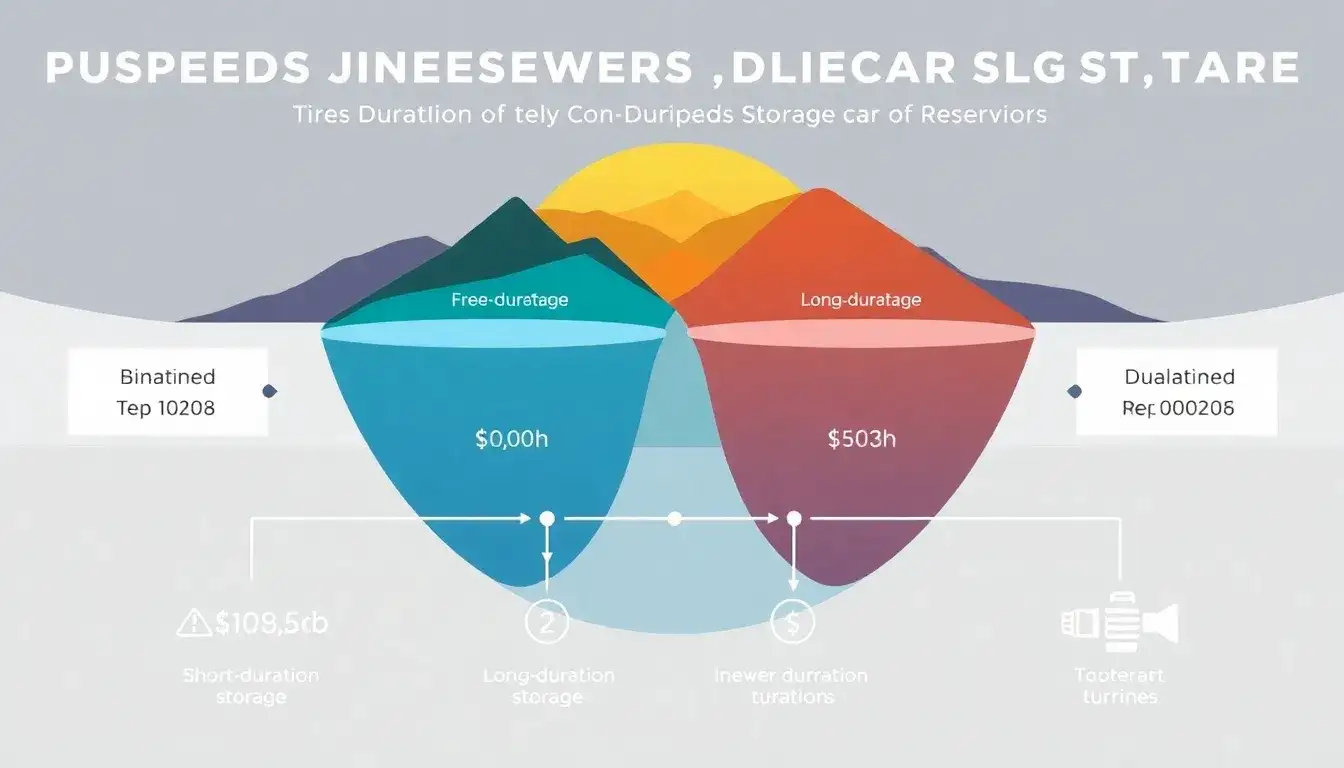
1. Scale Efficiency at Longer Durations
Longer-duration storage (≥8 hours) benefits from economies of scale in reservoir construction. As storage duration increases:
- Fixed costs (e.g., equipment, site preparation) are spread over larger energy capacity, reducing per-kWh costs.
- Variable reservoir costs (e.g., earthworks, materials) dominate, but incremental additions become cheaper proportionally compared to fixed infrastructure.
For example, an 8–11-hour PSH system shows total plant costs between $2,300–$2,637/kW, with fixed costs like turbines and pumps amortized over larger energy storage.
2. Head vs. Reservoir Size Trade-off
Higher-head systems (greater elevation difference) require smaller reservoirs for the same energy storage due to increased potential energy per unit volume. While higher head reduces reservoir size, it does not necessarily lower costs because:
- Geotechnical challenges (e.g., tunneling, dam stability) may offset savings from smaller reservoirs.
- Lower-head systems need larger reservoirs but may face higher land and excavation costs.
3. Cost Ranges
- Typical project costs for PSH range between $2,500–$3,500/kW (including substations/transmission), with duration-specific adjustments.
- Levelized cost of storage (LCOS) for PSH remains competitive at $70–170/MWh, even for newer closed-loop projects, partly due to the scalability of reservoir-based storage compared to battery limits.
In summary, longer durations reduce per-kWh costs through scale, while reservoir design (head, terrain) determines absolute costs. Closed-loop projects avoid environmental constraints, further optimizing cost structures.
Original article by NenPower, If reposted, please credit the source: https://nenpower.com/blog/how-does-the-duration-of-energy-storage-impact-the-cost-of-reservoirs-in-psh-projects/

