

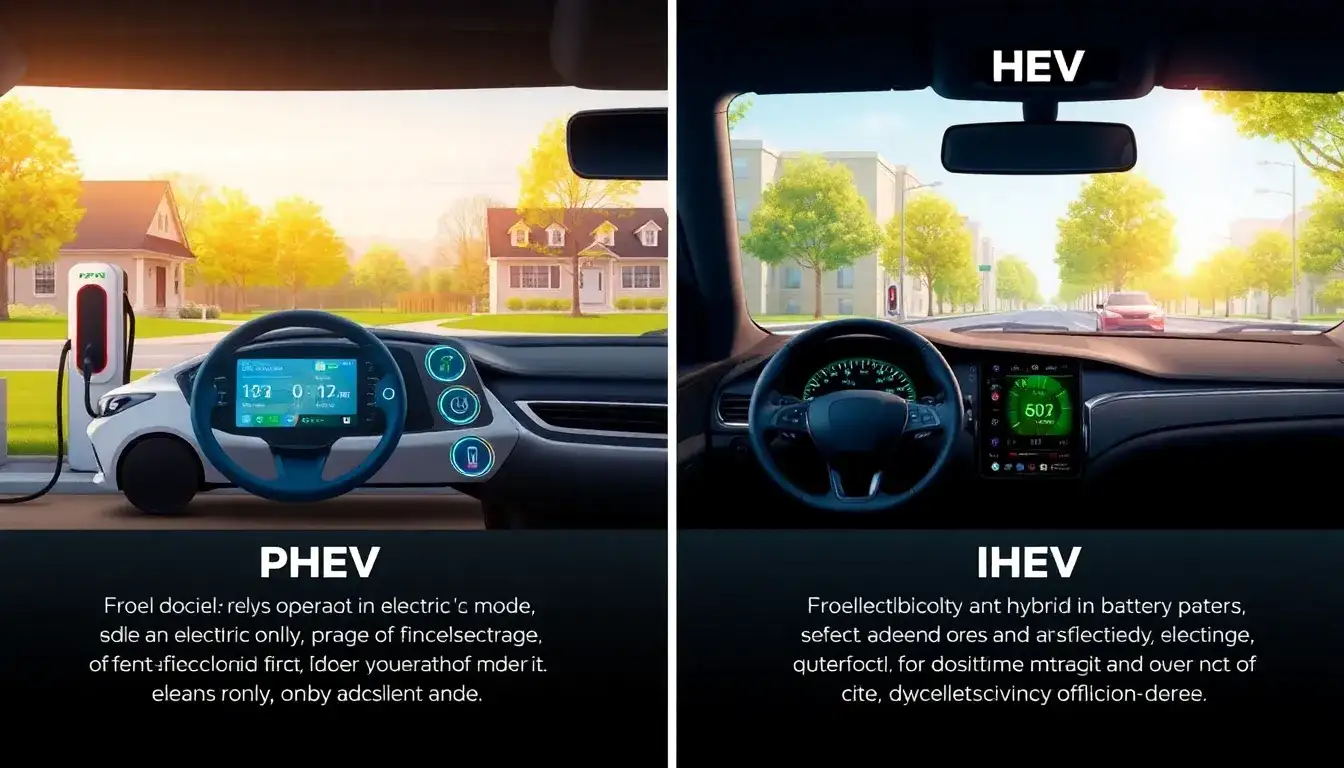
The driving experience differs between Plug-in Hybrid Electric Vehicles (PHEVs) and Hybrid Electric Vehicles (HEVs) primarily due to battery size, electric-only driving capability, and charging requirements.
Battery and Electric-Only Driving
- HEVs use a relatively small battery (around 1 kWh) that is charged through regenerative braking and the internal combustion engine (ICE). This battery supports electric motor assist during acceleration and improves fuel efficiency, especially in stop-and-go city traffic, but does not enable the vehicle to drive on electricity alone for extended distances.
- PHEVs have a much larger battery—about 10 to 20 times bigger than that of HEVs—which can be externally charged by plugging in. This larger battery capacity allows PHEVs to operate purely on electric power for typically 20 to 50 miles, depending on the model and battery size.
Charging and Energy Management
- HEVs rely solely on regenerative braking and the gasoline engine to keep the battery charged, with no need for external charging. This means the fuel efficiency gains come from hybrid system management rather than significant electric-only driving.
- PHEVs require regular external charging to utilize their full electric range. If not plugged in frequently, they function similarly to HEVs but with the added benefit of a reserve electric capacity.
Driving Feel and Practical Use
- HEVs deliver a seamless blend of gasoline engine and electric motor power, typically starting on electric assist but quickly engaging the ICE as speed builds. They feel like fuel-efficient gasoline cars with smooth transitions between power sources.
- PHEVs offer the flexibility to drive in full electric mode for short trips, providing a quieter, smoother, and more instant electric driving experience in that range. When the battery depletes, the vehicle switches to hybrid mode, combining engine and motor power. This dual-mode driving can feel like a battery electric vehicle (EV) at low speeds and hybrid at higher speeds or longer distances.
- For longer trips, PHEVs provide stress-free driving without range anxiety typical of full EVs since the gasoline engine kicks in when the electric range is exhausted. This eliminates concerns about finding charging stations and allows easy refueling at gas stations, making PHEVs more versatile for extended journeys.
Summary Table of Driving Experience Differences
| Aspect | HEVs | PHEVs |
|---|---|---|
| Battery Size | Small (~1 kWh) | Large (10-20 times HEV battery) |
| Electric-Only Driving | Minimal to none | 20-50 miles electric range |
| Charging | No external charging needed | Requires plugging in to maximize EV range |
| Driving Feel | Hybrid mode blending engine & motor | Electric drive at low speeds; hybrid when battery depleted |
| Long Trip Suitability | Functions as hybrid only | Combines EV-like local driving with hybrid for long trips |
| Fuel Efficiency | Improved over gasoline only | Potentially higher due to extended electric driving |
In essence, PHEVs provide a more versatile and electric-focused driving experience with the convenience of a gasoline engine backup, while HEVs offer continual hybrid assistance without the need for charging but lack significant electric-only driving capability.
Original article by NenPower, If reposted, please credit the source: https://nenpower.com/blog/how-does-the-driving-experience-differ-between-phevs-and-hevs/

