

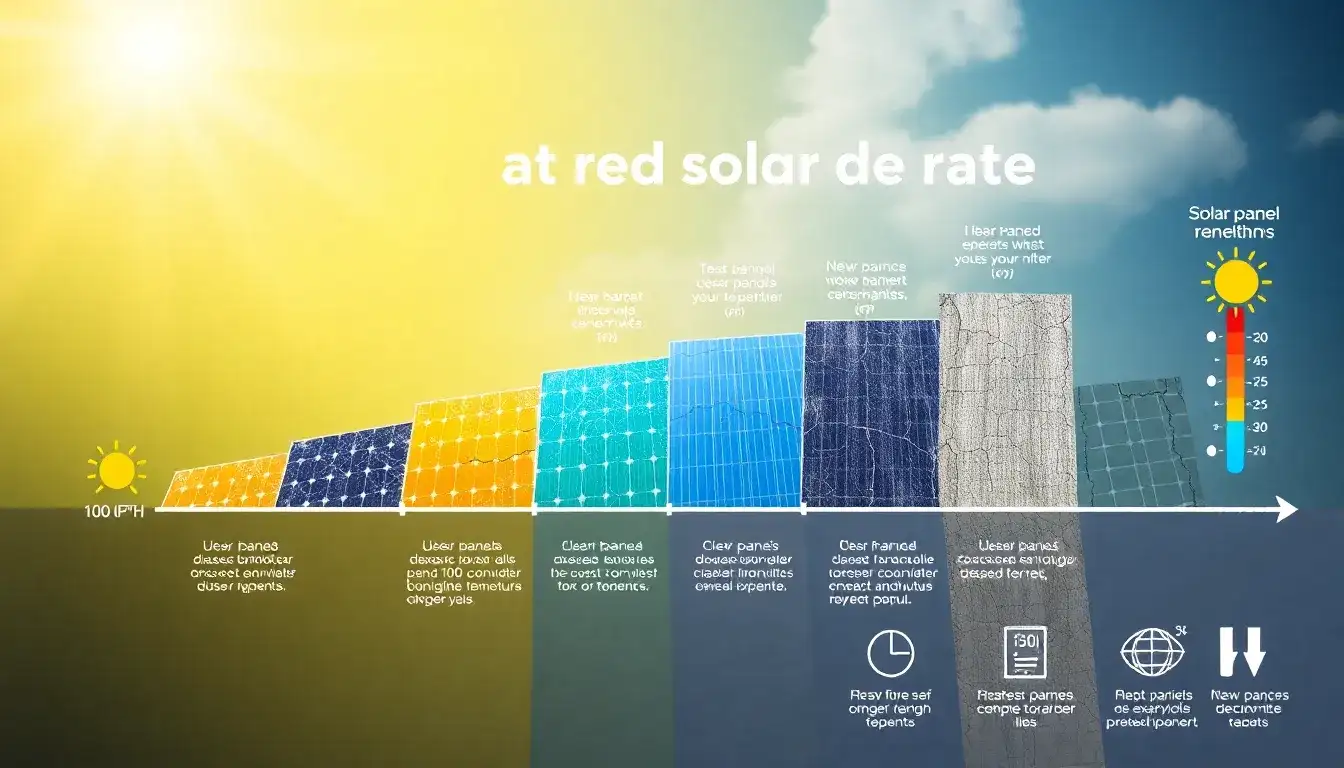
Solar Panel Degradation Rates
Solar panel degradation rates follow a non-linear pattern, starting higher initially and stabilizing over time. Here’s a breakdown of the key phases:
Initial Degradation (First Hours/Weeks)
The highest degradation occurs immediately after installation due to light-induced degradation (LID). Panels lose 1-3% efficiency within the first 1,000 hours (~42 days) of sunlight exposure as the photovoltaic cells stabilize.
Long-Term Degradation (Years 1-25+)
After the initial drop, degradation slows significantly:
- Average rate: ~0.5% annual loss (median found in NREL studies)
- Warranty baseline: Manufacturers typically guarantee ≤1% annual degradation, ensuring 90% output at 10 years and 80% at 25-30 years
- High-efficiency panels: Some premium models degrade as slowly as 0.4%/year (post-2000 monocrystalline panels in NREL’s global study)
Environmental & Quality Impacts
Degradation accelerates in:
- Hot climates: Thermal cycling (expansion/contraction) causes microcracks
- Extreme weather: Hail, humidity freeze, and UV exposure degrade backsheets and cells
- Low-quality installations: Poor mounting or incompatible materials increase PID (voltage leakage)
Lifespan & End Performance
Most panels remain functional well beyond warranty periods, with:
- Typical post-warranty output: 75-85% at 30 years
- Exceptional cases: Early solar panels (e.g., 1954 Bell Labs unit) still produce at 60+ years
- Grid-scale risks: Some newer high-efficiency modules degrade up to 2%/year in desert/tropical environments
Key factors mitigating degradation include professional installation, UV-resistant materials, and regular maintenance.
Original article by NenPower, If reposted, please credit the source: https://nenpower.com/blog/how-does-the-degradation-rate-of-solar-panels-vary-over-time/

