

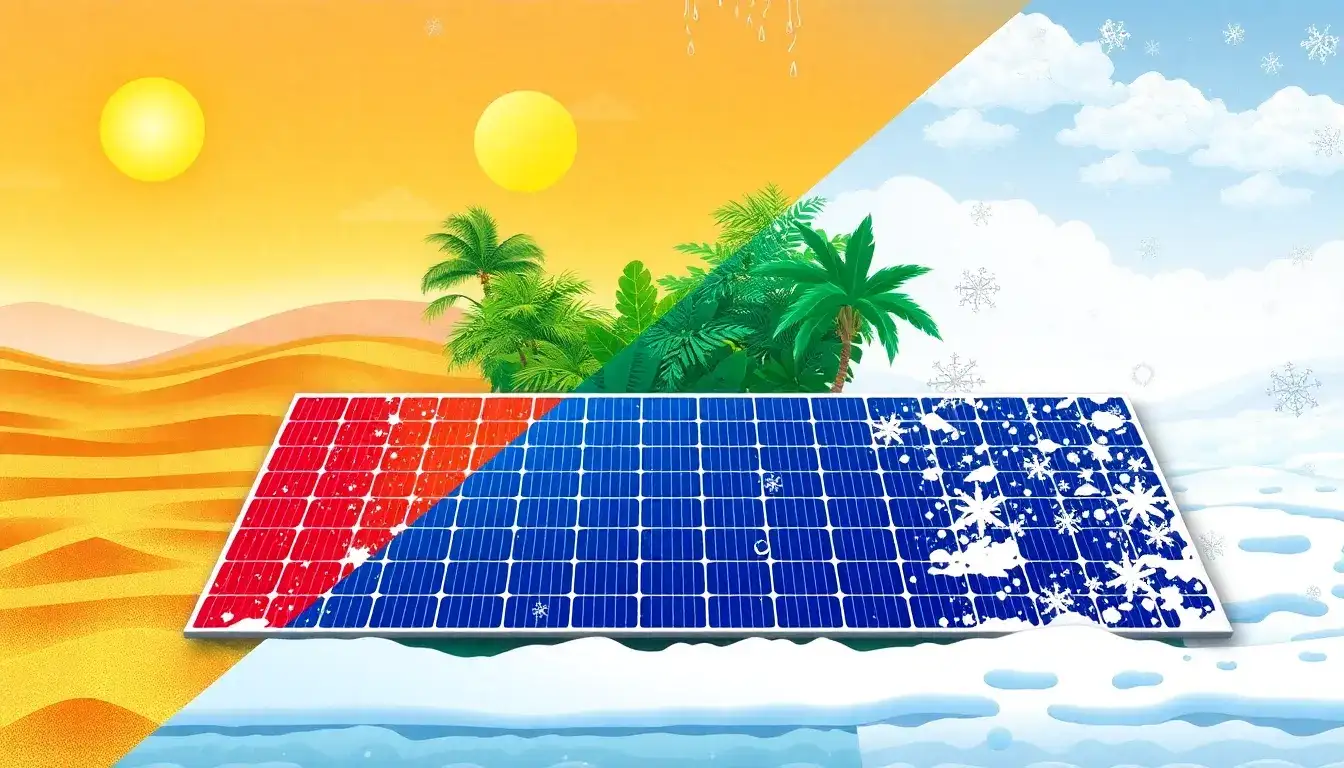
Solar panel degradation rates
Solar panel degradation rates vary significantly across climates due to environmental stressors such as temperature, humidity, UV exposure, and extreme weather. Here’s a breakdown of key climate-specific effects:
Hot and Humid Climates
- Degradation rates: Up to 1%/year or higher due to combined heat and humidity accelerating hydrolysis (chemical breakdown of materials) and increasing thermal stress.
- Examples: Northern Australia sees nearly doubled degradation rates by 2100 under high-emission scenarios, while tropical regions like Indonesia show location-dependent failure mechanisms.
Desert Climates
- Degradation rates: Moderate to high (approximately 1%/year) due to extreme daytime heat and dust accumulation.
- Examples: Systems in Phoenix (AZ, USA) and Libya exhibited ~1%/year degradation after decades of operation.
Temperate and Moderate Climates
- Degradation rates: Typically 0.4–0.75%/year, driven by balanced temperature and humidity levels.
- Examples: Systems in Massachusetts (USA) and Sweden maintained degradation rates as low as 0.17–0.4%/year over 20–25 years.
Alpine/Polar Climates
- Degradation rates: Highly variable. Facade-mounted systems in the Canadian Arctic and European Alps showed minimal degradation (<0.5%/year), while ground-mounted panels exposed to snow loads experienced higher rates.
Extreme Weather Impact
- Short-term: Events like hail (>25mm) or winds >90 km/h cause localized damage, adding ~1% annual loss.
- Long-term: Repeated stress from wind/snow accelerates cell cracking and system degradation.
Key Drivers
- Temperature: Hotter regions double degradation compared to cooler zones (0.88%/year vs. 0.48%/year).
- Humidity: Increases hydrolysis in encapsulants (e.g., EVA), especially in coastal areas.
- UV Exposure: Long-term UV exposure correlates with slow power loss, particularly in arid/sunny climates.
Degradation Projections
Climate change is expected to increase degradation rates in hot/humid regions by up to 12%, impacting energy costs by ~10% by 2059. Design strategies emphasizing climate resilience (e.g., humidity-resistant coatings) are critical for future PV systems.
Original article by NenPower, If reposted, please credit the source: https://nenpower.com/blog/how-does-the-degradation-rate-of-solar-panels-differ-between-various-climates/

