

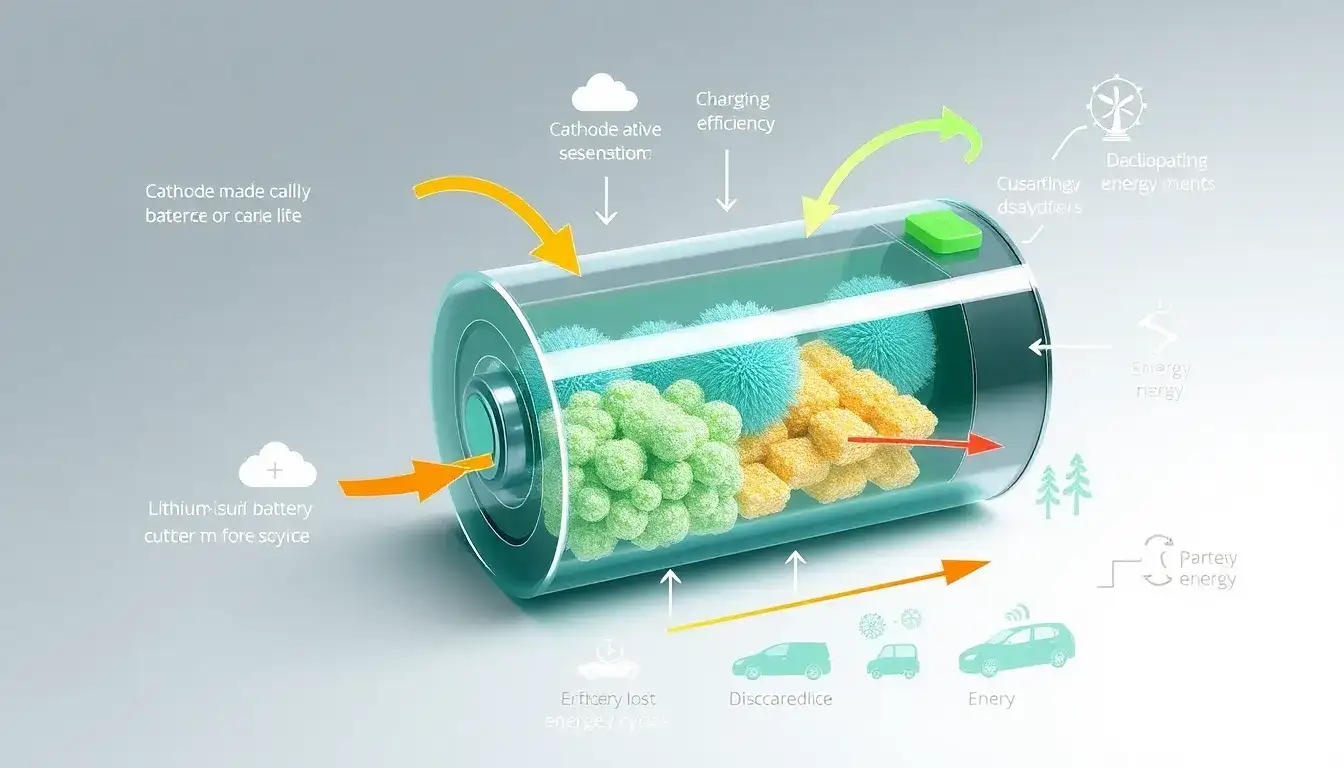
The cycle life of lithium-sulfur (Li-S) batteries significantly impacts their overall efficiency, primarily due to their relatively shorter lifespan compared to traditional lithium-ion batteries. This shorter cycle life has historically limited their practical use despite their high theoretical capacity and potential advantages.
Impact of Cycle Life on Efficiency
- Capacity retention over cycles: Lithium-sulfur batteries typically suffer from capacity loss because of the dissolution of polysulfides in the electrolyte, known as the shuttle effect. This leads to active material loss and degradation with cycling, reducing the battery’s effective capacity and thus its efficiency over time.
- Typical cycle life ranges: Traditional Li-S batteries have about 1,000 charging cycles lifespan, significantly less than the ~2,000 cycles common in lithium-ion cells. Early Li-S cells had even fewer cycles, but advancements have increased cycle life to 1,500 or even 4,000 cycles in some cases due to new materials and designs.
- Recent advancements: Innovations like improved cathode materials and new anode designs have extended cycle life substantially. For example, some recent Li-S batteries can retain 80% of their charge capacity even after 25,000 cycles in experimental settings, indicating a potential for much longer operational lifetimes and improved efficiency.
- Operating conditions: Factors such as charging rate and temperature affect the practical cycle life. Fast charging tends to reduce cycle life to around 1,000 cycles, which still translates to about a 10-year lifespan for applications like electric vehicles, making Li-S batteries increasingly viable.
Summary
The shorter cycle life of lithium-sulfur batteries historically limits their efficiency because degradation processes reduce usable capacity over time. However, with ongoing material and design improvements, the cycle life is extending closer to or exceeding 1,000 cycles, and in some advanced cases reaching tens of thousands of cycles while maintaining high capacity. This markedly enhances their overall efficiency and practical utility, potentially making Li-S batteries competitive alternatives to lithium-ion batteries with advantages in energy density and sustainability.
Original article by NenPower, If reposted, please credit the source: https://nenpower.com/blog/how-does-the-cycle-life-of-lithium-sulfur-batteries-impact-their-overall-efficiency/

