

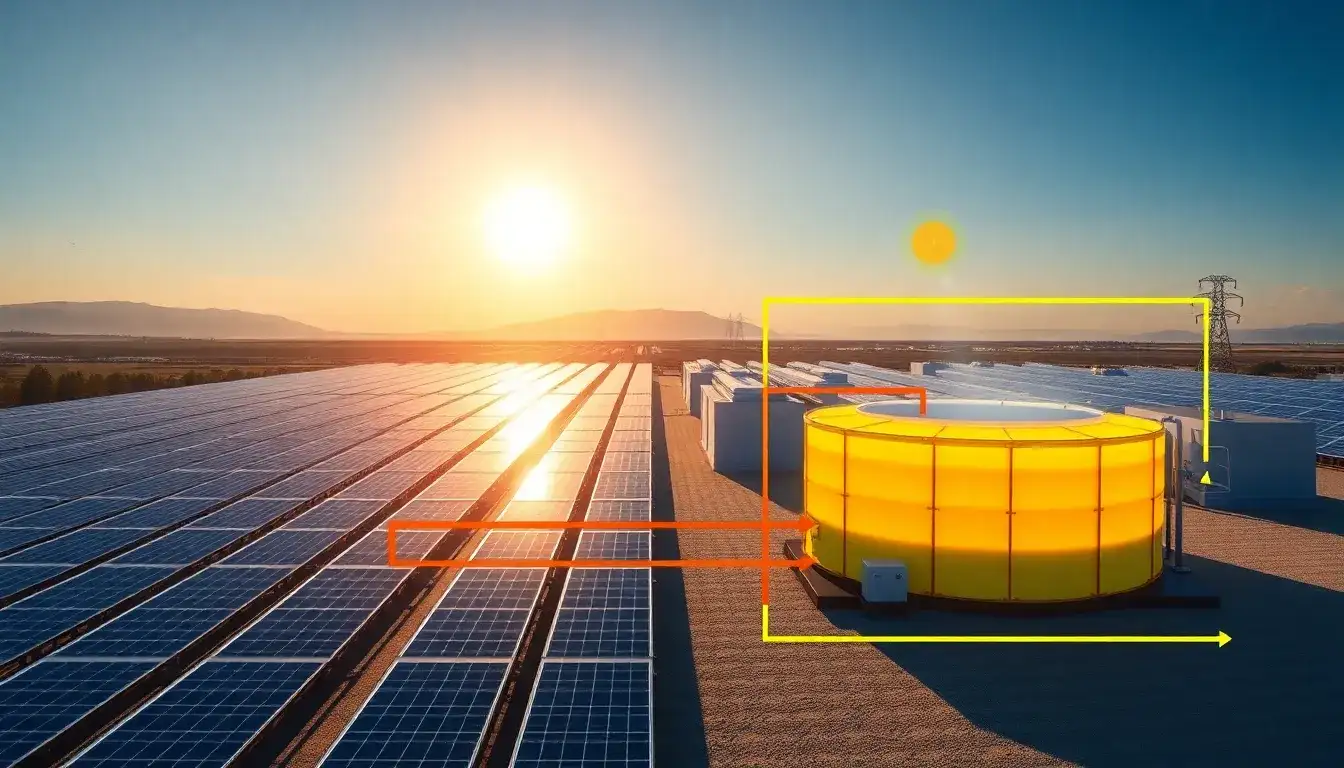
The cost of thermal energy storage (TES) has a significant impact on the overall efficiency and economic viability of solar power plants, particularly concentrated solar power (CSP) plants that rely on TES to store heat for use when sunlight is unavailable.
Impact of TES Cost on Solar Power Plant Efficiency and Economics
1. TES Costs Influence Levelized Cost of Energy (LCOE) and Plant Design
TES allows CSP plants to operate beyond sunlight hours by storing excess thermal energy, thus increasing the plant’s capacity factor and enabling more consistent electricity generation. However, the cost of TES affects the overall levelized cost of energy (LCOE) for the solar power plant because it adds to the capital expenditure (capex). For instance, TES capital costs have been reported in the range of about $232/kWh (installed system cost) globally, with some variation depending on region and technology maturity. Lower TES costs directly contribute to reducing LCOE, making solar thermal plants more competitive with fossil fuels and other renewables.
2. TES Size and Storage Duration Affect Plant Efficiency
The storage capacity, often measured in hours of maximum capacity output, determines how long the plant can sustain electricity generation without solar input. Higher TES capacity allows for larger solar fields and better use of available solar energy, improving operational efficiency. TES typically has a high roundtrip efficiency around 98.5%, meaning only a small fraction of energy is lost during storage cycles. However, increasing storage size also raises costs, so there’s a trade-off between longer storage durations and capital investment.
3. TES Cost Reduction Enhances Economic Attractiveness
New innovations aim to drastically reduce TES costs. Traditional TES costs for CSP plants have ranged from $15 to $30 per kWh thermal capacity, with projects targeting costs as low as $3.54/kWh thermal to compete with fossil fuel baseload plants. Significant TES cost reductions can increase the capacity factor to 75% or higher by enabling more effective storage and dispatch of electricity, thus improving the overall plant efficiency and utilization.
4. Comparison With Other Storage Technologies
Thermal energy storage is currently among the least expensive long-duration energy storage technologies compared to lithium-ion batteries and compressed air storage, especially for discharge durations longer than eight hours. For example, the global average capex for TES is about $232/kWh, while lithium-ion batteries for four-hour storage average $304/kWh, making TES more cost-effective for long-duration storage applications in solar power plants.
Summary Table: TES Cost Metrics and Their Effects
| Parameter | Typical Value / Range | Impact on Solar Power Plant |
|---|---|---|
| TES Capex (installed cost) | ~$232/kWh (global average) | Major component of CSP capital costs |
| TES Cost for CSP plants | $15–$30 per kWh thermal | Influences LCOE and economic feasibility |
| Target TES cost from research | As low as $3.54/kWh thermal | Enables higher capacity factors and lower LCOE |
| TES Roundtrip Efficiency | ~98.5% | Minimal energy loss during storage cycles |
| Storage duration | Varies (1+ hours of full capacity output) | Longer duration increases plant dispatchability |
Conclusion
The cost of thermal energy storage is a key factor in determining the overall efficiency and economic competitiveness of solar power plants, especially CSP facilities. Lower TES costs enable larger storage capacity, higher capacity factors, and reduced LCOE, thereby improving the plant’s effective efficiency and reliability. Advances aiming to reduce TES costs to under $5/kWh thermal could significantly enhance the role of solar thermal plants in providing baseload renewable energy.
Thus, TES cost directly impacts not only the capital investment but also the operational efficiency and economic success of solar power plants.
Original article by NenPower, If reposted, please credit the source: https://nenpower.com/blog/how-does-the-cost-of-thermal-energy-storage-impact-the-overall-efficiency-of-solar-power-plants/

