

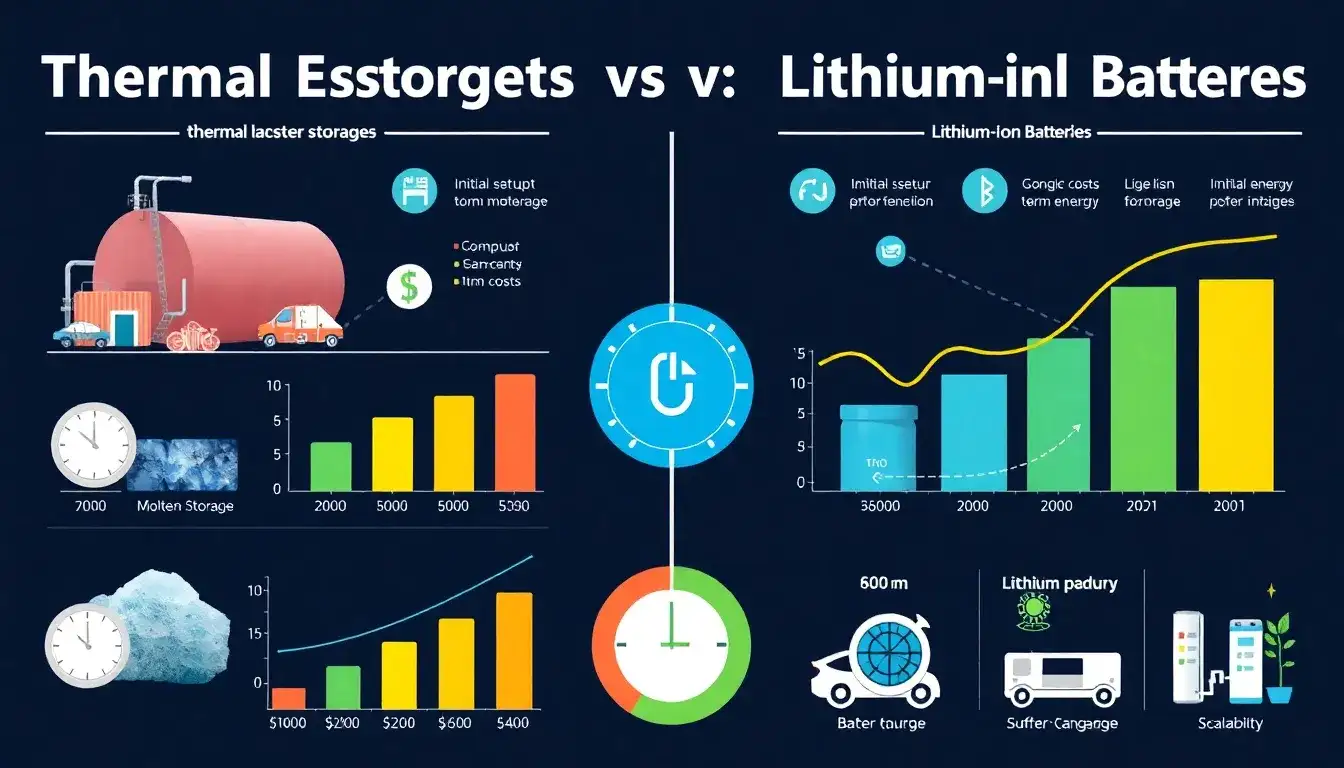
When comparing the costs of thermal energy storage and lithium-ion batteries for long-duration applications, thermal energy storage often emerges as a more cost-effective option. Here are some key points to consider:
Capital Expenditure (Capex)
- Thermal Energy Storage: The average capex for thermal energy storage systems is around $232 per kilowatt-hour (kWh), making them one of the cheapest technologies for long-duration energy storage.
- Lithium-Ion Batteries: For four-hour duration systems, lithium-ion batteries have a higher average capex of approximately $304 per kWh as of 2023. For longer durations, the cost of lithium-ion can increase due to the need for more battery stacks and power conversion equipment.
Long-Term Cost Considerations
- Scalability and Economies of Scale: Thermal energy storage can be more scalable for long-duration applications because increasing energy capacity doesn’t necessarily require additional power conversion equipment. However, lithium-ion batteries have benefited from economies of scale thanks to their widespread use in electric vehicles and consumer electronics, which drives down costs.
- Geographical Variations: In China, thermal energy storage and other non-lithium technologies are developing rapidly, with lower costs due to large-scale projects and favorable policies. Outside China, these technologies face higher costs but still offer potential for investment and innovation.
- Operating and Maintenance Costs: Thermal energy storage systems, like the ThermalBattery™, are often more maintenance-friendly and environmentally friendly compared to lithium-ion batteries, potentially reducing long-term costs.
Efficiency and Lifetime
- Thermal Energy Storage: Offers high round-trip efficiencies (often over 90%) and does not have a limited cycle life, requiring less maintenance over time.
- Lithium-Ion Batteries: Have high round-trip efficiencies (85-95%) but are limited by a finite number of charge-discharge cycles (2,000-8,000), which can impact long-term viability and replacement costs.
In summary, thermal energy storage is more cost-effective for long-duration applications due to its lower capex and operational advantages. However, lithium-ion batteries continue to benefit from their versatility and economies of scale, particularly in regions like China.
Original article by NenPower, If reposted, please credit the source: https://nenpower.com/blog/how-does-the-cost-of-thermal-energy-storage-compare-to-lithium-ion-batteries-in-the-long-term/

