

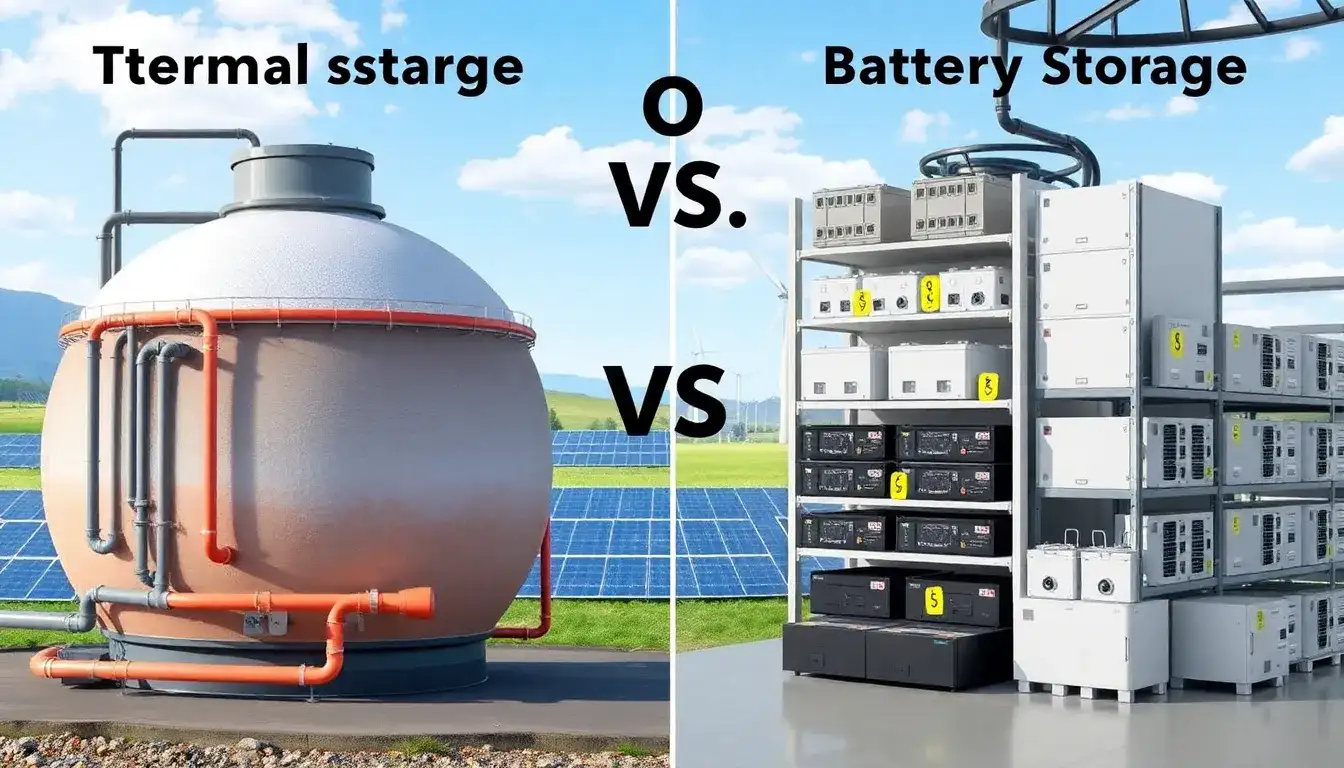
The cost comparison between thermal energy storage (TES) and battery storage, especially lithium-ion batteries, reveals important distinctions mainly driven by the application, scale, and technology maturity.
Cost of Thermal Energy Storage
- Thermal energy storage systems, particularly using molten salt as a storage medium, have capital expenditure (capex) costs around $350/kWh thermal, resulting in estimated costs of about 13.5 cents per kWh-thermal for a 10% internal rate of return (IRR). With optimized design and lower capex, these costs can fall to between 5 and 10 cents per kWh-thermal.
- More recent global average capex costs for fully installed thermal energy storage systems are estimated to be approximately $232/kWh, making TES the cheapest long-duration energy storage technology category overall. This is especially true for discharge durations longer than eight hours.
- The National Renewable Energy Laboratory (NREL) highlights particle thermal energy storage using inexpensive materials like silica sand, which can achieve very low storage costs estimated at $2–$4 per kWh-thermal. This reflects the low cost of raw materials like sand and concrete infrastructure, translating to highly scalable and cost-effective long-duration TES solutions.
- The MIT Thermal Energy Grid Storage (TEGS) project estimates cost per stored energy below $20/kWh, emphasizing that TES potentials for grid-scale, long-duration storage are significantly lower than typical battery costs when considering energy stored over long timeframes.
Cost of Battery Storage
- Lithium-ion battery storage systems, particularly for four-hour duration applications, have higher installed system costs. For example, BloombergNEF reports a global average installed cost of lithium-ion battery storage at around $304/kWh for four-hour systems.
- Battery costs have been falling rapidly with economies of scale and technology improvements, with residential-scale lithium-ion battery costs having declined by over 70% from 2014 to 2020, reaching around $776/kWh at small scale.
- Despite rapid cost declines and a leading position for short-duration applications, lithium-ion batteries tend to have higher upfront costs relative to TES for long-duration discharge needs (greater than 6-8 hours).
Summary Comparison
| Feature | Thermal Energy Storage (TES) | Lithium-Ion Battery Storage |
|---|---|---|
| Capex Cost (approximate) | $232/kWh (long-duration) to $350/kWh-th | $304/kWh (4-hour systems), higher at smaller scale |
| Cost per kWh (energy stored) | 5–13.5 cents/kWh-thermal (depending on setup) | Generally higher for equivalent duration storage |
| Duration Suitability | Well-suited for long-duration (>8 hours) | Often optimized for shorter duration (1-4 hours) |
| Materials Cost | Low-cost raw materials (e.g., sand, molten salt) | More expensive raw materials, advanced tech |
| Efficiency | TES round-trip efficiency lower but improving | Higher round-trip efficiency, especially for short durations |
| Scale | Easily scalable to very large capacities | Scale limited by cell manufacturing capacity and costs |
| Geographic Flexibility | Can be sited broadly, some TES systems use existing infrastructure | Requires battery manufacturing and recycling infrastructure |
Conclusion
Thermal energy storage generally offers lower costs for long-duration, grid-scale storage compared to lithium-ion batteries, primarily due to cheaper storage media (e.g., sand, molten salt), scalable infrastructure, and lower capex per kWh stored energy. Lithium-ion batteries remain competitive for shorter-duration and high power density needs but are more expensive on a per kWh basis for long-duration applications. This cost dynamic positions TES as a promising solution for large-scale renewable integration and decarbonization of the grid where long-duration storage is critical.
Original article by NenPower, If reposted, please credit the source: https://nenpower.com/blog/how-does-the-cost-of-thermal-energy-storage-compare-to-battery-storage/

