

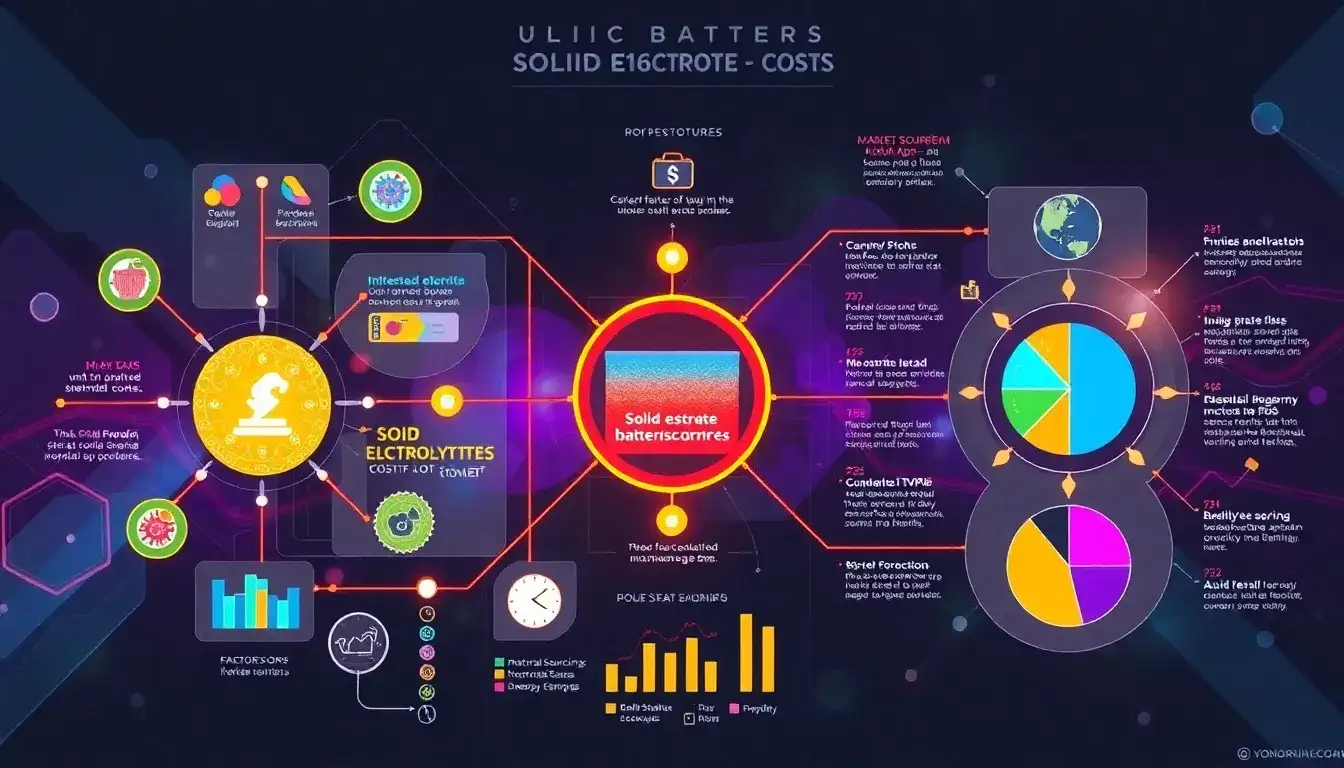
The cost of solid electrolytes significantly impacts the overall cost of solid-state batteries (SSBs), primarily because solid electrolytes currently involve expensive raw materials and complex manufacturing processes.
Cost Contribution of Solid Electrolytes to Solid-State Batteries
- High material cost: One of the main cost drivers in solid-state batteries is the solid electrolyte material itself. For example, top-performing sulfide-based solid electrolytes typically cost around $170 per kilogram, largely due to costly lithium sulfide salts used in their production. This price is substantially higher than traditional liquid electrolytes.
- Efforts to reduce costs: Researchers have developed new solid electrolytes using less expensive materials and novel processing, such as an amorphous sulfur-lithium-iodide mixture, which reduces the electrolyte cost to about $28 per kilogram—approximately one-sixth the price of previous materials—while maintaining decent ionic conductivity. Such innovations are critical to making solid electrolytes, and thus solid-state batteries, commercially viable.
- Impact on battery cost per kWh: The electrolyte cost influences the battery’s overall cost per kilowatt-hour (kWh). Recent forecasts estimate solid-state battery costs to be between $65 and $90 per kWh by the late 2020s as scaling improves and manufacturing processes mature. However, earlier estimates predicted steep costs ranging from $400 to $800 per kWh in the mid-2020s due to the high cost of materials and production barriers.
- Scaling and manufacturing effects: The high initial costs are partly due to smaller production volumes and lack of process optimization. As with conventional lithium-ion batteries, economies of scale and production experience can dramatically reduce costs over time—from hundreds per kWh down to below $100 per kWh, with solid electrolyte materials becoming less expensive as production scales and new cheaper formulations emerge.
Summary of Cost Influence
| Aspect | Detail / Impact |
|---|---|
| Solid electrolyte material cost | Typically around $170/kg for sulfide electrolytes, reduced to ~$28/kg with new materials |
| Battery cost per kWh | Forecasted to decrease from $400-$800/kWh (2026) to $65-$90/kWh by late 2020s |
| Production scale | Initial high costs due to low volume and complexity, expected to drop sharply with scale-up |
| Cost reduction strategies | New electrolyte formulations using cheaper chemicals and simpler processing |
In conclusion, the cost of solid electrolytes is a major contributor to the overall cost of solid-state batteries. While currently expensive, innovative materials and scaling production are poised to reduce these costs substantially, thereby improving the commercial viability of solid-state battery technology over the next decade.
Original article by NenPower, If reposted, please credit the source: https://nenpower.com/blog/how-does-the-cost-of-solid-electrolytes-impact-the-overall-cost-of-solid-state-batteries/

