

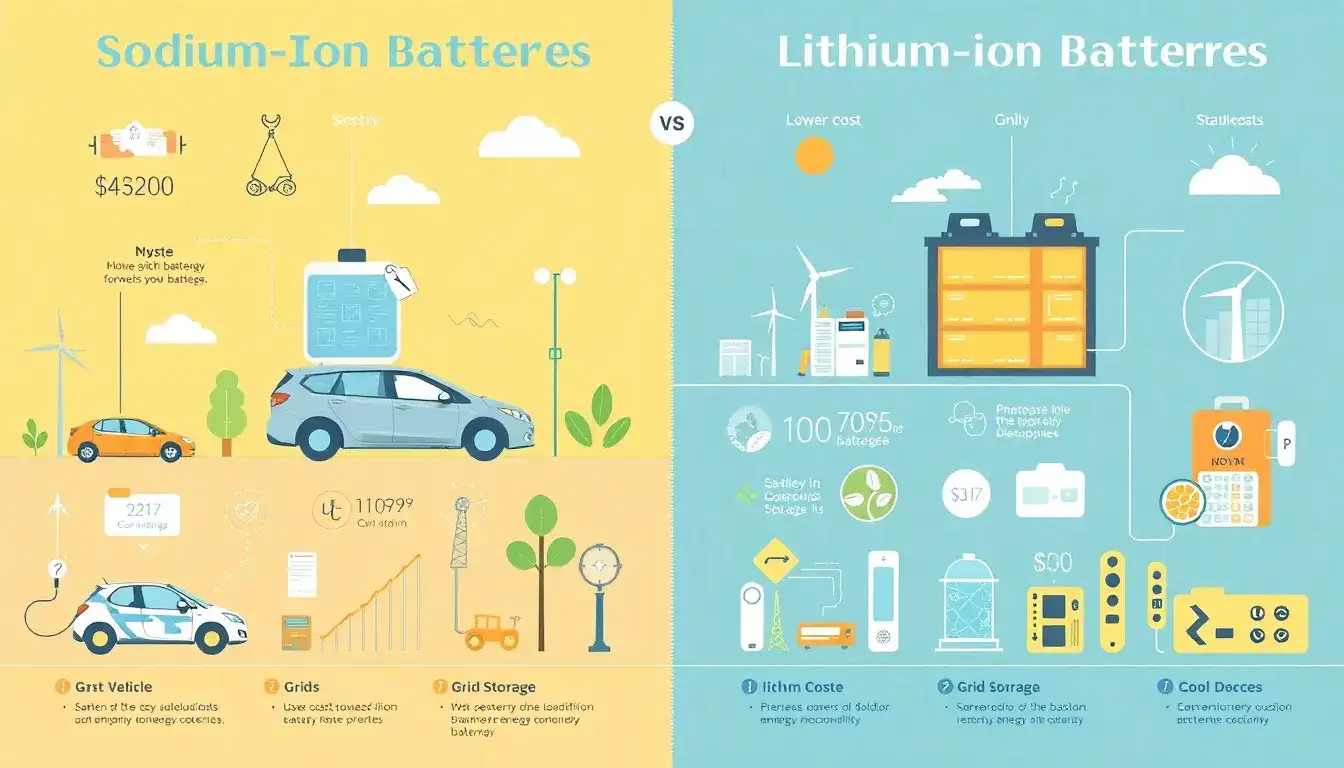
The cost of sodium-ion batteries compared to lithium-ion batteries shows significant advantages in several real-world applications. Here’s a breakdown of their cost comparison:
Cost Comparison Overview
- Raw Materials: Sodium is far more abundant and less expensive than lithium. For instance, sodium carbonate is priced at about $290 per metric ton, while lithium carbonate costs approximately $35,000 per metric ton, highlighting a substantial cost disparity favorable to sodium-ion batteries.
- Battery Manufacturing Costs: Estimates suggest that sodium-ion batteries can be 20% to 30% cheaper than lithium-ion batteries, particularly when considering the reduced cost of sodium and associated materials. In 2024, the manufacturing cost for sodium-ion cells was approximately $50/kWh compared to about $70/kWh for lithium-ion cells.
- Market Prices: Recent data indicates that sodium-ion cells cost about $87/kWh, marginally cheaper than lithium-ion cells at $89/kWh in 2024. This marginal difference is expected to increase as sodium-ion technology continues to improve.
Application-Specific Cost Considerations
- Electric Vehicles (EVs): For EVs, lithium-ion batteries currently dominate due to their higher energy density. However, sodium-ion batteries could be a more cost-effective option for short-range urban vehicles.
- Stationary Storage: Sodium-ion batteries are particularly promising for stationary energy storage. They offer lower costs, which could be crucial for applications where energy density is not the top priority.
- Grid-Scale Energy Storage: The ability of sodium-ion batteries to provide longer storage durations at a lower cost makes them attractive for grid-scale energy storage.
Challenges and Future Directions
While sodium-ion batteries hold cost advantages, they still need to overcome challenges in energy density and large-scale production to fully compete with lithium-ion technology. As technology improves, sodium-ion batteries are expected to become more competitive in both manufacturing cost and performance.
Overall, sodium-ion batteries offer a cost-effective alternative to lithium-ion batteries, especially for applications that prioritize sustainability and cost over high energy density, such as low-range EVs and stationary storage solutions.
Original article by NenPower, If reposted, please credit the source: https://nenpower.com/blog/how-does-the-cost-of-sodium-ion-batteries-compare-to-lithium-ion-batteries-in-real-world-applications/

