

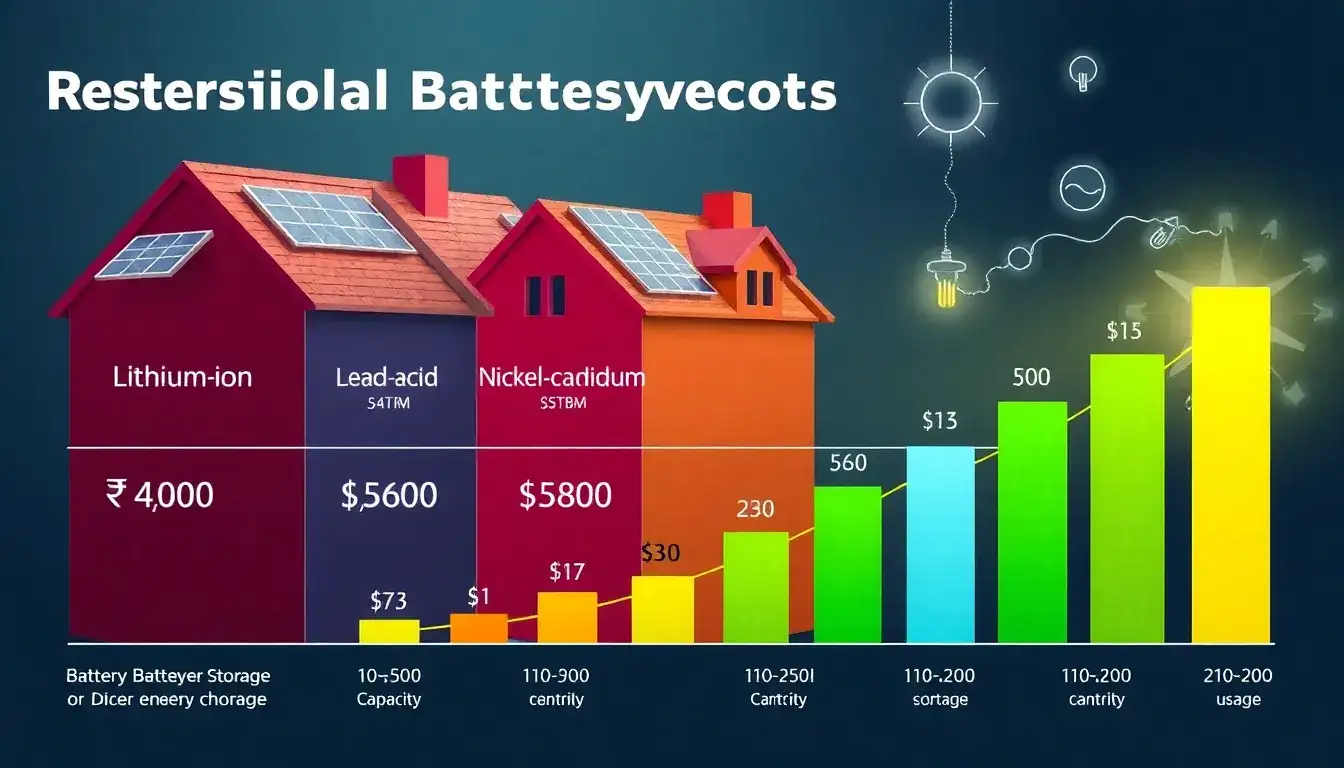
The cost of residential battery storage systems varies significantly with different battery chemistries. Here’s a breakdown of how different chemistries influence costs:
Battery Chemistries and Costs
- Lithium-Ion Batteries: These are commonly used in residential storage systems and come in various types, such as Nickel Manganese Cobalt (NMC) and Lithium Iron Phosphate (LFP). Lithium-ion batteries are generally more expensive than lead-acid batteries, often 2-4 times the cost. For residential systems, lithium-ion battery packs typically range between $700 to $900 per kWh without installation, primarily due to their high energy density and long cycle life.
- Lead-Acid Batteries: These are more traditional and have been used for years, particularly in off-grid systems. Lead-acid batteries are less expensive than lithium-ion batteries but offer less energy density and shorter lifetimes, making them less favorable for modern residential storage.
- Nickel-Cadmium (Ni-Cd) Batteries: Although not commonly used in residential settings due to toxicity concerns and environmental regulations, Ni-Cd batteries were once used in niche applications. Their cost can be higher than lead-acid but less than lithium-ion, though they are largely obsolete for residential use.
Factors Influencing Battery Cost
- Energy Storage Capacity: More significant capacities (measured in kWh) result in higher costs. For example, a 12 kWh system might cost between $12,000 and $18,000.
- Installation Costs: Professional installation, which is common for grid-tied systems, adds to the overall cost. Installation can increase the price by several hundred dollars per kWh.
- Inverter Costs: An inverter may be needed to convert DC to AC power, adding to total system costs. The cost of inverters can range depending on the type and capacity.
- Chemistry Selection: Different chemistries offer varying levels of performance, safety, and cost. LFP (Lithium Iron Phosphate) chemistry is becoming popular for stationary storage due to its safety and cost-effectiveness.
Conclusion
The choice of battery chemistry significantly affects the cost of a residential battery storage system, with lithium-ion batteries offering the best balance of performance and cost for many applications. Costs vary widely based on capacity, installation requirements, and chemistry, making it important to evaluate multiple options when selecting a battery system for residential use.
Original article by NenPower, If reposted, please credit the source: https://nenpower.com/blog/how-does-the-cost-of-residential-battery-storage-systems-vary-with-different-battery-chemistries/

