

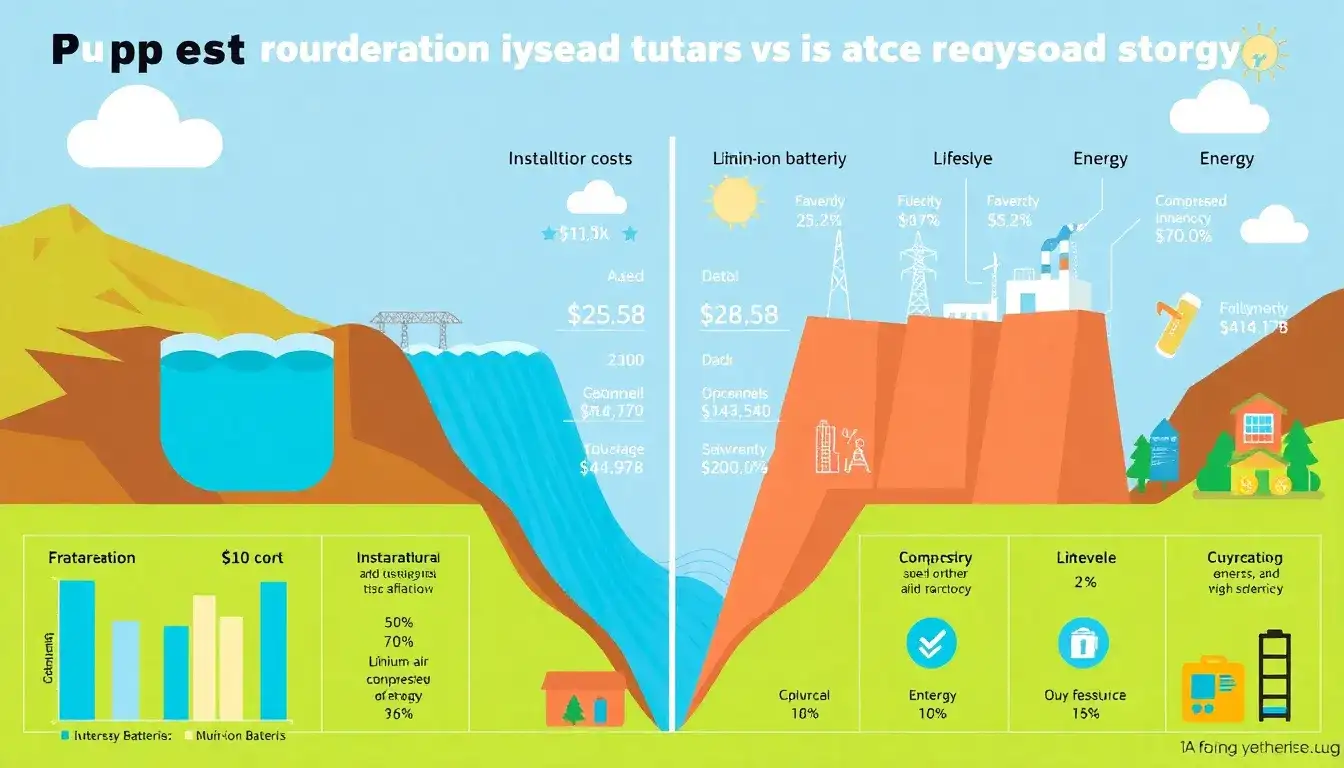
Pumped hydroelectric energy storage (PHES) generally has lower costs compared to other forms of utility-scale energy storage, particularly lithium-ion battery storage, when evaluated on a per kilowatt-hour ($/kWh) basis.
Cost Comparison of Pumped Hydroelectric vs. Battery Storage
- Pumped Hydroelectric Storage:
- Typically, PHES has a capital cost ranging from about $1,000 to $2,000 per kW of capacity and around $100 to $200 per kWh of energy storage capacity in many cases, depending on site-specific factors such as geography and construction conditions.
- PHES benefits from long lifespans (often 40-60 years), and relatively low operating costs once constructed.
- It is more cost-effective for large-scale, long-duration energy storage (multi-hour to multi-day).
- Utility-Scale Lithium-Ion Battery Storage:
- According to the National Renewable Energy Laboratory (NREL) data for 2023-2024, utility-scale lithium-ion battery energy storage systems (BESS) have capital costs that vary depending on duration but generally are higher on a $/kWh basis.
- Installed capital costs for utility-scale lithium-ion BESS (at 60 MW scale) decrease with longer storage duration but still remain notably above typical PHES costs, often several hundreds of dollars per kWh, with power capacity costs in $/kW also significant.
- Batteries have shorter operational lifetimes (generally 10-15 years) and higher replacement costs.
- Battery costs also vary based on duration from 2 to 10 hours, with longer durations typically lowering $/kWh but increasing $/kW system costs.
Additional Considerations
- PHES projects require specific geographic conditions such as suitable elevation differences and water availability, limiting their siting flexibility.
- Lithium-ion battery storage is much more flexible for location, can be rapidly deployed, and is suitable for shorter-duration storage and grid services.
- Both technologies enable integration of renewable energy and grid stability, but their cost-effectiveness depends on the project scale, location, and storage duration needs.
Summary Table
| Feature | Pumped Hydroelectric Storage | Utility-Scale Lithium-Ion Batteries |
|---|---|---|
| Capital Cost ($/kW) | ~$1,000 – $2,000 | Higher, varies by system size and duration |
| Capital Cost ($/kWh) | ~$100 – $200 | Higher, several hundreds of $/kWh |
| Lifetime | 40-60 years | ~10-15 years |
| Suitable Storage Duration | Long-duration (>6 hours) | 2 to 10 hours (varies by design) |
| Flexibility of Location | Site-dependent | Highly flexible |
| Deployment Speed | Long construction time | Rapid deployment |
In conclusion, pumped hydroelectric energy storage often offers lower cost per kWh and longer lifecycle for utility-scale, long-duration storage compared to lithium-ion battery systems, which are more flexible but currently more expensive and shorter-lived at scale.
Original article by NenPower, If reposted, please credit the source: https://nenpower.com/blog/how-does-the-cost-of-pumped-hydroelectric-energy-storage-compare-to-other-forms-of-utility-scale-energy-storage/

