

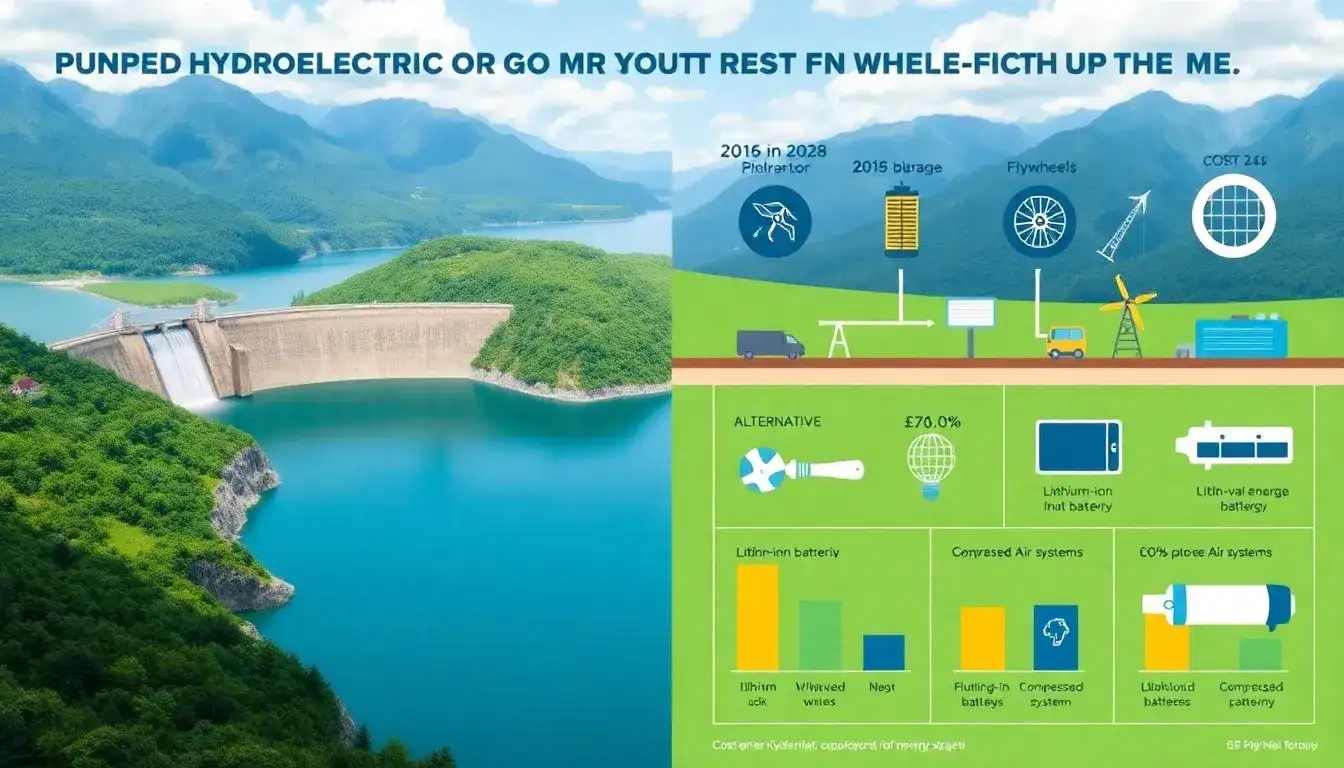
Pumped hydroelectric energy storage (PSH) remains one of the most cost-effective large-scale energy storage technologies, especially for long-duration applications. Here’s a comparison with other storage technologies based on recent data:
Cost Per kWh of Storage Capacity
- Pumped hydro: $106–$200/kWh, with older estimates around $105–$165/kWh.
- Lithium-ion batteries: $393–$581/kWh (project costs), though per-cycle costs (factoring cycle life) may favor newer battery chemistries for short-duration storage.
- Compressed air energy storage (CAES): ~$105/kWh, though site-specific geology requirements limit deployment.
Capital Expenditure (CAPEX) per kW of Power Capacity
- Pumped hydro: $1,800–$5,505/kW, depending on site characteristics like head height. Projects with higher heads (e.g., 2,400 feet) achieve lower $/kW costs ($1,800/kW for the Goldendale project).
- Lithium-ion batteries: ~$1,100–$1,500/kW (varies by duration).
Operational and Long-Term Economics
- PSH fixed O&M: $18/kW-year, with $0.51/MWh variable costs.
- Lithium-ion: Higher $/kWh degradation and replacement costs over time.
- Value proposition: PSH excels in long-duration storage (8+ hours), while lithium-ion dominates short-duration grid services (frequency regulation, 1–4 hours).
Key Advantages and Challenges
- Pumped hydro: Lowest $/kWh for bulk storage but requires specific geography (reservoirs, elevation difference) and faces regulatory hurdles.
- Batteries: Modular, scalable, and easier to site, but higher $/kWh for long-duration use.
- Emerging tech: Flow batteries and thermal storage aim to bridge the gap but currently lack PSH’s scale or cost maturity.
For grid-scale, long-duration needs, PSH is unmatched in cost, but lithium-ion and hybrid systems are more practical for shorter durations or location-constrained projects.
Original article by NenPower, If reposted, please credit the source: https://nenpower.com/blog/how-does-the-cost-of-pumped-hydroelectric-energy-storage-compare-to-other-energy-storage-technologies/

