

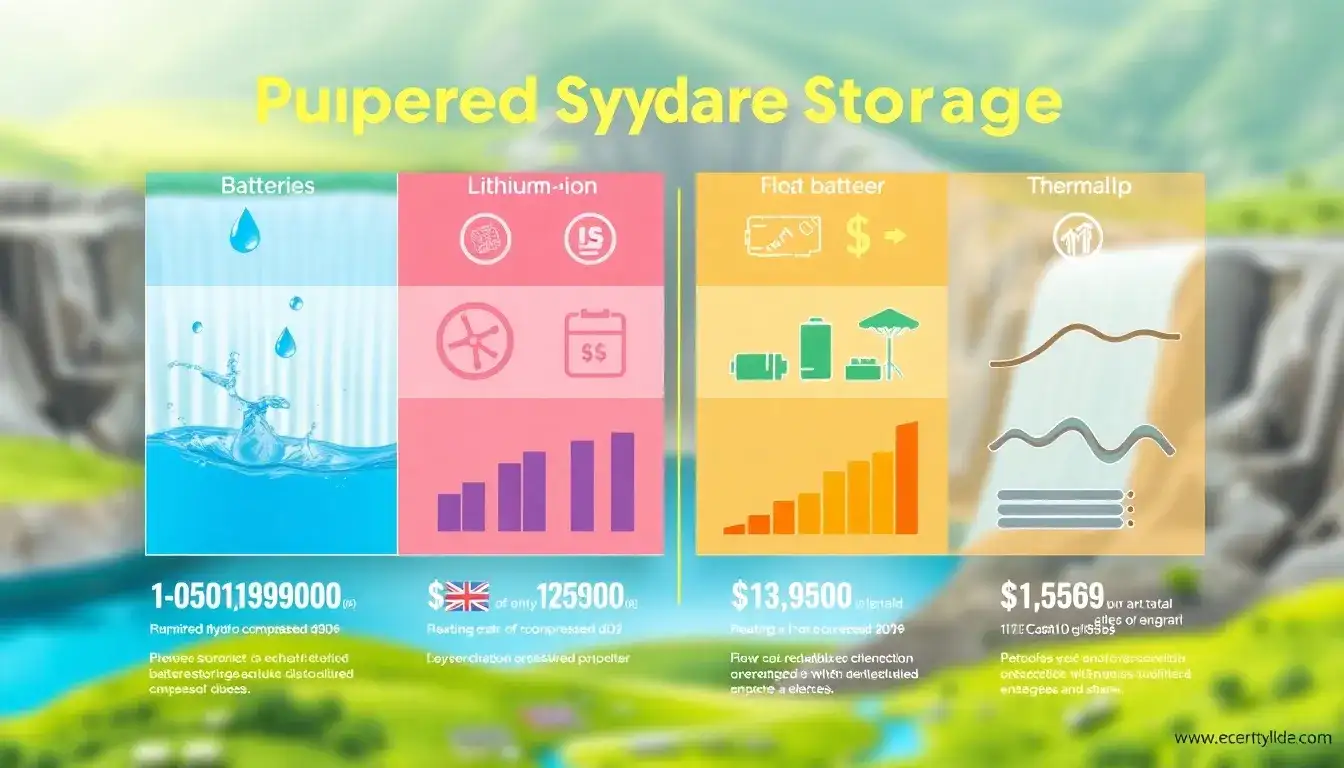
Comparison of Pumped Hydro Storage (PHS) with Other Energy Storage Technologies
Pumped hydro storage (PHS) is a mature and efficient technology for storing large amounts of energy over long periods. It offers several advantages, including high round-trip efficiency (typically around 80-90%) and a long lifespan (50-100 years). However, its deployment is limited by geographical constraints, as suitable sites with significant elevation differences are required. Here’s a comparison of PHS with other energy storage technologies in terms of cost and characteristics:
Capital Costs
- Pumped Hydro Storage: The capital cost for PHS ranges from $1.5 million to $2.5 million per MW installed. This translates to approximately $1,500 to $2,500 per kW, considering a typical MW rating. Costs per kWh stored can be significantly lower when compared at large scales, particularly for long-duration storage, with estimates around $165/kWh when including balance of plant costs.
- Grid-Scale Battery Solutions: Batteries, such as lithium-ion, have higher installation costs, typically ranging from $3.5 million to $7.5 million per MW. However, they are more versatile and can be deployed anywhere.
Cost per kWh Stored
- Pumped Hydro Storage: Offers one of the lowest costs per kWh stored at around $165/kWh for long-duration storage with an energy-to-power ratio of 16.
- Lithium-Ion Batteries: While the cost per kWh for lithium-ion batteries is decreasing, they remain more expensive than PHS for long-term storage. However, for short-term applications, their costs are competitive and improving over time.
Lifespan and Operating Costs
- Pumped Hydro Storage: Long lifespan of 50-100 years and relatively low maintenance costs.
- Lithium-Ion Batteries: Shorter lifespan (e.g., Powerwall2 is guaranteed to maintain 70% capacity at 10 years) but can provide quick power response times suitable for frequency regulation and peak demand management.
Operational Flexibility
- Pumped Hydro Storage: Requires specific geography, making it less flexible in deployment compared to batteries.
- Lithium-Ion Batteries: Highly scalable and can be deployed at various levels of the power grid, from residential to grid-scale.
Conclusion
For long-duration energy storage, PHS offers lower costs per kWh stored and higher round-trip efficiency, making it a crucial component for grid stability, especially in regions with suitable geography. However, lithium-ion batteries and other technologies are more versatile and better suited for short-term power management and rapid response applications. As energy markets evolve, both technologies will continue to play significant roles in different aspects of energy storage.
Original article by NenPower, If reposted, please credit the source: https://nenpower.com/blog/how-does-the-cost-of-pumped-hydro-storage-compare-to-other-forms-of-energy-storage/

