

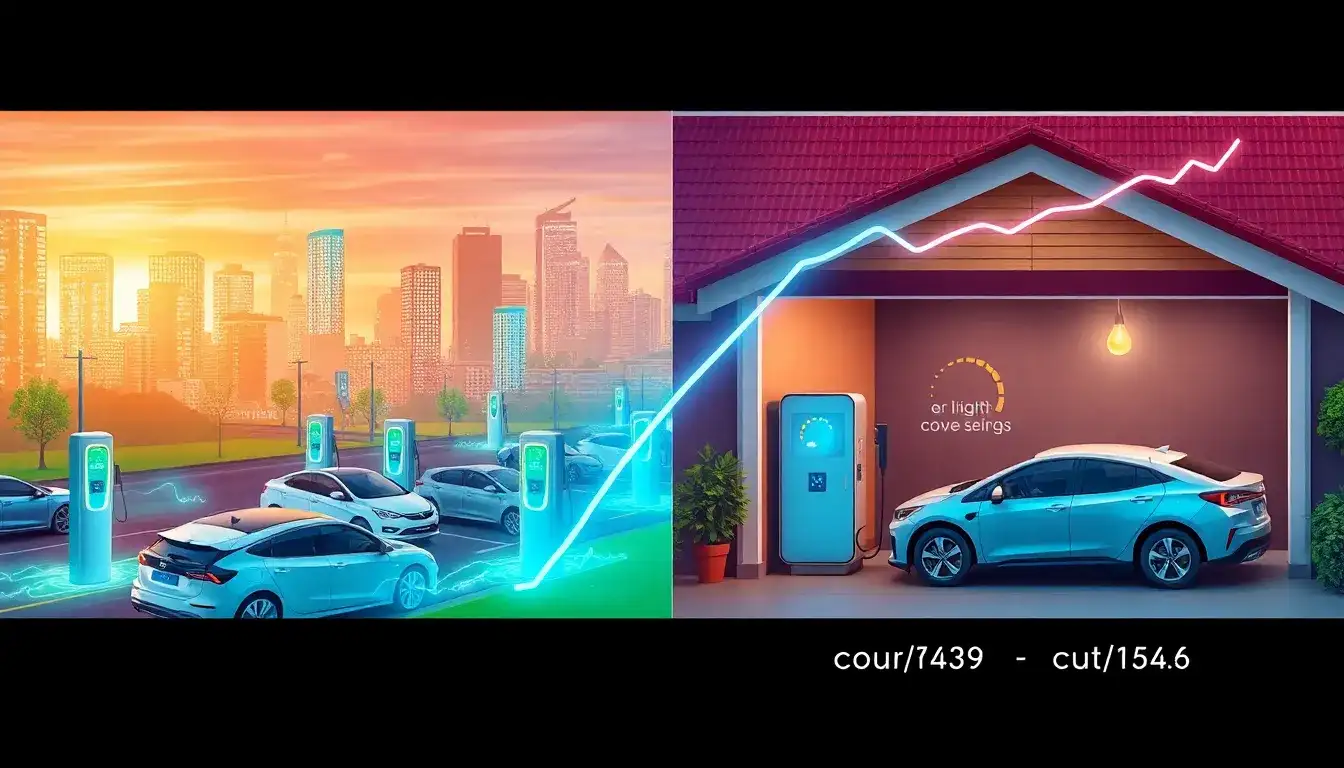
As electricity rates rise, public charging for electric vehicles (EVs) remains significantly more expensive than home charging, often costing two to three times more per charge.
Home Charging Costs and Impact of Rising Electricity Rates
- The average U.S. residential electricity rate is about $0.16 per kWh as of early 2025 but varies widely by state—from $0.11 in Washington to as high as $0.41 in Hawaii.
- Charging a typical 40 kWh EV battery at home under the average rate costs roughly $6.00 to $6.40 per full charge.
- In states with higher rates like California ($0.30/kWh), the cost can be about $10.18 per 100 miles driven, amounting to around $1,425 annually for 14,000 miles.
Public Charging Costs and Comparison
- Public charging stations, especially DC fast chargers, charge significantly more—commonly around $0.50 per kWh or more—making a full charge cost roughly $20 or higher, which is about three times the home charging cost.
- Public chargers may bill by the minute or per kWh, and some offer subscription models, but overall, public charging remains costlier, particularly with fast charging stations that add convenience at a premium.
- Although some new EVs provide limited free public charging credits, these are time-limited or network-specific, so long-term reliance on public charging is more expensive.
Effect of Rising Residential Rates on Cost Gap
- While higher residential electricity rates increase the cost of home charging, public charging costs generally stay proportionally higher.
- For example, in states with high electricity rates (around $0.30/kWh), home charging costs rise but still remain substantially below public charging prices which can be close to or exceed $0.50/kWh.
- Thus, even as electricity rates escalate, home charging remains the more economical choice compared to public charging, with the cost disparity persisting or even growing when factoring in speed and convenience premiums at public fast chargers.
In summary, rising electricity rates increase both home and public charging costs, but public charging remains roughly two to three times more expensive than home charging, emphasizing the economic advantage of home EV charging despite electricity rate variations across regions.
Original article by NenPower, If reposted, please credit the source: https://nenpower.com/blog/how-does-the-cost-of-public-charging-compare-to-home-charging-as-electricity-rates-rise/

