

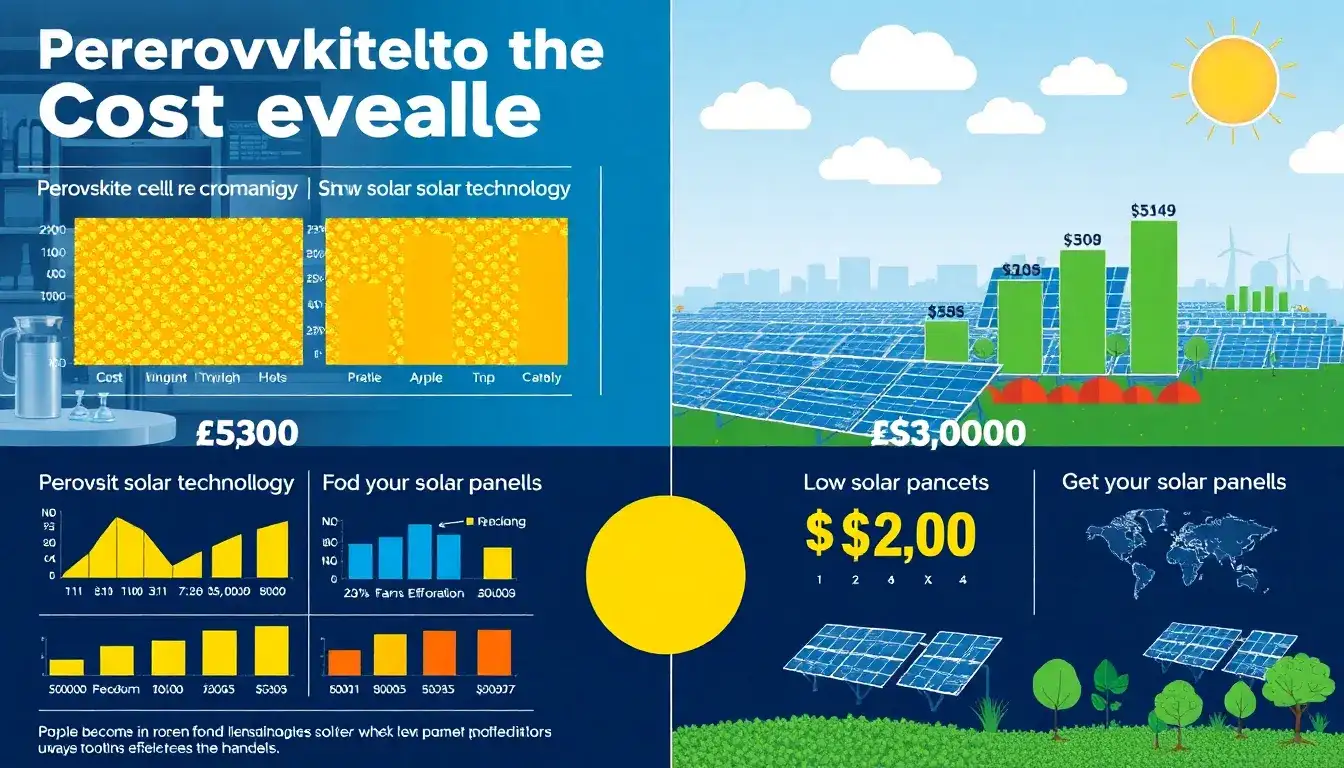
The cost of perovskite solar cells is generally lower than many traditional solar technologies and could become one of the cheapest photovoltaic (PV) technologies in the near future.
Current Cost Comparison
- Perovskite Solar Cells:
- Current production costs are around $0.10 to $0.16 per watt, with some estimates suggesting it could decrease to $0.10/W in the future due to advancements in manufacturing and materials.
- In India, the cost per watt is approximately ₹12-13 (about $0.15-$0.17), with potential reductions to ₹7-8 ($0.09-$0.10) as technology matures.
- For perovskite-silicon tandem modules produced in the U.S., costs range from approximately $0.29/W to $0.42/W, depending on efficiency and architecture. Higher efficiency (30%-35%) can push costs down to about $0.26-$0.31/W, approaching or becoming competitive with current silicon PV modules priced at around $0.285/W.
- Crystalline Silicon (c-Si) Solar Cells:
- Mature technology with costs typically around $0.16 per watt or more for commercial modules.
- Polycrystalline silicon solar cells cost around ₹25.5 per watt (~$0.32/W), and monocrystalline silicon cells cost about ₹31 per watt (~$0.39/W) in India.
- Thin-Film Technologies:
- Regular thin-film PV costs about $0.40 to $0.69 per watt, which is significantly higher than perovskite costs.
- GaAs Solar Cells:
- Extremely expensive at around $50 per watt, primarily used for specialized applications where high efficiency is critical.
Cost Drivers and Future Prospects
- The higher cost in perovskite-silicon tandem modules comes mainly from materials such as solar glass, backsheets, encapsulation, and electron transport layers needed for the perovskite sub-cell, along with specialized processing equipment.
- There is strong optimism that with industrial scale standardization and further development, costs for perovskite precursors and processing can decrease, making perovskite solar cells even more cost-competitive relative to silicon and other PV technologies.
- The thin absorber layer of perovskite cells (0.2 to 0.4 mm) reduces material usage and thus production costs.
Summary Table of Approximate Costs per Watt
| Technology | Cost per Watt (USD) | Notes |
|---|---|---|
| Perovskite Solar Cells | $0.10 – $0.16 | Potential to drop to $0.10/W with scale |
| Perovskite-Silicon Tandem | $0.26 – $0.42 | Depends on efficiency and design |
| Crystalline Silicon (c-Si) | ~$0.16 – $0.39 | Mature, widely deployed technology |
| Regular Thin-Film | $0.40 – $0.69 | Higher cost than perovskites |
| GaAs | ~$50 | Specialized, very high cost |
In conclusion, perovskite solar cells currently offer a manufacturing cost advantage over most existing thin-film and silicon technologies, with costs anticipated to fall further as the technology matures and scales. Tandem perovskite-silicon modules are currently somewhat more expensive but have the potential to reach or undercut silicon-only module costs with improved efficiency and production methods.
Original article by NenPower, If reposted, please credit the source: https://nenpower.com/blog/how-does-the-cost-of-perovskite-solar-cells-compare-to-other-solar-technologies/

