

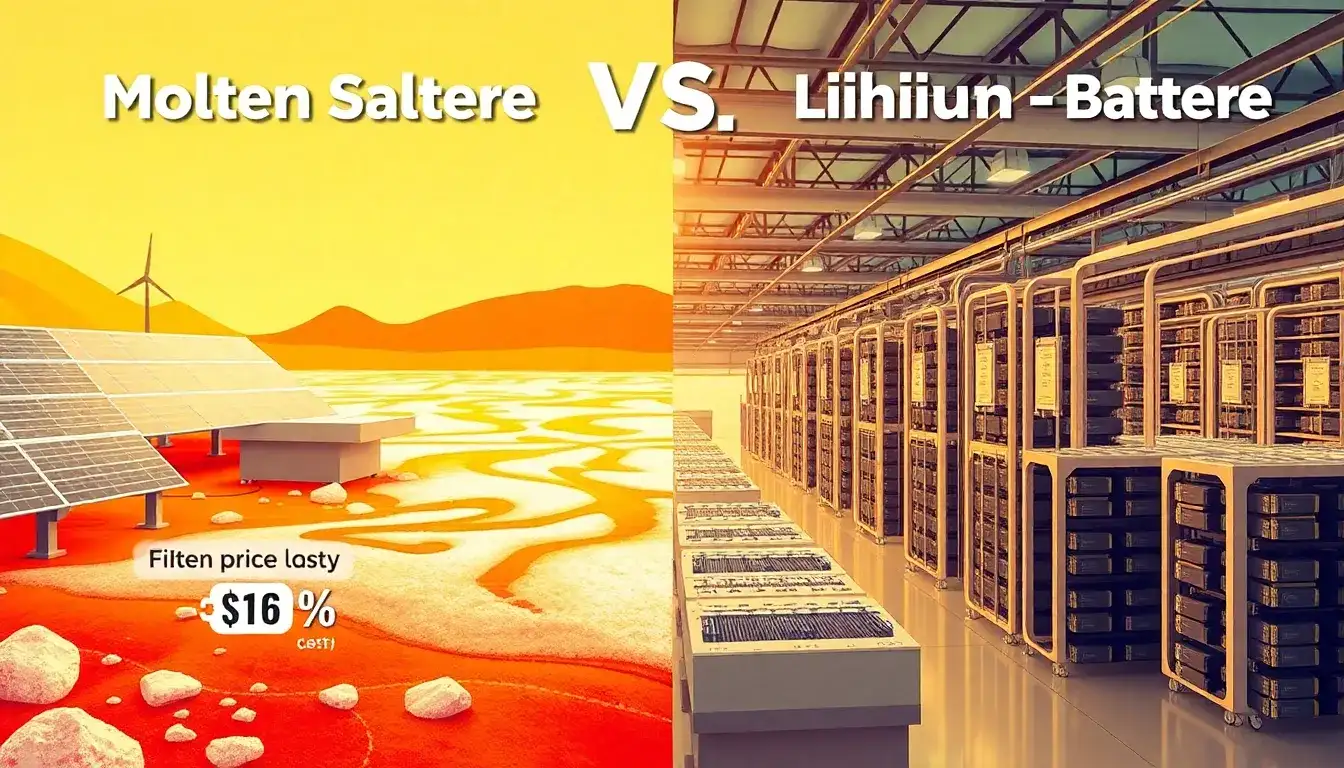
The cost of molten salt energy storage is significantly lower than that of lithium-ion batteries, by a large margin according to various sources.
Cost Comparison
- Molten salt thermal energy storage costs range around 15 to 25 EUR per kWh thermal (kWhth), while lithium-ion batteries are roughly 833 EUR per kWh electric (kWhel) according to the German Energy Storage Association (BVES). This translates to molten salt storage being about 33 times cheaper than lithium-ion batteries when comparing storage capacity on a per-kWh basis.
- In dollar terms, a recent prototype molten salt battery reported a materials cost of $23 per kWh, whereas typical lithium-ion battery materials cost about $90 per kWh. Researchers aim to reduce this cost further to around $6 per kWh by substituting nickel with iron.
Explanation of Differences
- Molten salt storage stores energy in the form of heat, which is inherently cheaper to store than electricity as in lithium-ion batteries, which store electrical energy chemically.
- Molten salt systems are well-suited for large-scale, long-duration energy storage, often integrated with concentrated solar power (CSP) plants, where heat is stored and later converted to electricity on demand.
- Lithium-ion batteries, while more energy-dense and suitable for short-term electrical storage, are more expensive due to higher material costs and manufacturing complexities.
Summary Table
| Storage Type | Cost per kWh | Notes |
|---|---|---|
| Molten Salt Thermal | 15 – 25 EUR/kWhth | About 33 times cheaper than Li-ion (kWhel basis) |
| Molten Salt Battery (prototype) | $23 per kWh (materials) | Potential to drop to $6/kWh with design improvements |
| Lithium-ion Battery | 833 EUR/kWhel / $90 per kWh (materials) | Current standard for electrical energy storage |
Conclusion
Molten salt energy storage is substantially more cost-effective than lithium-ion batteries, particularly for large-scale and long-duration applications, with costs up to 30 times lower or more depending on the comparison metric. While lithium-ion batteries remain dominant for electrical storage with high energy density, molten salt offers a compelling, lower-cost alternative especially for thermal energy storage and grid-scale applications.
Original article by NenPower, If reposted, please credit the source: https://nenpower.com/blog/how-does-the-cost-of-molten-salt-energy-storage-compare-to-lithium-ion-batteries/

