

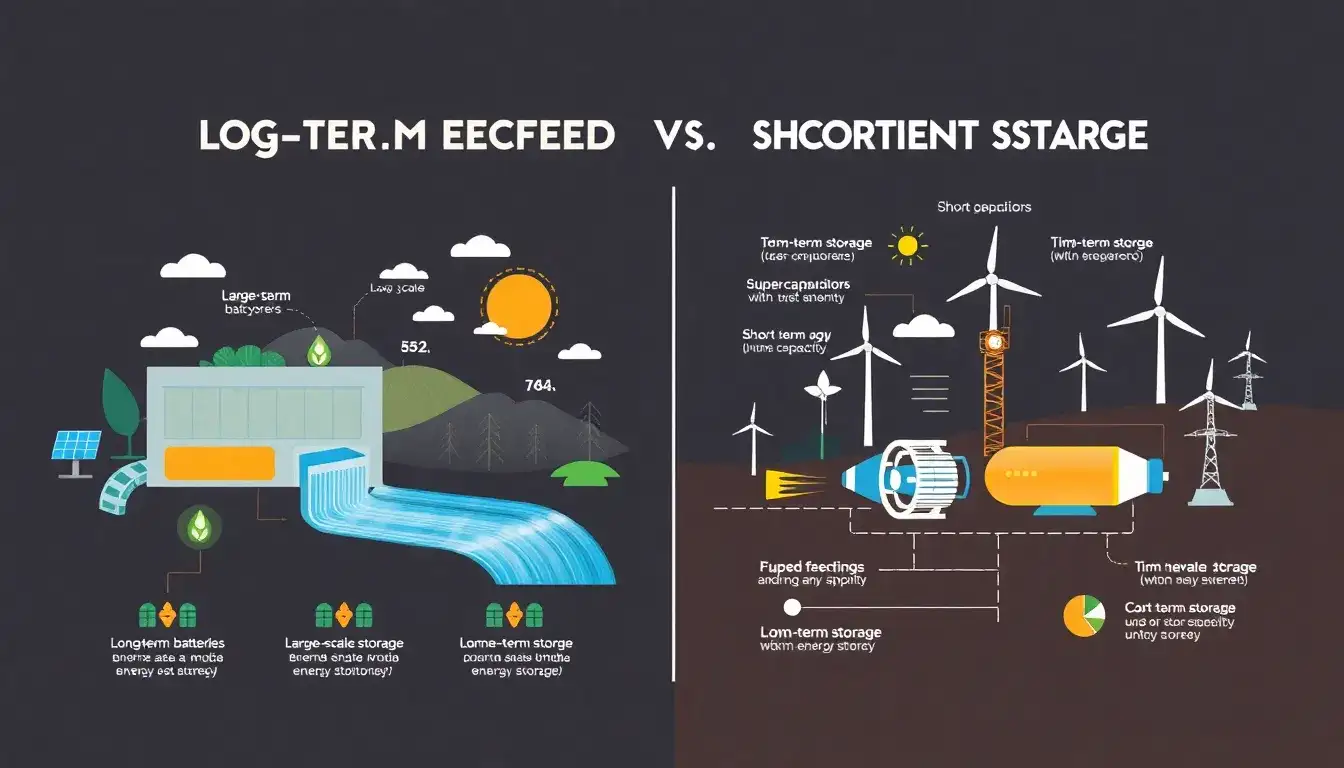
Long-duration energy storage (LDES) is increasingly relevant in the context of renewable energy integration, particularly as demand grows for systems capable of storing energy for extended periods. Compared to short-duration energy storage (SDES), the cost dynamics and operational characteristics of LDES reveal significant distinctions.
Cost Comparison
- Short-Duration Storage (SDES): Typically dominated by lithium-ion batteries, SDES systems can reliably discharge energy for durations of up to about 10 hours. As of 2023, the average capital expenditure (capex) for lithium-ion batteries with a four-hour duration was approximately $304 per kilowatt-hour (kWh). These systems are favored for their rapid deployment and high round-trip efficiency, making them ideal for short-term stabilization needs on the grid.
- Long-Duration Storage (LDES): LDES technologies, categorized by their ability to discharge energy for durations exceeding 10 hours, often incur lower costs compared to lithium-ion systems, particularly for extended discharge needs. For instance, thermal energy storage and compressed air energy storage were reported at $232/kWh and $293/kWh, respectively, making them cheaper alternatives for storage durations longer than eight hours. Notably, pumped hydro storage (PHS) facilities have a projected levelized cost of storage (LCOS) of around $186/MWh, significantly less than lithium-ion systems which can reach $285/MWh over similar lifetime spans.
Cost Dynamics
The cost dynamics for LDES and SDES differ significantly due to their respective scaling characteristics:
- SDES Systems: For lithium-ion batteries, increasing duration requires linear scaling, which means that costs rise proportionally with additional storage capacity. This linear increase can make lithium-ion systems less competitive for long-duration needs as the costs compound.
- LDES Systems: Many LDES technologies, such as thermal and compressed air storage, exhibit economies of scale, where the unit costs decrease with longer discharge durations. This makes them more cost-effective for providing energy over extended periods without the same proportional cost increases seen with lithium-ion batteries.
Future Trends
- As the demand for LDES grows, ongoing innovations are expected to further reduce costs, with the U.S. Department of Energy targeting reductions that could bring costs below $0.05/kWh for specific LDES technologies by 2030. However, achieving such targets may require substantial advancements and investments in emerging technologies.
- The landscape is evolving, with the potential for LDES systems like flow batteries, thermal storage, and gravity storage to play an increasingly critical role in a decarbonized energy future, particularly in non-China markets where lithium-ion costs are comparatively higher.
In summary, while SDES systems, particularly lithium-ion batteries, are currently prevalent for shorter durations, LDES options present a more economically viable solution for longer-term energy storage needs, particularly as the market matures and technology innovations continue to emerge.
Original article by NenPower, If reposted, please credit the source: https://nenpower.com/blog/how-does-the-cost-of-long-duration-energy-storage-compare-to-short-duration-storage/

