

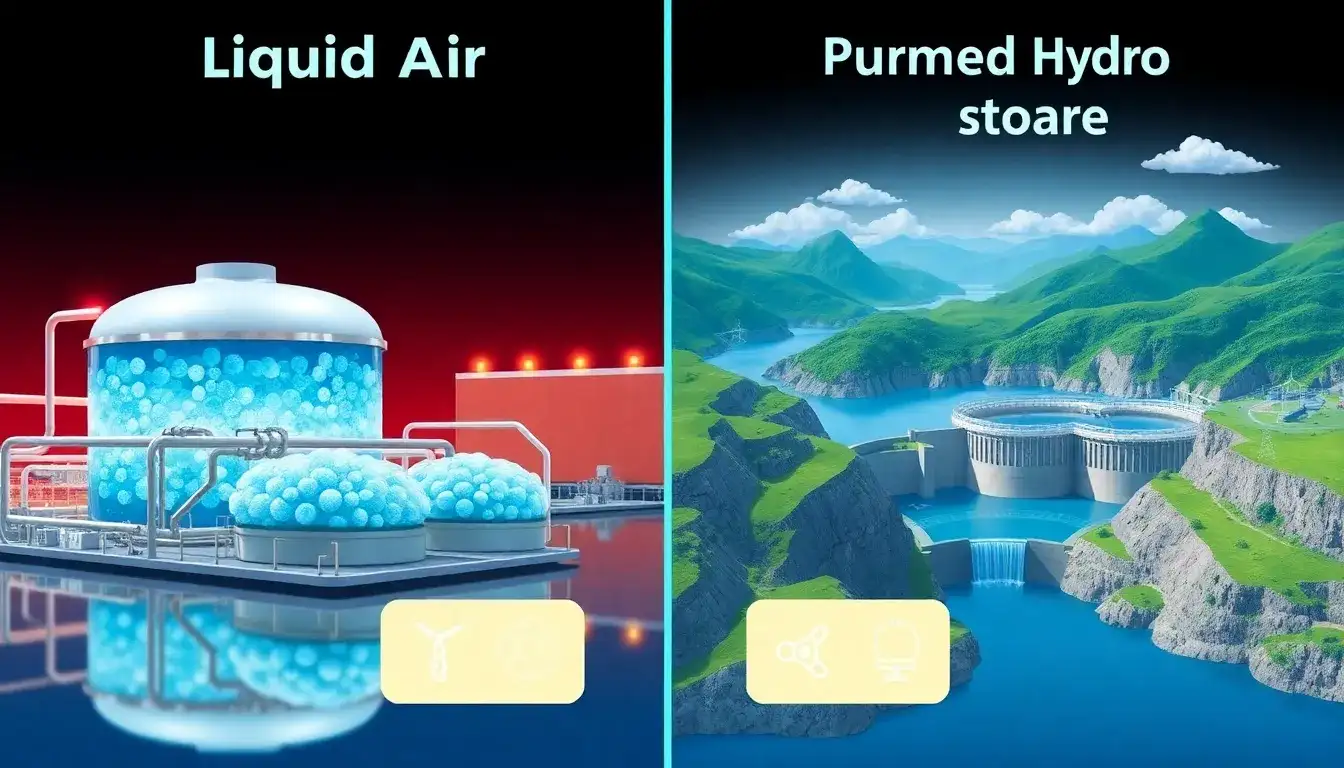
The cost of liquid air energy storage (LAES) compares favorably to pumped hydro storage, generally being significantly less expensive on a levelized cost of storage (LCOS) basis.
Cost Comparison:
- LAES has an LCOS of about $60 per megawatt-hour (MWh), according to recent modeling by researchers from MIT and the Norwegian University of Science and Technology. This is roughly half the cost of pumped hydro storage.
- Pumped hydro storage typically has about twice the LCOS of LAES, placing it near $120 per MWh or more depending on the project.
- LAES’s LCOS is also about a third of that of lithium-ion battery storage, making it an attractive option for long-duration grid-scale energy storage as well.
Additional Insights:
- LAES stores energy by liquefying ambient air when excess electricity is available, storing it in insulated tanks at low temperature and atmospheric pressure, then later expanding the liquid air back into gas to drive turbines and generate electricity.
- The technology relies on commercially available components and does not require rare materials, enhancing its potential scalability and cost-effectiveness.
- The cost advantages of LAES over pumped hydro come alongside the benefit that LAES can be sited in more varied locations (including industrial sites with waste heat integration), whereas pumped hydro requires specific topography such as large elevation differences and water reservoirs.
In summary, LAES currently presents a more cost-effective and flexible long-duration energy storage solution compared to pumped hydro, with about half the levelized cost of storage, making it a promising alternative especially where pumped hydro is impractical.
Original article by NenPower, If reposted, please credit the source: https://nenpower.com/blog/how-does-the-cost-of-liquid-air-energy-storage-compare-to-pumped-hydro-storage-2/

