

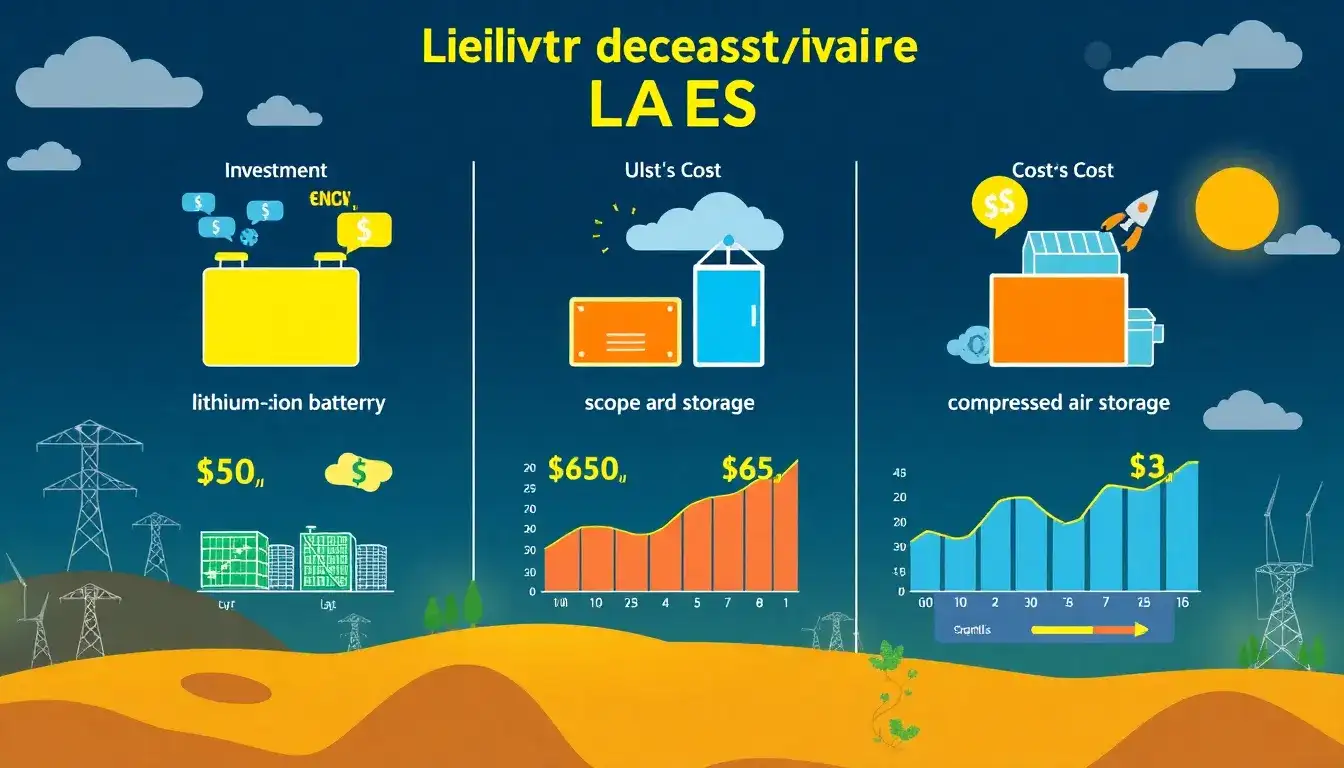
The cost of liquid air energy storage (LAES) compares favorably to other grid-scale energy storage technologies, particularly in terms of its levelized cost of storage (LCOS).
Cost Comparison of Liquid Air Energy Storage vs. Other Technologies
| Technology | Approximate LCOS ($/MWh) | Notes |
|---|---|---|
| Liquid Air Energy Storage | ~$60/MWh | About one-third the cost of lithium-ion batteries and half that of pumped hydro |
| Lithium-ion Batteries | ~$180 – 285/MWh (varies by source) | According to MIT and other analyses, roughly three times more expensive than LAES |
| Pumped Hydro Storage | ~$120 – 198/MWh | Roughly twice the cost of LAES |
| Compressed Air Energy Storage (CAES) | ~$100/MWh (diabatic CAES) | Lowest LCOS among some long-duration options but still higher than LAES by some estimates |
| Other batteries (lead-acid, sodium) | Higher LCOS than LAES | Sodium and lead-acid can have LCOS around $310/MWh or more, significantly above LAES |
Key Insights on Liquid Air Energy Storage Cost
- The LCOS for LAES is approximately $60/MWh regardless of different decarbonization scenarios, indicating stable cost-effectiveness across various energy transition pathways.
- LAES costs are about one-third those of lithium-ion battery storage, which is often cited as the current dominant storage technology for grid applications.
- LAES also demonstrates about half the LCOS of pumped hydroelectric storage, a mature and widely used long-duration storage technology.
- This cost advantage is partly because LAES uses ambient air, commercially available components, and can utilize waste heat from nearby industrial sources to improve efficiency, avoiding reliance on rare or expensive materials.
- LAES is particularly suited for long-duration energy storage, which is increasingly important for integrating variable renewable energy sources like wind and solar into the grid.
- While LAES systems may not yet be widely deployed or economically attractive from an investment perspective today, ongoing research and development are expected to maintain or improve their cost competitiveness.
Summary
Liquid air energy storage offers a substantially lower levelized cost of storage compared to lithium-ion batteries and pumped hydro, making it one of the most economically attractive options for grid-scale and long-duration energy storage solutions at around $60 per megawatt-hour. This positions LAES as a promising technology for future grid-scale storage expansions, especially where cost and scalability are critical factors.
Original article by NenPower, If reposted, please credit the source: https://nenpower.com/blog/how-does-the-cost-of-liquid-air-energy-storage-compare-to-other-grid-scale-energy-storage-solutions/

