

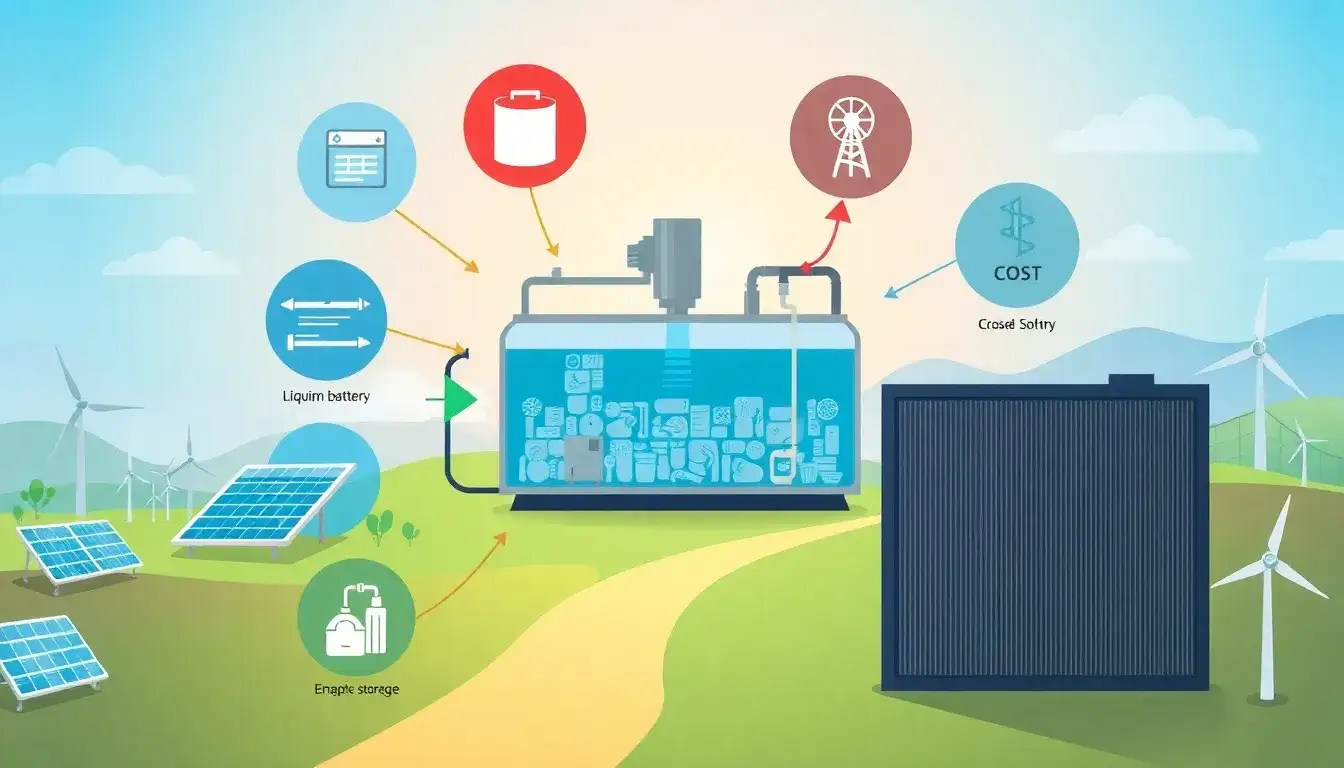
The cost of liquid air energy storage (LAES) compares favorably to other energy storage technologies, particularly in terms of levelized cost of storage (LCOS) and suitability for long-duration grid-scale storage.
Cost Comparison
- Liquid Air Energy Storage (LAES) has an LCOS of approximately $60 per megawatt-hour (MWh), a figure that remains consistent irrespective of decarbonization scenarios and location factors.
- This LCOS for LAES is about:
- One-third the cost of lithium-ion battery storage, which typically ranges much higher (e.g., $285–$581 per MWh for comparable systems).
- About half the cost of pumped hydro storage, which can have an LCOS in the range of $152–$198 per MWh.
- Compared to other long-duration storage technologies such as compressed air energy storage (CAES), pumped hydro, and hydrogen, LAES offers a competitive and comparatively low cost option, especially for durations of several hours or more.
Technology and Cost Drivers
- LAES technology works by liquefying air using electricity, storing it in insulated tanks at low temperatures, and then re-gasifying it to generate electricity when needed. This process is relatively clean, relies on ambient air, and uses commercially available components without rare or expensive materials, which supports its cost-effectiveness.
- The ability to use waste heat (e.g., from nearby industrial sites) can further improve efficiency and reduce operational costs.
Economic Viability and Outlook
- Although LAES systems may not yet be economically viable as investments compared to incumbent technologies, their low LCOS suggests they could become increasingly important as grid-scale storage demand grows and alternatives remain costly or limited.
- The cost advantages, especially for long-duration storage, highlight LAES as a promising and potentially least-cost solution for integrating variable renewable energy sources like wind and solar.
Summary Table of Approximate LCOS Comparison
| Storage Technology | Typical LCOS ($/MWh) |
|---|---|
| Liquid Air Energy Storage | ~$60 |
| Lithium-ion Batteries | ~$180 – $580+ (varies) |
| Pumped Hydro Storage | ~$150 – $200 |
| Compressed Air Storage | ~$100 (for large scale) |
Note: Cost figures vary by system scale, duration, and location but LAES generally remains among the lowest-cost options for grid-scale, long-duration storage.
In conclusion, liquid air energy storage offers a significantly lower levelized cost of storage compared to lithium-ion batteries and pumped hydro, making it a highly competitive option for long-duration and grid-scale energy storage needs going forward.
Original article by NenPower, If reposted, please credit the source: https://nenpower.com/blog/how-does-the-cost-of-liquid-air-energy-storage-compare-to-other-energy-storage-technologies/

