

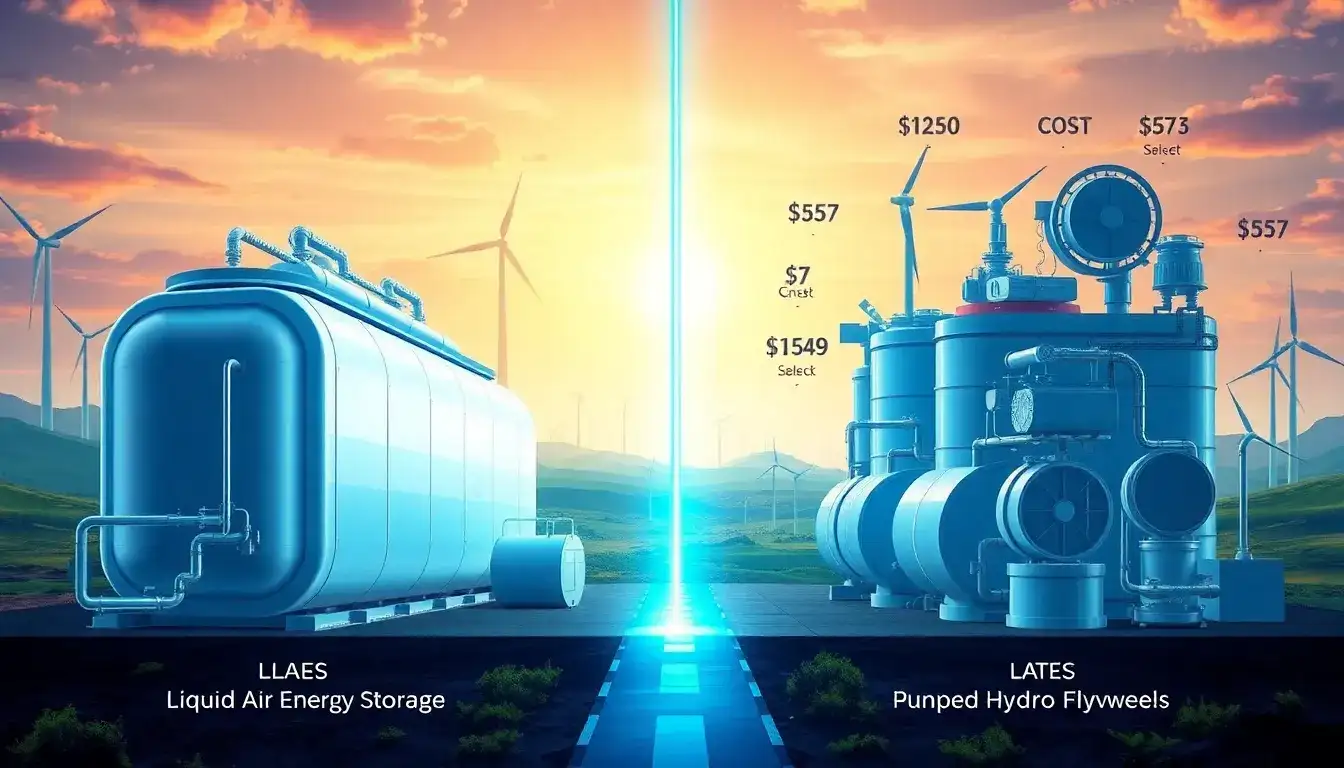
The cost of Liquid Air Energy Storage (LAES) systems compares very favorably to other grid-scale energy storage technologies, especially in terms of levelized cost of storage (LCOS), which measures the average cost of storing one megawatt-hour (MWh) of electricity over the system’s lifetime.
LCOS Comparison
- LAES has an LCOS of about $60 per MWh, according to recent MIT/NTNU research, which is roughly:
- One-third the cost of lithium-ion battery storage
- Half the cost of pumped hydro storage
This positions LAES as an economically attractive option for grid-scale storage, especially for long-duration applications.
- Lithium-ion batteries typically have a significantly higher LCOS compared to LAES. Estimates suggest lithium-ion battery storage costs around three times that of LAES per MWh.
- Pumped Storage Hydropower (PSH), often considered one of the lowest-cost mature storage technologies, has an LCOS about twice that of LAES.
- Compressed Air Energy Storage (CAES) and thermal storage technologies also compete closely in cost at large scales, sometimes achieving LCOS values near or below pumped hydro at durations of 10 hours or more. CAES can reach costs as low as $0.10/kWh (or $100 per MWh) at large gigawatt scales, which is still higher than LAES’s reported $60/MWh in some analyses.
Installed Cost and Duration Effects
- Batteries often show higher installed costs, usually several hundreds of dollars per kWh for 4 to 10-hour duration systems, while LAES benefits from lower capital costs due to reliance on mature industrial refrigeration and energy conversion technologies.
- LAES’s LCOS can vary depending on the deployment location and operational parameters, suggesting that reporting a single cost figure for any storage technology can be misleading without context.
Economic Viability and Future Perspective
- While LAES may not yet be broadly commercially viable today, research findings suggest it holds promise as a cost-effective solution for grid storage expansion and energy security in the coming decades.
- Ongoing innovation and scale-up could further reduce costs, closing gaps between LAES, CAES, pumped hydro, and battery storage systems, especially for long-duration storage needs.
Summary Table
| Technology | Approximate LCOS ($/MWh) | Relative Cost vs. LAES | Notes |
|---|---|---|---|
| Liquid Air Energy Storage | ~60 | Baseline | LCOS varies by location and use case |
| Lithium-ion Batteries | ~180 (3x LAES) | Much higher | Higher capital and cycle costs |
| Pumped Hydro Storage | ~120 (2x LAES) | Higher | Mature tech, site-dependent |
| Compressed Air Storage | ~100 | Higher | Competitive at large scale |
| Thermal & Gravitational | ~$80–130 | Variable | Depends on system specifics |
In conclusion, LAES systems offer a potentially lower-cost alternative to lithium-ion batteries and pumped hydro for large-scale, long-duration energy storage, with an LCOS about one-third that of lithium-ion and half that of pumped hydro in some studies, indicating strong economic potential for future deployment.
Original article by NenPower, If reposted, please credit the source: https://nenpower.com/blog/how-does-the-cost-of-laes-systems-compare-to-other-energy-storage-technologies/

