

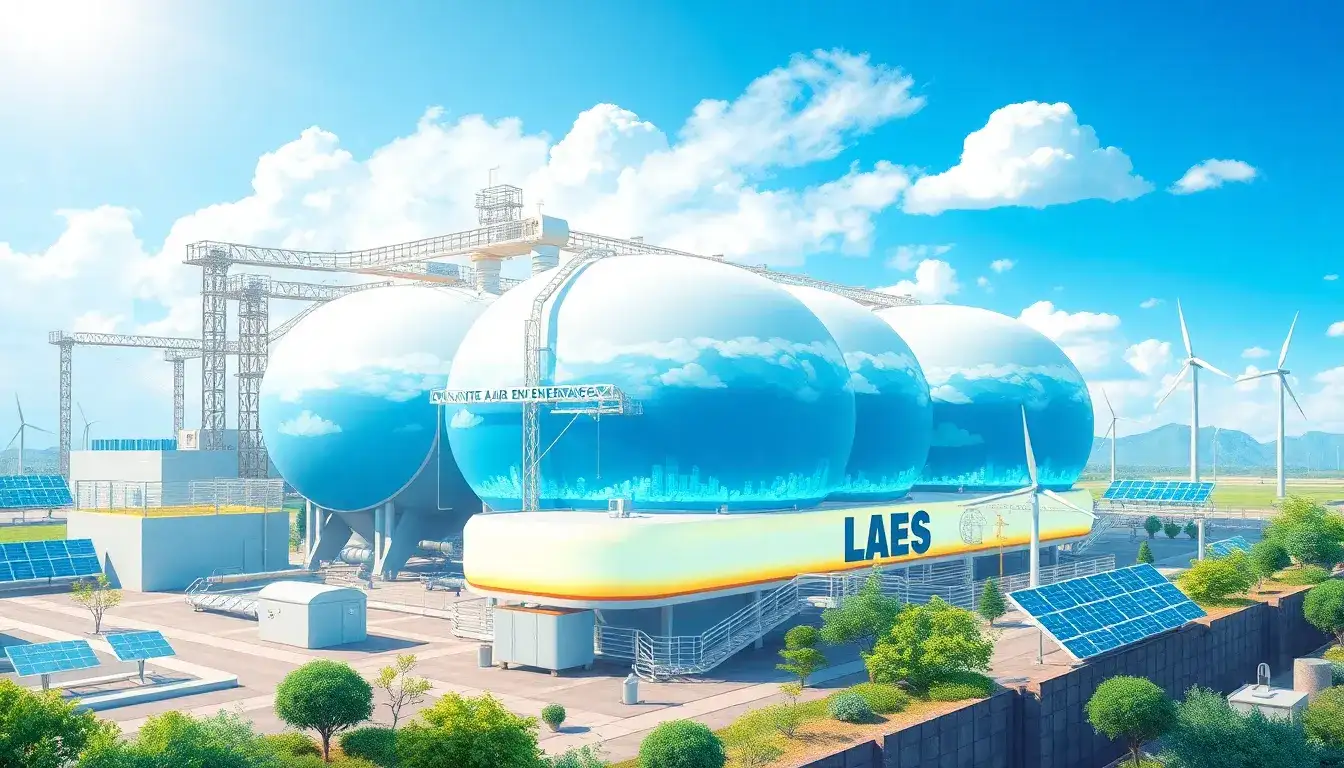
The cost of Liquid Air Energy Storage (LAES) plays a significant role in its scalability, influencing both investment decisions and the technology’s ability to compete with other energy storage options.
Cost Impact on Scalability
1. Levelized Cost of Storage (LCOS) and Cost Competitiveness
LAES has a reported LCOS of around $60 per megawatt-hour (MWh), which is approximately one-third the cost of lithium-ion battery storage and about half that of some other long-duration storage technologies. This relatively low LCOS positions LAES as a promising option for grid-scale energy storage and supports its scalability potential since lower costs can enable larger deployments.
2. Capital Expenditure (CapEx) and Economic Viability Challenges
Despite its cost advantages, LAES faces hurdles regarding upfront capital costs. Studies have found specific capital expenditures ranging roughly from $882/kW to $1,177/kW depending on region and timing of investment, with levelized costs between $0.105/kWh and $0.174/kWh in some markets like China. This makes it currently economically challenging for private investors to commit to LAES projects without subsidies or anticipating future cost reductions.
3. Investment Timing and Market Conditions
Economic feasibility analyses suggest that immediate investments in LAES systems may not be attractive under current market conditions. Optimal investment periods are projected in the late 2020s to mid-2030s depending on location. This timing consideration impacts scalability by slowing early adoption but allowing for cost reductions and market maturation to improve economics over time.
4. Efficiency Improvements vs. Cost Structure
Improvements in the energy efficiency of LAES have little effect on its economic viability. This indicates that the cost structure—mainly capital and operational expenditures—rather than efficiency, is the main barrier to scaling LAES up commercially. Strategic subsidies and supportive policies, rather than purely technological improvements, are seen as critical to encouraging scale-up investments.
5. Scalability Advantages
LAES’s design flexibility allows it to be scaled to meet various energy storage capacities, from smaller to very large grid-scale applications. Its clean operation, only cycling ambient air and electricity without contaminants, adds environmental appeal which may facilitate regulatory support and scalability.
Summary Table: Cost Factors Affecting LAES Scalability
| Factor | Impact on Scalability |
|---|---|
| LCOS (~$60/MWh) | Supports competitive large-scale deployment |
| Capital Expenditure ($882–1177/kW) | High upfront costs delay large-scale investment |
| Market Investment Timing | Delays investment until late 2020s-2030s |
| Efficiency Improvements | Little effect on economics; cost reductions key |
| Policy/Subsidies | Needed to improve investment attractiveness and scale growth |
| Scalability Flexibility | Can be designed for various capacities, aiding deployment |
In conclusion, while the relatively low levelized cost of LAES favors its scalability, the high capital costs and current economic conditions limit private investment and immediate large-scale adoption. The cost structure’s impact means that policy incentives, subsidies, and time for cost reductions are crucial for LAES to scale effectively in the energy storage market.
Original article by NenPower, If reposted, please credit the source: https://nenpower.com/blog/how-does-the-cost-of-laes-impact-its-scalability/

