

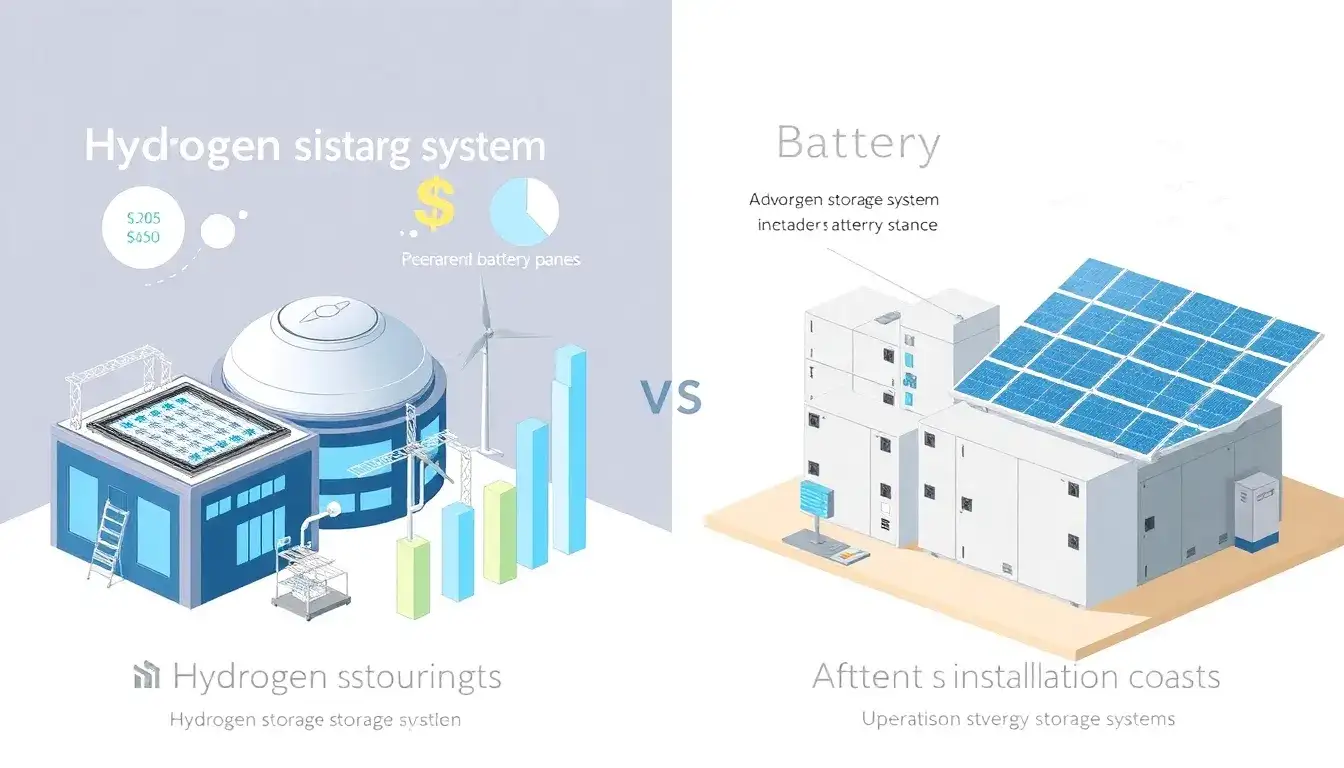
The cost comparison between hydrogen storage systems and battery storage systems depends significantly on the type, scale, and duration of storage considered.
Hydrogen Storage System Costs
- Large-scale hydrogen storage such as liquid (cryogenic) tanks typically costs about $30–50 per kg of hydrogen stored. When levelized over use, this translates roughly to $0.16 per kg-H2 for continuous, full utilization. If utilization drops to 50%, costs can double to about $0.32 per kg-H2.
- Salt cavern storage, a large underground storage method, tends to be the cheapest option for hydrogen storage over multiple days or longer durations, with storage costs estimated between $2–10 per kWh. More economical cavern costs around $2/kWh are achievable depending on geology.
- Other hydrogen storage modes like pressurized tanks or line packing are generally more expensive per unit stored than salt caverns, especially as storage duration increases.
- System costs include electrolyzers, compressors, and fuel cells, which are projected to decrease significantly by 2030 but still contribute to overall hydrogen system cost.
Battery Storage System Costs
- While the search did not provide direct battery cost figures, widely available data outside the provided results show battery storage costs, particularly for lithium-ion, have declined to roughly $100-$150 per kWh installed capacity, and levelized costs vary depending on cycling and lifespan.
- Batteries are generally more cost-effective for short-duration storage (hours to a day), where their high round-trip efficiency and fast response time provide value.
Comparative Insights
- Hydrogen storage systems typically incur lower costs for very large-scale and long-duration energy storage (days to weeks or more), especially when using salt cavern storage, making them economically attractive for seasonal or grid-scale storage.
- Battery systems excel at short-duration, daily cycling storage due to higher efficiency and lower upfront costs per energy unit for small-scale applications.
- The cost per kWh stored in hydrogen systems can be as low as a few dollars or less with salt caverns, which is competitive versus batteries when considering long durations and scale.
- However, hydrogen storage includes additional complexity and costs tied to compression, liquefaction, and fuel cells for energy conversion, which batteries largely avoid.
In summary, hydrogen storage tends to be more cost-effective than battery storage for large-scale, long-duration applications, while battery storage remains more economical for short-term, high-efficiency usage scenarios.
Original article by NenPower, If reposted, please credit the source: https://nenpower.com/blog/how-does-the-cost-of-hydrogen-storage-systems-compare-to-battery-storage-systems/

