

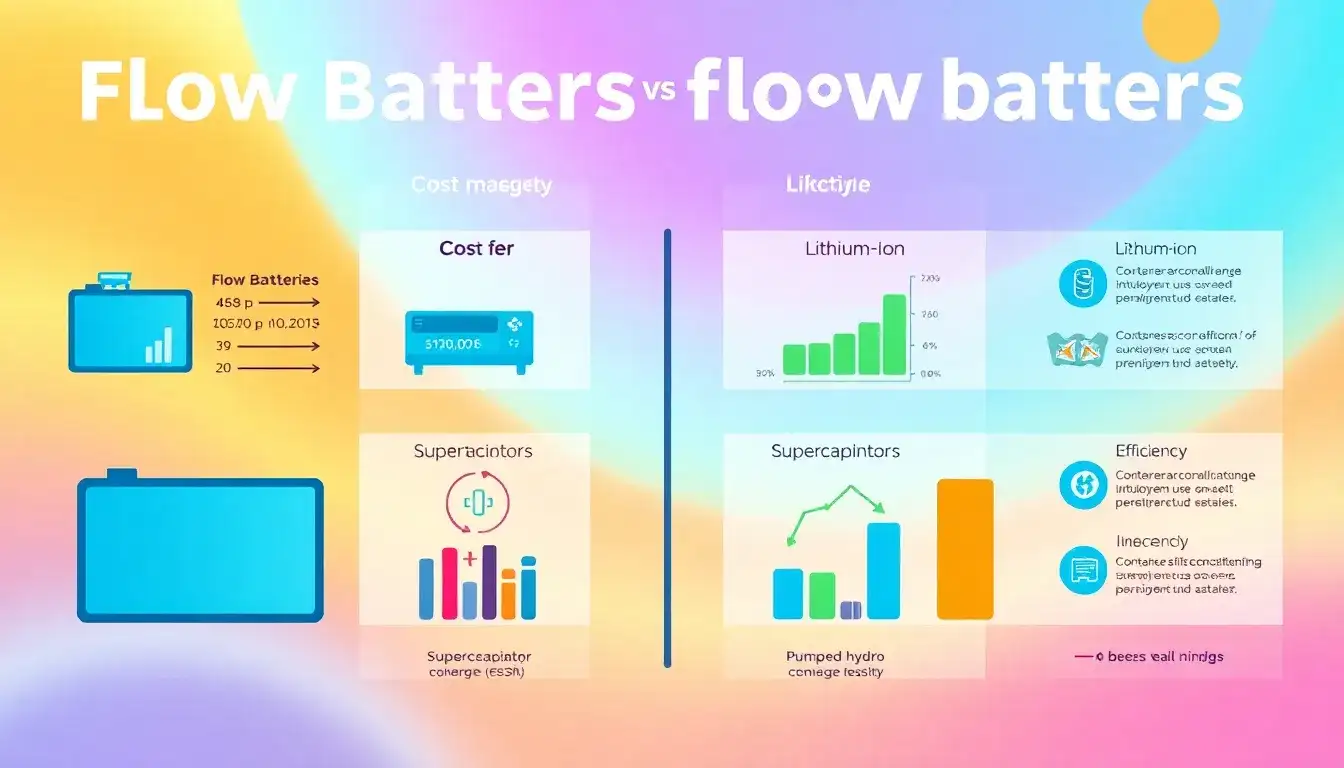
Cost Comparison of Flow Batteries with Other Energy Storage Solutions
Flow batteries offer distinct advantages in terms of scalability and long-duration energy storage, making them competitive with other technologies. Here’s a breakdown of their costs compared to other solutions:
Flow Batteries
- Cost Potential: Flow batteries have a potential levelized cost of storage (LCOS) that could be reduced to as low as $0.052/kWh by 2030, down from the current estimate of $0.160/kWh.
- Cost Performance: Flow batteries are noted to have one of the best cost-performance ratios for long-duration storage, with costs as low as $0.06/kWh.
- Scalability: They are modular and scalable, allowing for easy size adjustments by increasing electrolyte volume, which is relatively inexpensive.
Lithium-Ion Batteries
- Cost: Lithium-ion batteries currently hold a higher upfront cost advantage but are projected to experience slower cost reductions compared to flow batteries.
- Performance: They are better suited for short-duration applications due to higher energy density and quick charging capabilities, but face limitations in long-duration storage.
- Cost for Long-Duration Storage: Lithium-ion batteries have a higher cost for long-duration applications, typically around $0.07/kWh.
Other Energy Storage Technologies
- Thermal Energy Storage: Cheaper than lithium-ion for long-duration storage, with installed costs around $232/kWh globally.
- Compressed Air Storage: Also cheaper than lithium-ion for long durations, with costs around $293/kWh globally but higher outside China.
- Pumped Hydro Storage: Effective for long-duration storage but limited by geographical constraints.
Key Advantages and Limitations
- Flow batteries are more cost-effective for long-duration applications due to their scalability and cost structure.
- Lithium-ion batteries dominate short-duration applications due to performance but may struggle to match the cost reductions of flow batteries.
- Thermal and compressed air storage are cost-effective options but may have specific implementation challenges.
Overall, flow batteries are well-positioned to compete with other technologies in the energy storage market, particularly for long-duration applications, due to their scalability, cost potential, and reliability.
Original article by NenPower, If reposted, please credit the source: https://nenpower.com/blog/how-does-the-cost-of-flow-batteries-compare-to-other-energy-storage-solutions/

