

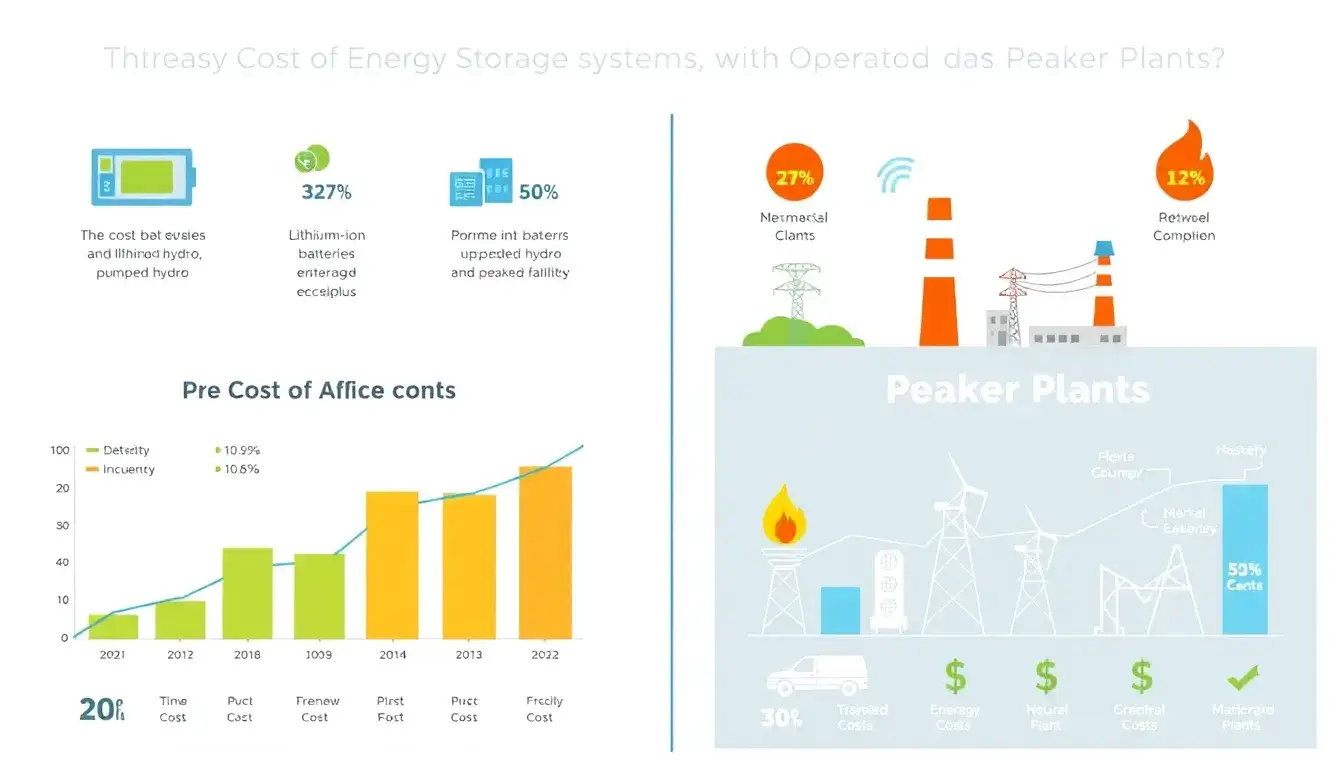
The cost of energy storage compared to operating peaker plants varies based on many factors, but recent studies indicate that battery energy storage systems (ESS), particularly 4-hour duration batteries, can be more cost-effective and environmentally beneficial than fossil-fueled peaker plants.
Cost Comparison Findings:
- A 2024 study in Maine showed that replacing aging gas-fired peaker plants with up to 200 MW of 4-hour battery storage results in a lower lifetime net cost than building new gas peaker plants. This holds true when considering both pure financial costs and social costs such as carbon emissions and local pollutants.
- Under current market rules (qualifying capacity framework), 2-hour battery storage is the lowest-cost peaker replacement, but under a proposed effective load-carrying capability (ELCC) framework—favoring longer-duration storage—4-hour batteries become the most economical option.
- When including social costs (e.g., carbon emissions), the net cost of new gas turbines rises significantly (from about $1.87/kWh to $3.10/kWh), whereas battery storage costs are stable since they produce no emissions. For example, net costs for 4-hour battery storage were as low as $2.42/kWh under QC and $2.63/kWh under ELCC frameworks, compared to higher costs for gas peakers.
- A California study similarly found that 4-hour battery storage has a lower net cost per kW-month than longer-duration storage options and can effectively replace gas peaker plants when considering capital expenditures and operating costs without charging energy costs included.
- Batteries offer additional operational advantages such as faster response times, enabling near-instant ramping to meet grid signals, whereas gas peakers are slower and less efficient to operate. This operational flexibility adds value beyond direct cost comparisons.
Summary:
Battery energy storage, especially 4-hour duration systems, generally have lower or comparable total net costs than operating fossil fuel peaker plants when both direct costs and social/environmental costs are considered. This trend is reinforced by battery storage’s zero emissions, faster response, and increasing cost-competitiveness as battery technology advances. Consequently, many regions, including Maine and California, are finding energy storage to be a more economic, equitable, and sustainable alternative to peaker plants.
Original article by NenPower, If reposted, please credit the source: https://nenpower.com/blog/how-does-the-cost-of-energy-storage-compare-to-the-cost-of-operating-peaker-plants/

