

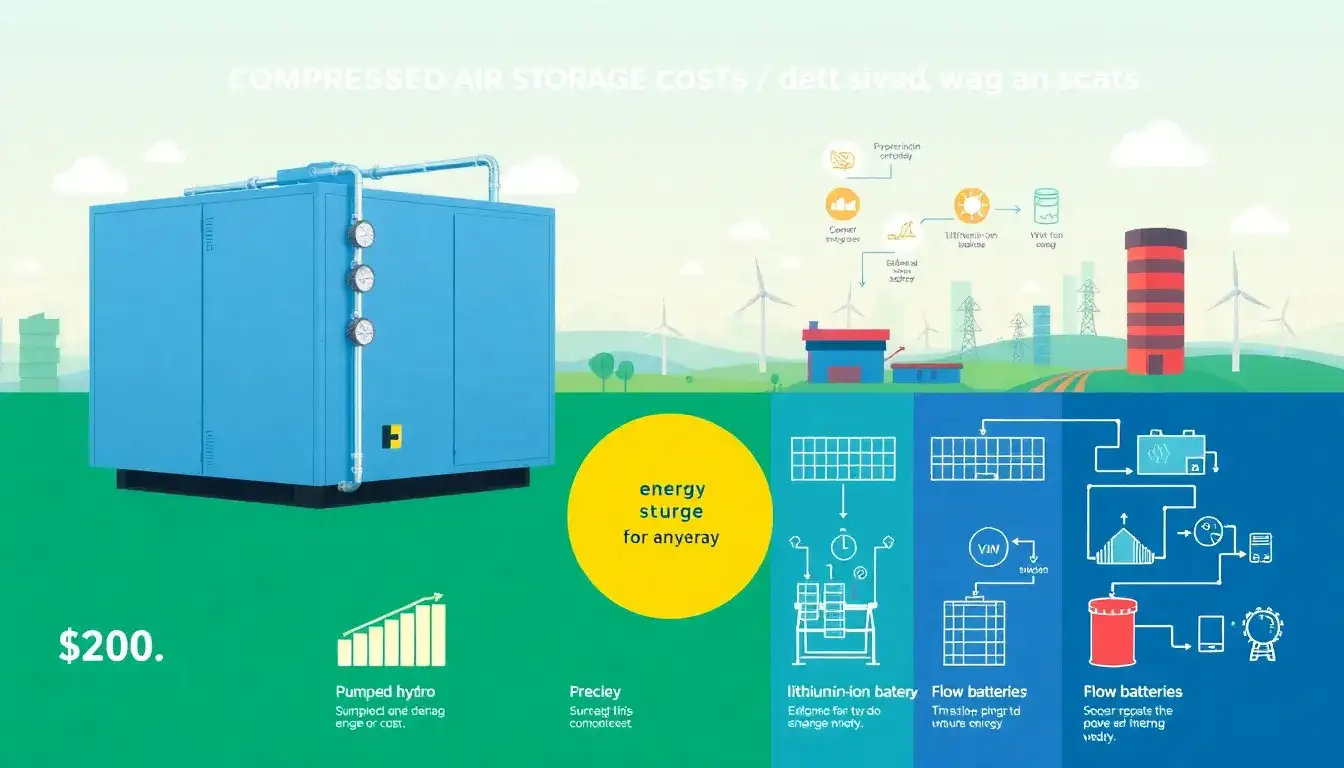
Compressed Air Energy Storage (CAES)
Compressed air energy storage (CAES) is one of several long-duration energy storage technologies that have emerged as alternatives to lithium-ion batteries. Here’s how CAES compares in cost to other long-duration storage technologies:
Cost Comparison
- Compressed Air Storage (CAES):
- The average capital expenditure (capex) for CAES is about $293 per kilowatt-hour (kWh) globally, according to BloombergNEF.
- Operating costs include higher maintenance due to moving parts compared to lithium-ion batteries.
- CAES can store energy for long durations but typically at a lower efficiency (around 60-65%).
- Thermal Energy Storage:
- Currently the cheapest long-duration energy storage technology, with a capex of $232 per kWh.
- Ideal for long-duration storage with high efficiency and scalability.
- Lithium-Ion Batteries (4-hour duration):
- Capex is about $304 per kWh, though typically used for shorter durations (e.g., four hours).
- Widely adopted in various applications but faces supply chain issues.
- Flow Batteries:
- Capex is higher than CAES and Li-ion batteries in non-China markets, with costs 66% higher than thermal energy storage systems.
- Offers flexible capacity and long-duration storage capabilities.
- Pumped Hydro and Gravity Storage:
- Pumped hydro is highly efficient and can be cost-effective, with potential for future cost reductions.
- Gravity storage has the highest capex at $643 per kWh due to structural requirements.
Cost Trends and Challenges
- Innovation and Cost Reductions:
- Technologies like CAES and flow batteries are expected to see significant cost reductions by 2030 if innovation targets are met.
- Geographical Variations:
- Costs vary significantly between China and other regions due to economies of scale and policy support.
- Scalability and Efficiency:
- CAES benefits from scalability if large underground storage sites are available but suffers from lower efficiency compared to other methods like thermal storage.
Overall, while CAES is cost-competitive with lithium-ion batteries in certain scenarios, thermal energy storage is currently the most cost-effective option for long-duration storage. CAES offers scalable solutions for regions with suitable underground storage capabilities.
Original article by NenPower, If reposted, please credit the source: https://nenpower.com/blog/how-does-the-cost-of-compressed-air-storage-compare-to-other-long-duration-energy-storage-technologies/

