

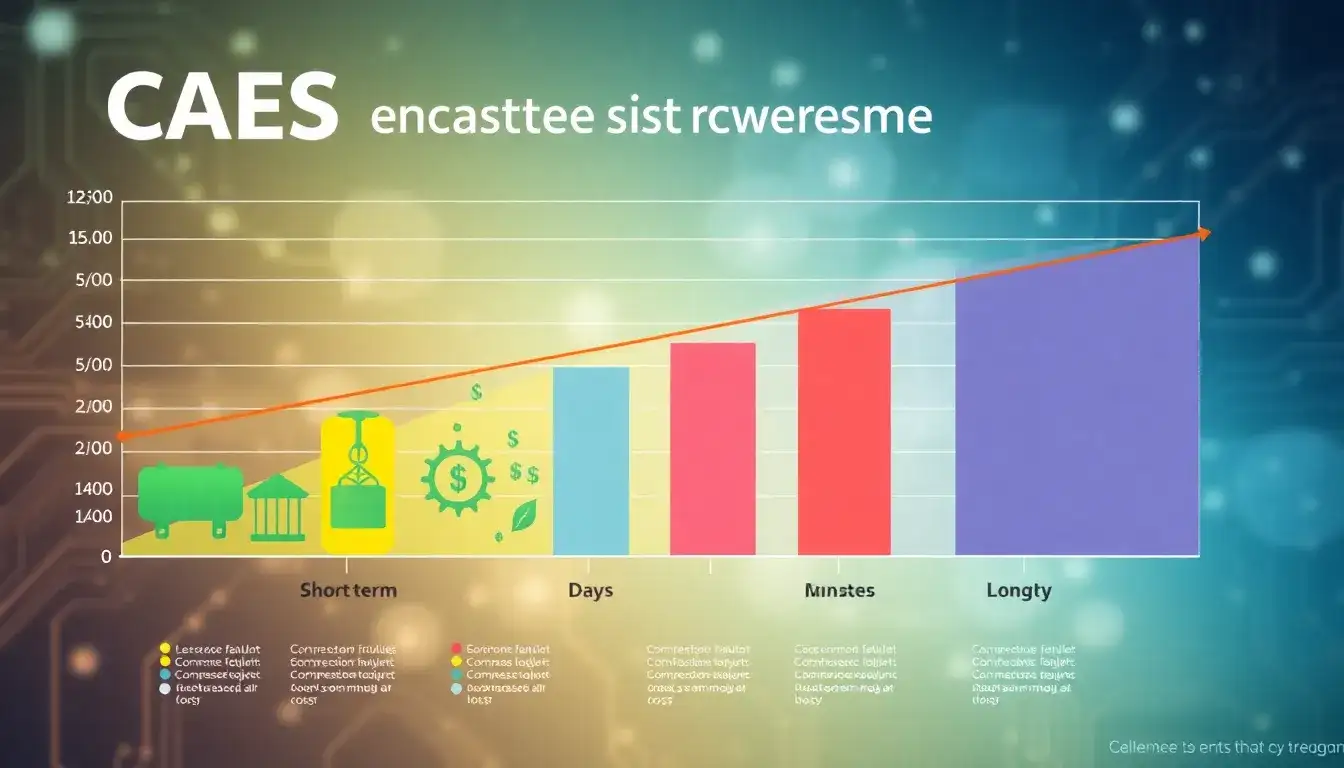
The cost of compressed air energy storage (CAES) can vary significantly with different storage durations, primarily due to the efficiency and capital costs associated with the technology.
Cost Variability with Duration
- Efficiency and Capital Costs:
- Efficiency: CAES systems have a round-trip efficiency of about 60-65%, which affects their cost-effectiveness. The efficiency can impact the overall energy output for longer storage durations, as more energy is lost during compression and storage.
- Capital Costs: The capital expenditure (capex) for CAES is generally quoted around $1,350/kW, but costs can vary based on the scale and availability of underground storage facilities.
- Long-Duration Storage Advantages:
- CAES becomes more competitive for long-duration storage needs, especially beyond 12 hours, as the storage duration can be extended without significantly increasing the power conversion equipment costs. Instead, larger underground caverns are used for longer durations.
- For extended storage periods like 24 hours, CAES can offer costs comparable to redox flow batteries but remains higher than thermal energy storage solutions.
- Impact of Storage Duration on Costs:
- Short Duration: For shorter durations, CAES may not be as cost-competitive with technologies like lithium-ion batteries, which are better suited for short-term energy storage.
- Long Duration: As duration increases, the cost advantages of CAES become more pronounced, particularly in scenarios where large underground storage facilities are available. This makes CAES suitable for high renewable energy penetration scenarios.
- Least-Cost Models and Location-Specific Costs:
- New models are being developed to optimize CAES integration with renewable energy systems, showing that CAES can be very cost-competitive for long-term storage needs. For example, in California, the cost could be as low as $0.123/kWh under certain conditions.
Example Costs by Duration
- 8-Hour Duration: The average fully installed cost for CAES at this duration is around $293/kWh, making it competitive with thermal storage options.
- 24-Hour Duration: Costs can range from 30-40 cents/kWh, making CAES a viable option for long-duration storage, though still higher than thermal energy storage.
In summary, while CAES is more cost-effective for longer storage durations due to its scalability and lower incremental energy costs, its overall cost-effectiveness is influenced by factors like efficiency, capital costs, and the availability of suitable storage sites.
Original article by NenPower, If reposted, please credit the source: https://nenpower.com/blog/how-does-the-cost-of-compressed-air-energy-storage-vary-with-different-durations/

