

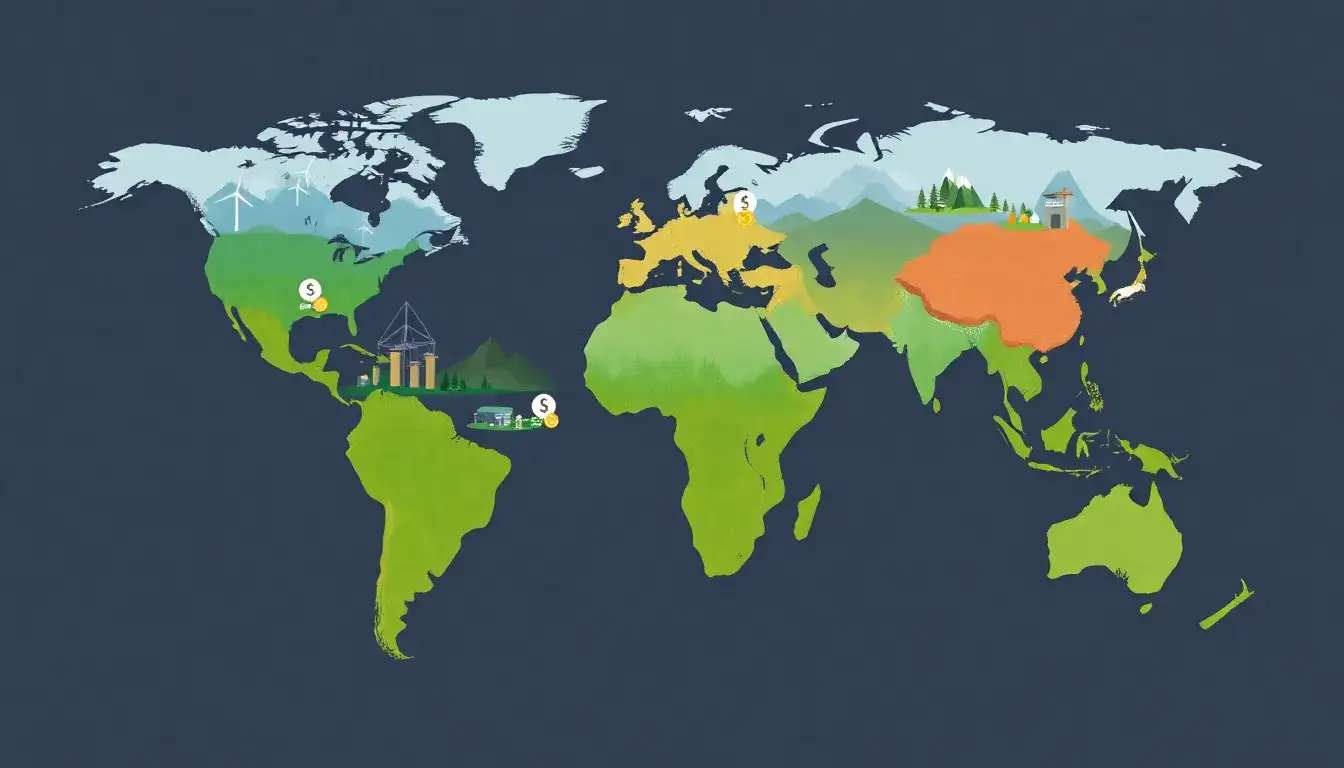
The cost of Compressed Air Energy Storage (CAES) varies significantly with geographic location, primarily due to site-specific geological and logistical factors.
Key Geographic Factors Affecting CAES Costs
1. Underground Storage Geology
- Large-scale CAES plants typically require suitable underground geological formations, such as salt caverns or porous rock reservoirs, for air storage. The availability and quality of these formations greatly influence the feasibility and cost of CAES projects.
- For example, the Columbia River Basalt Group in the Pacific Northwest USA has been identified as a promising geological site for CAES due to its extensive basalt formations offering large storage volumes at reasonable costs.
- The need for specific underground formations limits site options, and sites without optimal geology will incur additional costs for alternative storage solutions or smaller-scale above-ground storage, which is more expensive.
2. Site Accessibility and Construction Complexity
- Construction, engineering, procurement, and installation (EPC) costs vary depending on site accessibility, terrain complexity, and local labor and material costs. More remote or challenging locations increase logistics and construction expenses.
- Smaller CAES systems installed in constrained or existing structures can also push up costs due to limited space and increased complexity.
3. Component and Equipment Procurement
- Costs related to transporting and installing heavy-duty compressors, turbines, and storage vessels depend on the site’s remoteness and infrastructure, affecting overall project cost.
4. Regional Energy Prices and Fuel Availability
- Natural gas is often used to reheat air before expansion in traditional CAES, so regional fuel prices impact operational costs and economic viability. Areas with expensive or constrained fuel supply may face higher lifecycle costs.
5. Scale and System Configuration Tailored to Location
- The size and configuration of CAES plants are adapted to local conditions, affecting cost. For example, in the Pacific Northwest study, two different sites had different design approaches based on geological and operational constraints, resulting in different levelized costs of electricity (LCOEs), with one site achieving about 6 cents/kWh and another about 11.8 cents/kWh.
Cost Variation Examples and Estimates
| Location/Scenario | Cost Metric | Notes |
|---|---|---|
| Pacific Northwest (Columbia River Basalt) | LCOE ~6 to 11.8 cents/kWh | Variation due to site geology and operational design |
| Typical CAES Facility (general) | Capital cost ~$1,350/kW | Requires about 26 cents/kWh storage spread for 10% IRR; round-trip efficiency ~63% |
| Small-scale above-ground CAES | Initial investment ~$10,000 residential | Higher cost than batteries but longer lifespan; more flexible siting |
| Larger-scale CAES with adequate underground reservoir | Capex potentially below $50/kWh (energy basis) | Larger reservoir lowers per-unit cost considerably |
Summary
- CAES cost depends heavily on the presence of suitable underground storage formations, which vary by geography. Regions with optimal geology (e.g., basalt formations, salt caverns) can achieve significantly lower capital and operating costs.
- Remote or geologically unsuitable locations may require more costly above-ground storage or smaller systems, increasing costs.
- Logistics, local construction conditions, fuel prices, and system design tailored to site conditions also cause cost variability.
- Levelized cost of electricity from CAES can range roughly from 6 to nearly 12 cents/kWh depending on site and design factors, making location critical to economic viability.
- Small-scale, decentralized CAES offers siting flexibility at higher per-unit costs but with operational advantages.
In essence, regions with favorable underground geology and good infrastructure support the most cost-effective CAES projects, while other locations face higher capital and operational costs due to geology, site complexity, and logistics.
Original article by NenPower, If reposted, please credit the source: https://nenpower.com/blog/how-does-the-cost-of-caes-vary-with-different-geographic-locations/

