

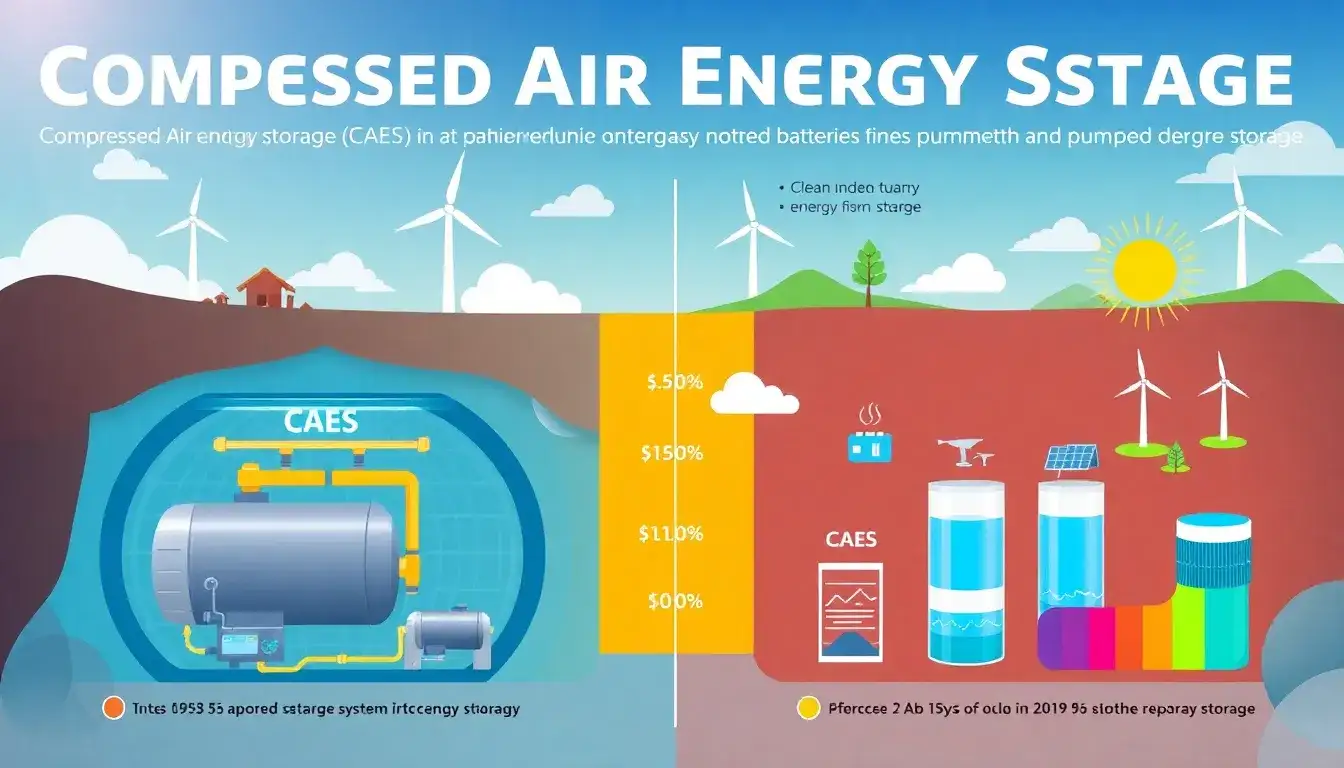
Cost Comparison: Compressed Air Energy Storage (CAES) vs. Traditional Energy Storage Methods
CAES systems offer unique advantages over traditional methods, particularly in terms of scalability and environmental impact. Here’s a comparison of CAES with other energy storage technologies:
Costs
- Compressed Air Energy Storage (CAES): The capital expenditure for CAES is approximately $293 per kilowatt-hour, which is competitive with lithium-ion batteries, especially for long-duration applications. However, the efficiency of CAES systems averages around 60-65%, which means additional energy is required to compensate for losses.
- Lithium-Ion Batteries: These have an average cost of $304 per kilowatt-hour for four-hour duration systems but are more expensive than CAES and thermal energy storage for longer durations. Lithium-ion costs are significantly lower in China due to economies of scale.
- Thermal Energy Storage: This is currently the cheapest long-duration storage technology, with a capex of $232 per kilowatt-hour.
- Pumped Hydro Storage (PHS): PHS is a mature technology but often requires specific geography, making it less versatile than CAES. However, PHS generally has higher upfront costs compared to CAES and thermal energy storage but can achieve high efficiency due to its mechanical nature.
Efficiency and Scalability
- CAES: Offers high scalability due to its potential use of large underground reservoirs, making it suitable for long-duration applications. However, it has relatively lower efficiency due to heat loss during compression and expansion.
- PHS and Thermal Storage: Both can achieve high efficiency but have different limitations. PHS requires suitable geography, while thermal storage can be more location-independent like CAES.
Environmental Impact and Suitability
- CAES: Environmentally friendly and uses less water compared to PHS, making it a more sustainable option for water-scarce regions.
- Lithium-Ion Batteries: Face supply chain issues and have environmental concerns related to material extraction and recycling.
Economic Feasibility
- CAES: While competitive in costs for long-duration applications, its overall economic viability depends on capturing economies of scale, particularly through large-scale deployments.
- Lithium-Ion Batteries: Benefiting from economies of scale due to widespread use in electric vehicles and consumer electronics, they remain a dominant force despite CAES’s competitive pricing.
In summary, CAES offers a cost-competitive solution for long-duration energy storage, especially in comparison to lithium-ion batteries, but faces challenges in efficiency and economies of scale compared to traditional storage methods like thermal energy storage.
Original article by NenPower, If reposted, please credit the source: https://nenpower.com/blog/how-does-the-cost-of-caes-systems-compare-to-traditional-energy-storage-methods/

