

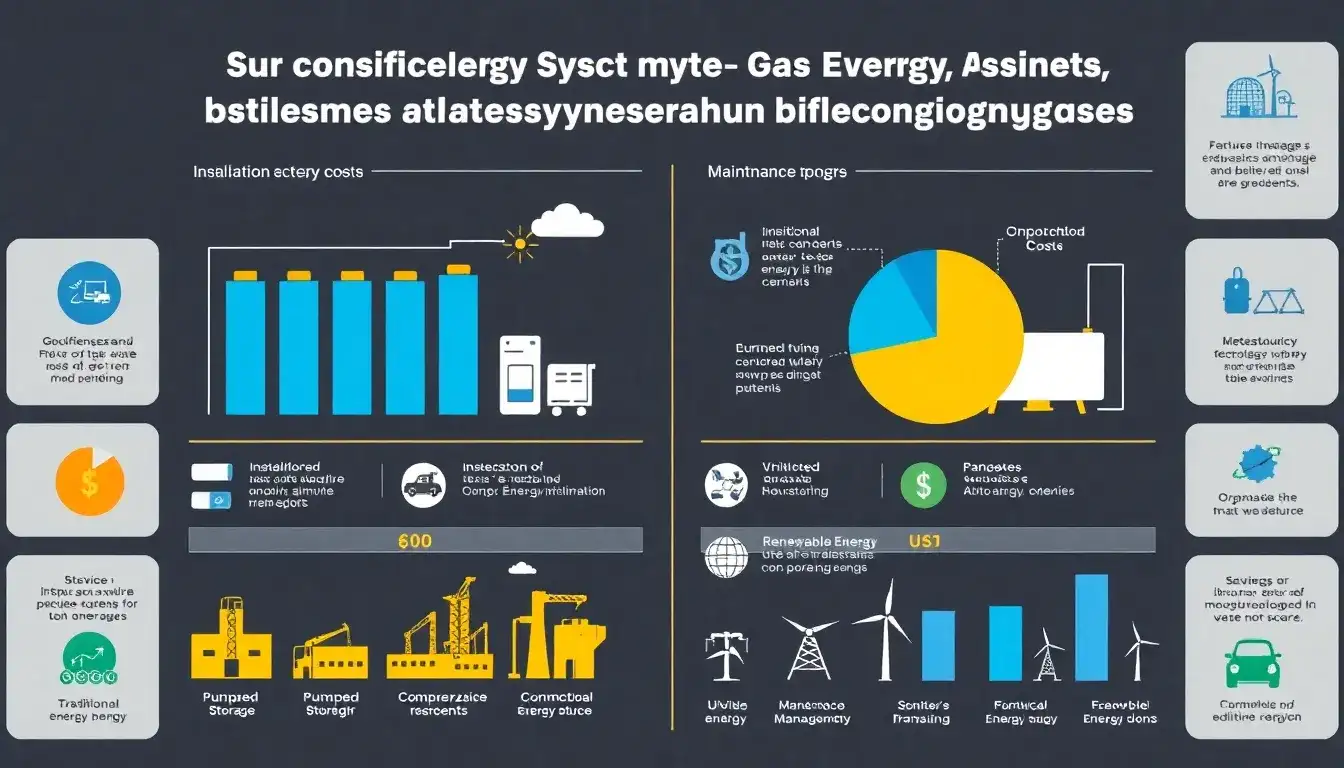
Battery Energy Storage Systems
- Cost: The cost of commercial and industrial battery energy storage systems ranges from $400 to $750 per kilowatt-hour (kWh) currently, depending on the technology and scale of the system. For industrial-scale systems, costs can range from $450 to $600 per kWh.
- Advantages: Battery storage allows for efficient peak shaving, load shifting, and integration of renewable energy sources. Lithium-ion batteries, the most common type used commercially, have seen significant cost reductions over the years, making them more competitive.
- Future Outlook: Costs are expected to continue decreasing, driven by technological advancements and economies of scale.
Traditional Energy Storage Methods
- Cost and Efficiency: Traditional methods such as pumped hydro storage (PHS) and other mechanical systems often have lower upfront costs compared to battery systems, especially at larger scales. However, they are typically less flexible in deployment locations and usage scenarios.
- Advantages: PHS offers long-duration energy storage and is the most widely used form of large-scale energy storage, but its geographical constraints limit its widespread adoption. Other traditional methods, like compressed air energy storage (CAES), are also site-specific and less adaptable compared to battery systems.
- Sustainability and Flexibility: While traditional methods are effective for large-scale energy storage, battery systems provide greater flexibility in terms of scalability, location adaptability, and grid stability services.
Comparison
| Technology | Cost per kWh | Advantages | Flexibility |
|---|---|---|---|
| Battery Storage | $400-$750 (commercial) | Peak shaving, load shifting, renewable integration | High flexibility in scale and location |
| $450-$600 (industrial) | Significant cost reductions over time | Suitable for diverse applications | |
| Pumped Hydro Storage | Lower upfront but site-specific | Large-scale storage capability | Limited by geography |
| Compressed Air Energy | Lower upfront but site-specific | Low cost per kWh for large installations | Limited by geography |
Conclusion: While traditional energy storage methods like PHS and CAES are cost-effective at scale and offer some advantages, battery storage systems provide the flexibility and adaptability that industries require for managing energy costs and integrating renewable energy sources efficiently. As technology continues to evolve, the cost of battery storage is expected to decrease further, making it an increasingly attractive option for industrial applications.
Original article by NenPower, If reposted, please credit the source: https://nenpower.com/blog/how-does-the-cost-of-battery-energy-storage-systems-compare-to-traditional-energy-storage-methods-for-industries/

