

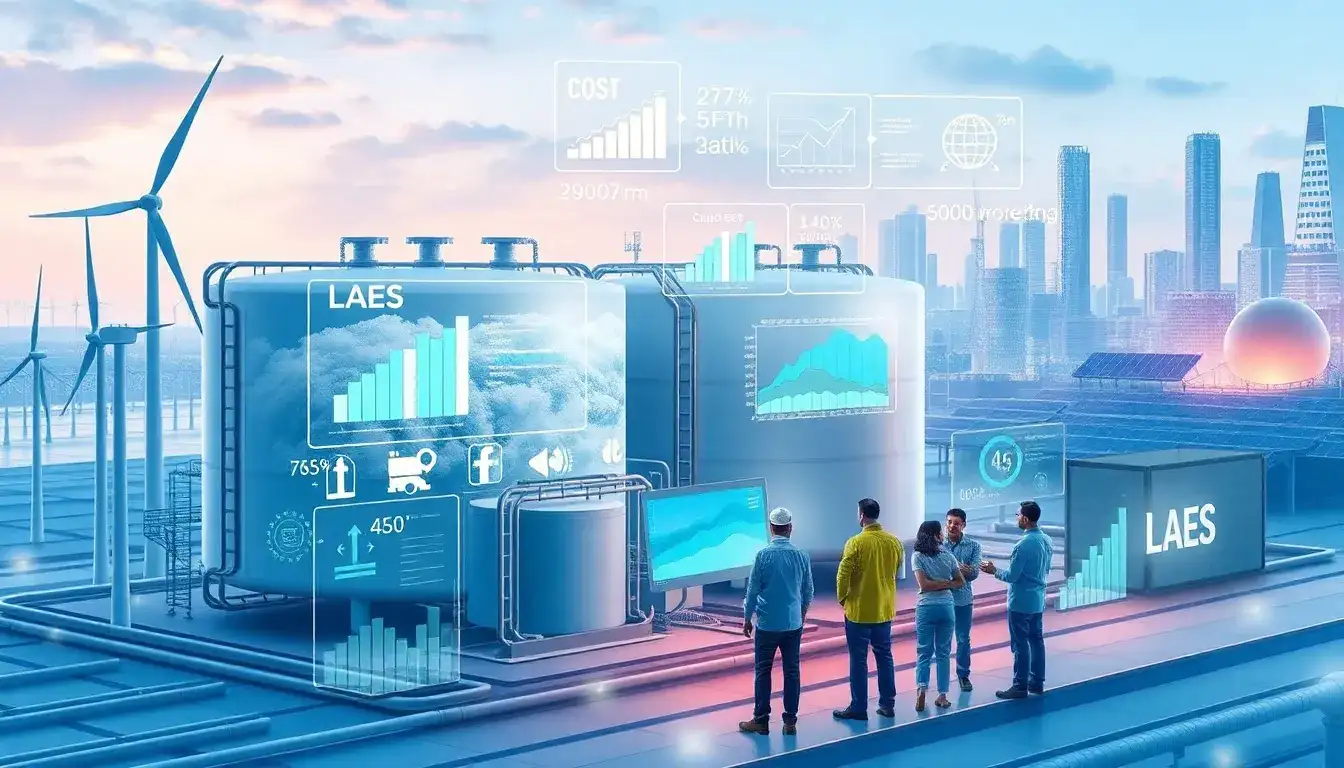
Cost Competitiveness
- LAES has a levelized storage cost around $60 per MWh, which is approximately one-third the cost of lithium-ion battery storage and about half the cost of pumped hydropower storage. This positions LAES as one of the cheapest long-term energy storage solutions available for grid-scale applications.
- LAES does not experience performance degradation over time like lithium-ion batteries, ensuring consistent operational efficiency and reducing replacement costs, which is an attractive economic feature.
Economic Viability and Market Adoption
- Despite the low cost per MWh, current economic models show that LAES is not yet economically viable for private investors in most cases, as the net present value (NPV) tends to be negative under typical market conditions. In other words, it generally costs more to store energy using LAES than the revenue earned from selling it back to the grid.
- Positive economic viability of LAES tends to appear only under very aggressive decarbonization scenarios (e.g., 100% decarbonization by 2035), which are considered less realistic, and primarily in specific regional markets such as Texas and Florida due to their unique energy market structures.
- Improvements in LAES energy efficiency have minimal impact on improving economic viability, indicating that better technology efficiency alone is unlikely to drive faster adoption.
Policy and Market Conditions Impact
- The adoption of LAES could be significantly boosted by financial incentives, such as capital expenditure subsidies ranging from 40% to 60%. Subsidies enhance the economic viability of LAES under more realistic decarbonization and market scenarios.
- LAES integration with existing power projects and industrial facilities can reduce costs further and improve the investment appeal, pointing to the importance of strategic deployment and infrastructure integration.
- The location of LAES installations affects costs and viability, making regional market analysis crucial for determining where LAES projects are most feasible.
Additional Benefits Supporting Adoption
- LAES can reduce the curtailment of renewable energy sources (RES) by more than 40%, thereby increasing the utilization of otherwise wasted renewable power.
- Use of LAES can lead to up to a 25% reduction in natural gas consumption and about a 19% reduction in overall power system operating costs, contributing to both economic and environmental benefits that support its market appeal.
- Since LAES uses ambient air and electricity without contaminants, it is a clean technology compatible with renewable energy systems, aligning well with sustainability goals.
Summary
While LAES offers a cost-effective and environmentally clean energy storage method with significant advantages over batteries and pumped hydro, its current economic viability is limited without supportive policies and subsidies. The technology’s adoption in the energy market is thus heavily influenced by decarbonization ambitions, regional market structures, and financial incentives. If these conditions align, LAES could become a key player in long-duration, grid-scale energy storage solutions and facilitate higher integration of renewable energy.
Original article by NenPower, If reposted, please credit the source: https://nenpower.com/blog/how-does-the-cost-effectiveness-of-laes-impact-its-adoption-in-the-energy-market/

