

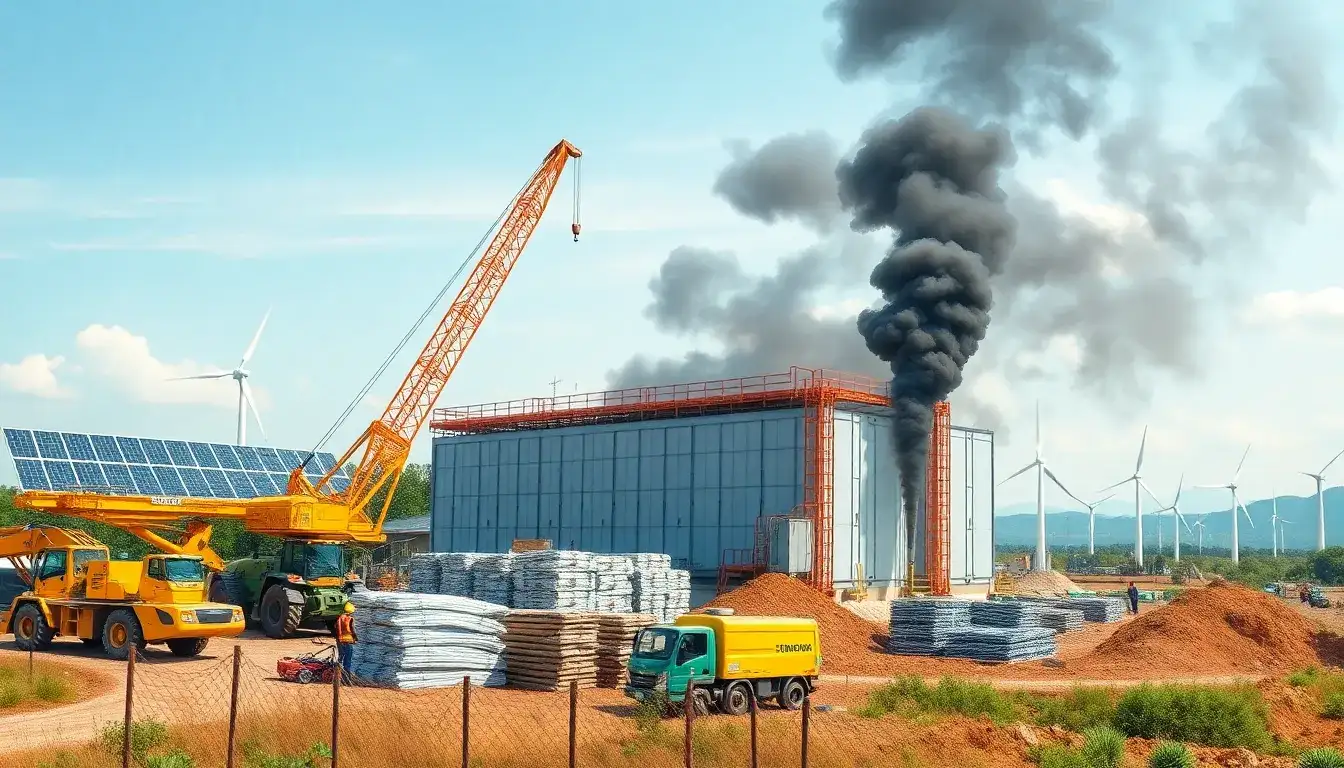
The construction process of energy storage facilities significantly impacts their overall greenhouse gas emissions, and this must be considered within a life-cycle emissions framework.
Construction-Related Emissions in Energy Storage Facilities
- Manufacturing and construction energy intensity: Battery Energy Storage Systems (BESS), particularly lithium-ion batteries, involve energy-intensive manufacturing processes. This results in considerable emissions during production and construction phases. For example, BESS construction-related emissions can be around 33–40 kg CO2e per MWh delivered, which is relatively high compared to other storage technologies.
- Material and component longevity: Facilities with longer-lived components, such as Pumped Hydropower Storage (PHS), tend to have lower construction-related emissions per unit of electricity delivered due to amortization of construction emissions over a longer operational life. PHS construction emissions can be as low as 6 kg CO2e/MWh owing to durable infrastructure lasting around 60 years.
- Emissions from fuel use during construction: Some technologies like Compressed Air Energy Storage (CAES) show higher emissions linked to natural gas combustion during operation rather than construction; however, construction emissions for CAES are also relatively low (roughly 4 kg CO2e/MWh), but overall life-cycle emissions can be significant due to fuel combustion.
Overall Impact on Emissions
- The energy and emissions embedded in the manufacturing and construction phase are a critical part of the total life-cycle emissions profile of energy storage facilities.
- For battery storage, upstream emissions in production depend on the power capacity and energy storage size, and the electricity grid emissions factor at the battery manufacturing location also influences the magnitude of embedded emissions.
- New tools developed by entities like the National Renewable Energy Laboratory (NREL) enable better estimation of lifetime greenhouse gas emissions, including construction impacts, allowing developers to assess and optimize projects accordingly.
Advances for Reducing Construction Emissions
- Emerging technologies such as CO2 energy storage in construction are promising for reducing carbon emissions associated with building and energy management processes, potentially enabling the construction industry to store excess energy with lower emissions.
In summary, the construction process contributes significantly to the overall emissions of energy storage facilities, especially for battery-based systems due to their energy-intensive manufacturing. Technologies with longer lifetimes and less intensive construction tend to have lower emissions per MWh over their operational life. Accurate life-cycle assessment tools that include construction impacts are essential for evaluating and minimizing the carbon footprint of these technologies.
Original article by NenPower, If reposted, please credit the source: https://nenpower.com/blog/how-does-the-construction-process-of-energy-storage-facilities-impact-their-overall-emissions/

