

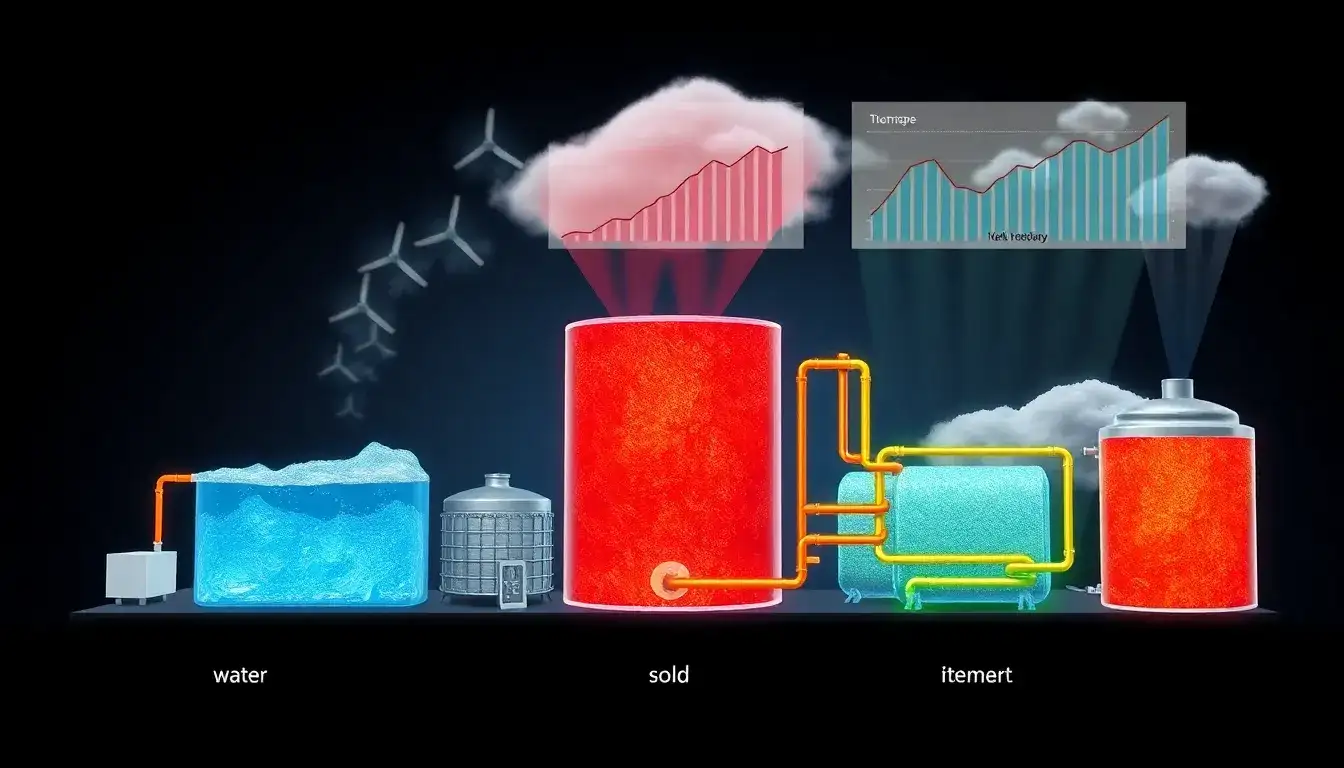
Impact of Storage Medium on Efficiency
- Thermal Conductivity and Heat Transfer: Materials with high thermal conductivity, such as metals, enable quicker heat transfer, which enhances the efficiency of energy storage and retrieval. Conversely, materials with poor thermal conductivity may slow down energy transfers, reducing system efficiency.
- Types of Thermal Energy Storage:
- Sensible Heat Storage: This method involves storing energy by changing the temperature of a material. It uses materials like concrete, rocks, or metals. Sensible heat storage efficiencies can range from 50% to 90%, depending on the specific heat capacity and thermal insulation of the medium.
- Latent Heat Storage: This method utilizes phase changes (e.g., solid to liquid) in materials like salts, paraffins, or ice. It offers higher energy density and efficiency (75% to 90%) compared to sensible heat storage. However, latent heat materials often have limitations due to their corrosive nature and phase change temperatures.
- Thermochemical Storage: This involves chemical reactions to store energy. It can achieve efficiencies close to 100% and is suitable for high temperatures above 300°C.
- Specific Examples:
- Molten Salts: These are commonly used in CSP (Concentrating Solar Power) systems for long-term thermal energy storage. They offer efficient heat storage but require insulation to maintain temperature.
- Ice and Zeolites: Ice provides high energy density due to the heat of fusion of water, while zeolites store energy via adsorption/desorption processes, both offering efficient and cost-effective options for cooling and heating.
- Material Choice and System Design:
- Radial vs. Axial Packed-Bed Designs: The design and material choice can reduce pressure drops and enhance efficiency. For instance, radial packed-bed designs have shown to improve thermal efficiencies by reducing parasitic power consumption.
In summary, the choice of storage medium is crucial for optimizing the efficiency of TES systems. Different materials and designs can provide a wide range of efficiencies, from 50% to over 90%, depending on their thermal properties and system configurations.
Original article by NenPower, If reposted, please credit the source: https://nenpower.com/blog/how-does-the-choice-of-storage-medium-impact-the-overall-efficiency-of-thermal-energy-storage-systems/

