

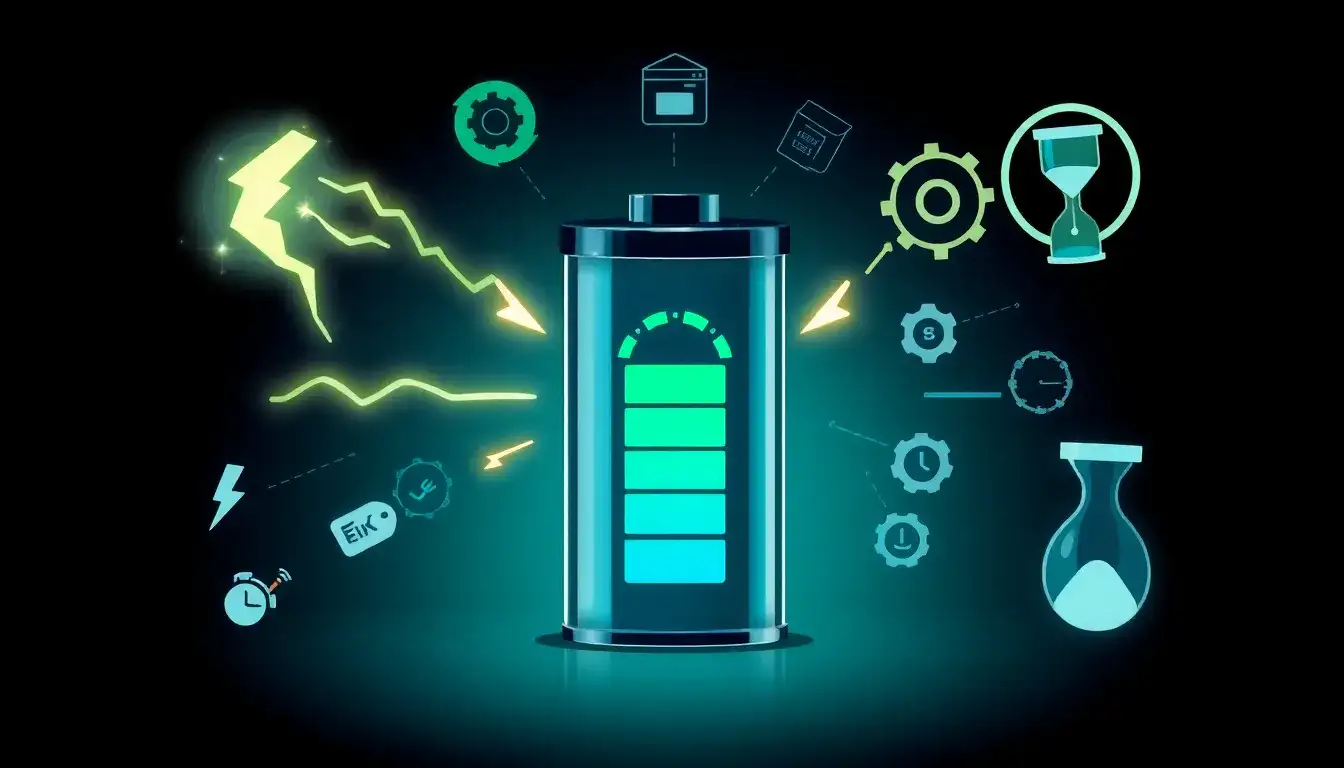
The charging time of lithium-ion batteries significantly impacts their overall efficiency, lifespan, and performance, and this relationship unfolds in several key ways:
Charging Time and Efficiency
- Lithium-ion batteries can be charged very efficiently, with charge efficiency around 99 percent, and the cell usually remains cool during charging, indicating minimal energy loss.
- Fast charging can fill a battery to about 80% capacity in roughly 30 minutes by using higher current and voltage, which is much quicker than slow charging that typically takes 6 to 8 hours.
- However, very fast charging requires sophisticated control to prevent overcharging, especially as the battery nears full capacity, by switching to constant voltage mode to safeguard battery health.
Impact on Battery Lifespan and Health
- Slow charging, characterized by lower current and power, generally extends the battery’s cycle life significantly—often beyond 3,000 cycles—whereas consistent fast charging can reduce cycle life due to increased stress on the battery.
- The first charge of a lithium-ion battery, often done at low current by manufacturers, has been found to be crucial for long-term battery health. New research shows that charging the battery initially at high current (fast charging) can actually increase the battery’s lifespan by 50% while drastically reducing the initial charging time from 10 hours to 20 minutes.
- Maintaining moderate charge levels (e.g., 75% rather than 100%) and avoiding full discharges can reduce capacity loss and prolong battery life; thus, faster charging that pushes full charge frequently can stress the battery more.
Trade-Off Between Charging Speed and Battery Longevity
- Fast charging offers convenience and time savings but comes with trade-offs in battery lifespan and potential additional costs due to required support equipment like AC to DC converters.
- Slow charging is gentler on the battery, promoting longevity and safety while being more cost-effective for regular use.
- Balancing fast and slow charging according to use cases and battery health preservation is key to optimizing overall efficiency.
Summary Table of Charging Time Effects
| Aspect | Slow Charging | Fast Charging |
|---|---|---|
| Charging Duration | 6-8 hours | ~30 minutes to 80% capacity |
| Battery Cycle Life | Can exceed 3,000 cycles | Reduced cycle life with regular use |
| Efficiency | High (~99%) | High (~99%) |
| Battery Stress | Lower | Higher due to increased current |
| Initial Charge Impact | Conventional slow initial charge | New research supports high-current initial charge for better lifespan |
| Equipment Needs | Basic | Requires AC to DC converters |
Conclusion
The charging time of lithium-ion batteries directly affects their overall efficiency and lifespan. While fast charging provides high convenience and can efficiently fill batteries in a short time without much loss in immediate efficiency, it tends to shorten cycle life due to increased stress unless managed carefully. Conversely, slow charging is gentler on batteries and extends their lifespan but takes significantly longer. Interestingly, recent findings reveal that a carefully controlled high-current initial charge can greatly improve battery longevity and reduce manufacturing times, suggesting optimized charging protocols could enhance both efficiency and lifespan simultaneously.
Original article by NenPower, If reposted, please credit the source: https://nenpower.com/blog/how-does-the-charging-time-of-lithium-ion-batteries-impact-their-overall-efficiency/

