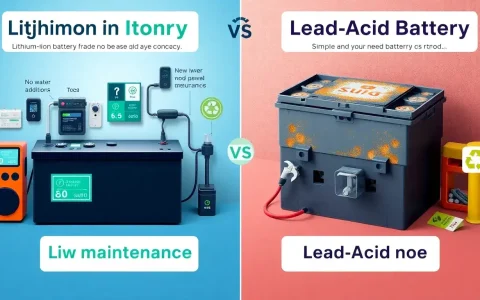
The charging time of lithium-ion batteries and lead-acid batteries can differ significantly, mainly due to their chemical properties and charging methodologies.
Lithium-ion Batteries
- Charging Speed: Lithium-ion batteries can be charged relatively quickly. For instance, a battery capable of being charged at a rate of 1C can go from 0% to fully charged in about 1 hour. Typically, they are charged with a constant current until they reach a specific voltage threshold, then switched to a constant voltage stage until the charging current drops to a predetermined level.
- Charge Time Calculation: The charging time for lithium-ion batteries is generally calculated as the capacity of the battery divided by the charger’s current, often with an additional factor to account for inefficiencies. For example, a 1800mAh battery charged with a 500mA charger might take about 3.6 hours with perfect efficiency, or around 5.4 hours with typical inefficiencies.
- Recommended Charging Practice: It’s often advisable to charge lithium-ion batteries to about 80-90% for regular use to prolong their lifespan, though full charging is sometimes necessary.
Lead-Acid Batteries
- Charging Speed: Lead-acid batteries charge more slowly compared to lithium-ion. They typically require a multi-stage charging process that involves bulk charging, absorption, and float stages. The bulk charging stage can take several hours, and the entire process, including absorption and float stages, can last from 8 to 24 hours depending on the battery’s state of charge and the charger’s capacity.
- Charge Time Calculation: The charging time for lead-acid batteries is not as straightforward as for lithium-ion and depends heavily on the battery’s state of charge, the charger’s capacity, and the desired level of charge (e.g., bulk, absorption, float).
- Charging Stages: Lead-acid batteries are first charged with a constant current (bulk charge), then switched to a constant voltage to top off the charge (absorption), and finally kept at a maintenance float voltage to prevent overcharge and sulfation.
In summary, lithium-ion batteries generally have faster charging capabilities and more straightforward charging times compared to lead-acid batteries, which require a more complex and lengthy charging process.
Original article by NenPower, If reposted, please credit the source: https://nenpower.com/blog/how-does-the-charging-time-of-lithium-ion-batteries-compare-to-lead-acid-batteries/