

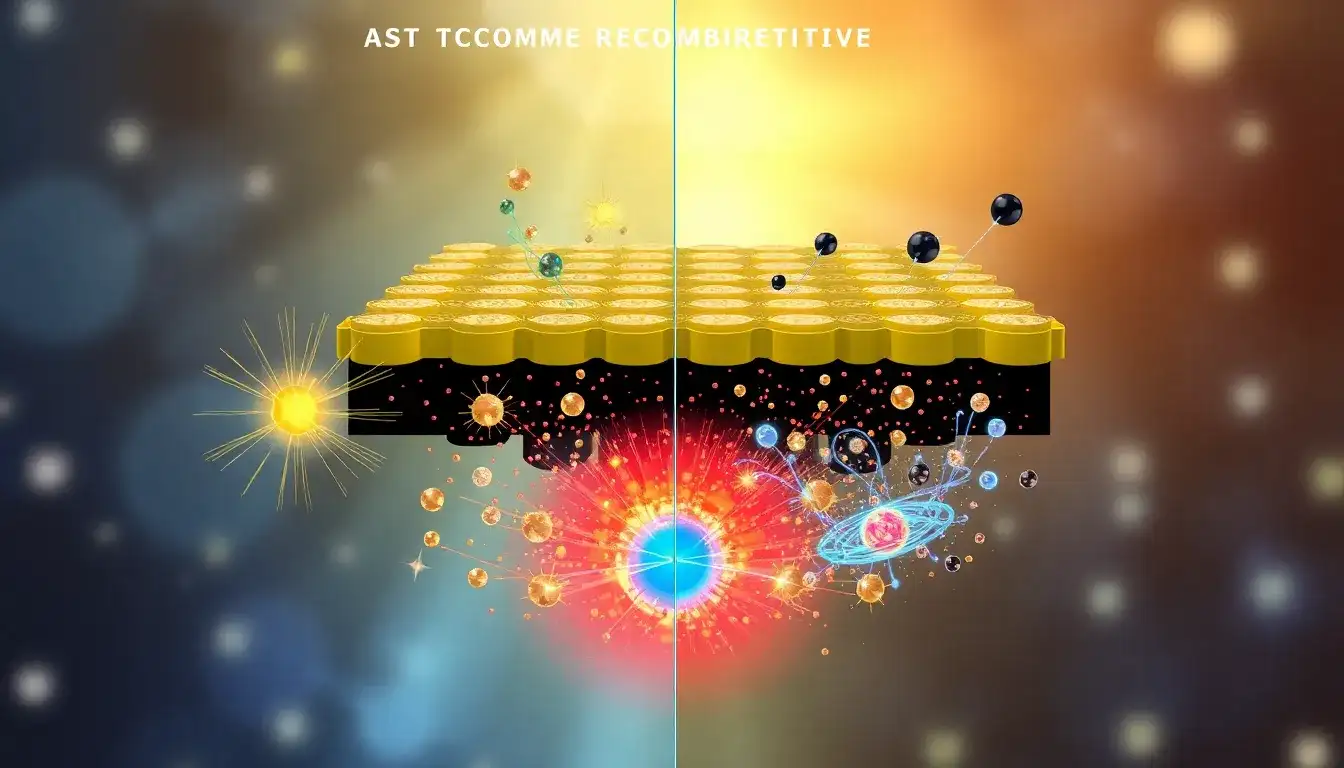
After ambient storage, the charge recombination mechanism in perovskite solar cells (PSCs) shifts from being surface-dominated to bulk-dominated. This change occurs because ambient storage leads to defect passivation at the perovskite surface, which reduces surface-related recombination losses. The passivation of defects effectively decreases recombination at interfaces, allowing bulk recombination processes within the perovskite layer to become more prominent.
Additionally, ambient storage improves the conductivity and alters the energy level alignment (specifically lowering the highest occupied molecular orbital level) of the hole transport material spiro-OMeTAD, which enhances charge extraction and further reduces charge recombination losses.
In summary, ambient storage:
- Passivates surface defects of the perovskite layer, reducing surface recombination.
- Changes the dominant recombination pathway to bulk recombination.
- Improves hole transport layer properties, facilitating better charge extraction.
This combination of effects results in improved device performance metrics such as fill factor and open-circuit voltage during the first days of storage.
Some subtleties remain in understanding the full mechanism, including the role of environmental factors (e.g., moisture incorporation) and manufacturing conditions, which can also influence trap densities and recombination behavior. However, the primary observed change is the transition from surface to bulk charge recombination due to defect passivation after ambient storage.
Original article by NenPower, If reposted, please credit the source: https://nenpower.com/blog/how-does-the-charge-recombination-mechanism-change-after-ambient-storage/

