

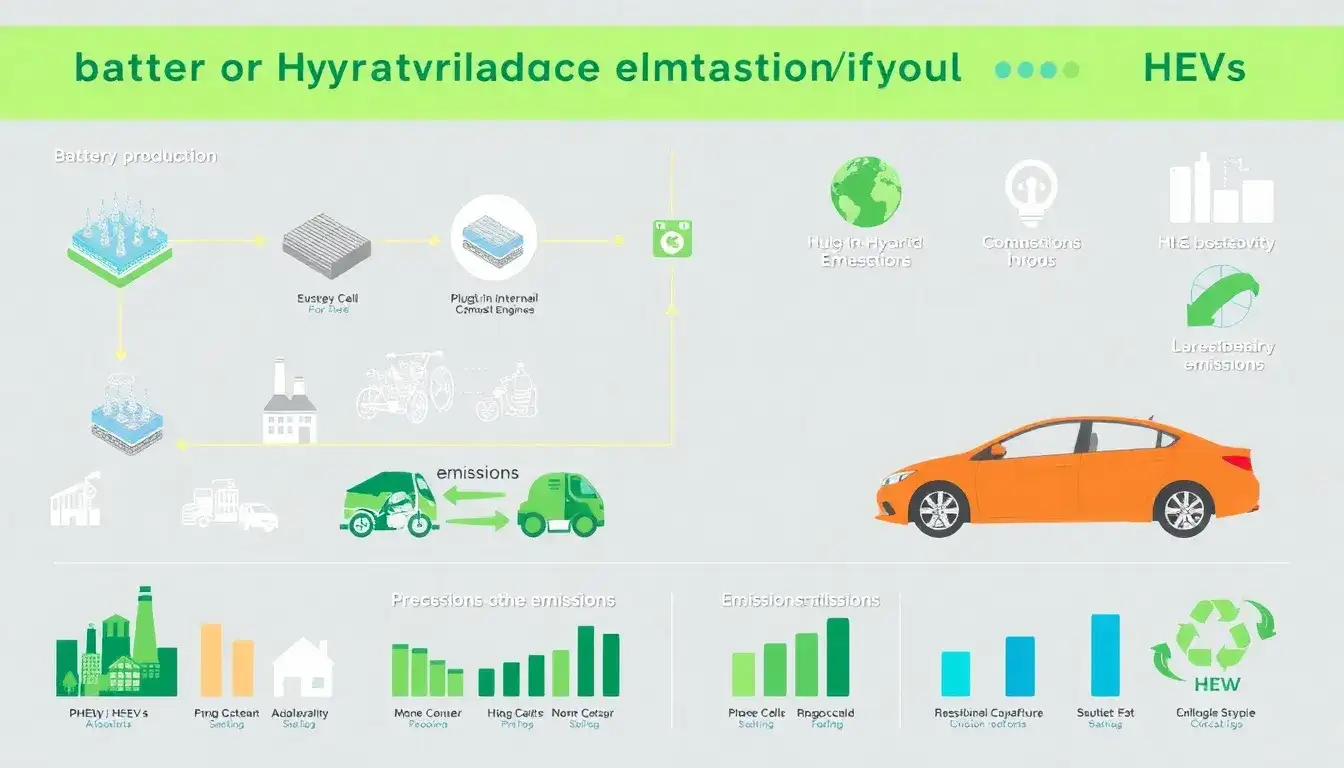
The production of batteries has a significant impact on the overall life cycle emissions of Plug-in Hybrid Electric Vehicles (PHEVs) and Hybrid Electric Vehicles (HEVs), influencing their environmental benefits compared to conventional internal combustion engine vehicles (ICEVs).
Battery Production and Its Emissions Impact
- High Emissions from Battery Production: The manufacturing of batteries, particularly lithium-ion ones used in PHEVs and HEVs, entails considerable emissions due to the extraction and processing of raw materials and the complex manufacturing processes. PHEVs typically have smaller batteries than Battery Electric Vehicles (BEVs)—about one-sixth the size of BEV batteries for a midsized PHEV—which results in correspondingly lower production emissions. This smaller battery size leads to significantly reduced embodied carbon in PHEVs compared to BEVs.
- Comparison of Life Cycle Emissions: Studies show that over a vehicle’s lifetime, PHEVs and HEVs generate fewer emissions than conventional gasoline vehicles, but battery production causes a notable portion of these emissions upfront before the vehicles are driven. For example, PHEVs reduce lifetime emissions by about 46% on average in the US compared to ICEVs, partly because of their smaller battery size and lower dependence on critical minerals. Life cycle greenhouse gas emissions for PHEVs are on average 34% lower than gasoline vehicles, although this varies widely depending on use and charging patterns.
- PHEVs vs HEVs Battery Impact: PHEVs have higher battery-related production emissions than HEVs due to their larger batteries (HEVs generally have much smaller or no batteries compared to PHEVs). However, because PHEVs can operate in all-electric mode, their emissions savings during use can offset the higher battery production emissions if the battery is used effectively. The real-world reduction of emissions depends greatly on how often PHEVs are charged and driven in electric mode; underuse of the battery reduces the emissions benefit while still incurring the production emissions cost.
Overall Life Cycle Emissions Context
- Life Cycle Emissions Include Production and Use: Life cycle (cradle-to-grave) emissions account for emissions from battery and vehicle production, fuel extraction and processing, vehicle operation, and end-of-life recycling or disposal. Battery production contributes significantly to the “vehicle-cycle” emissions part of this assessment.
- Electricity Source Matters: The overall emissions benefit of PHEVs is also influenced by the carbon intensity of the electricity used to charge the battery. Regions with cleaner electricity generation magnify the emissions advantage of PHEVs by lowering fuel-cycle emissions during the use phase. Where grids are more carbon-intensive, the benefits are reduced but PHEVs generally still outperform conventional vehicles.
Summary
- Battery production is a key contributor to the upfront emissions of PHEVs and HEVs.
- PHEVs have higher battery-related production emissions than HEVs, but their ability to use electricity for some driving distances can lead to greater lifetime emissions reductions.
- The relatively small battery size of PHEVs mitigates their production emissions compared to BEVs.
- Effective use of the battery and cleaner electricity grids maximize PHEVs’ emissions benefits.
- Overall, despite the battery production emissions, PHEVs and HEVs offer substantial life cycle emissions reductions compared to conventional gasoline vehicles.
Original article by NenPower, If reposted, please credit the source: https://nenpower.com/blog/how-does-the-battery-production-impact-the-overall-emissions-of-phevs-and-hevs/

