

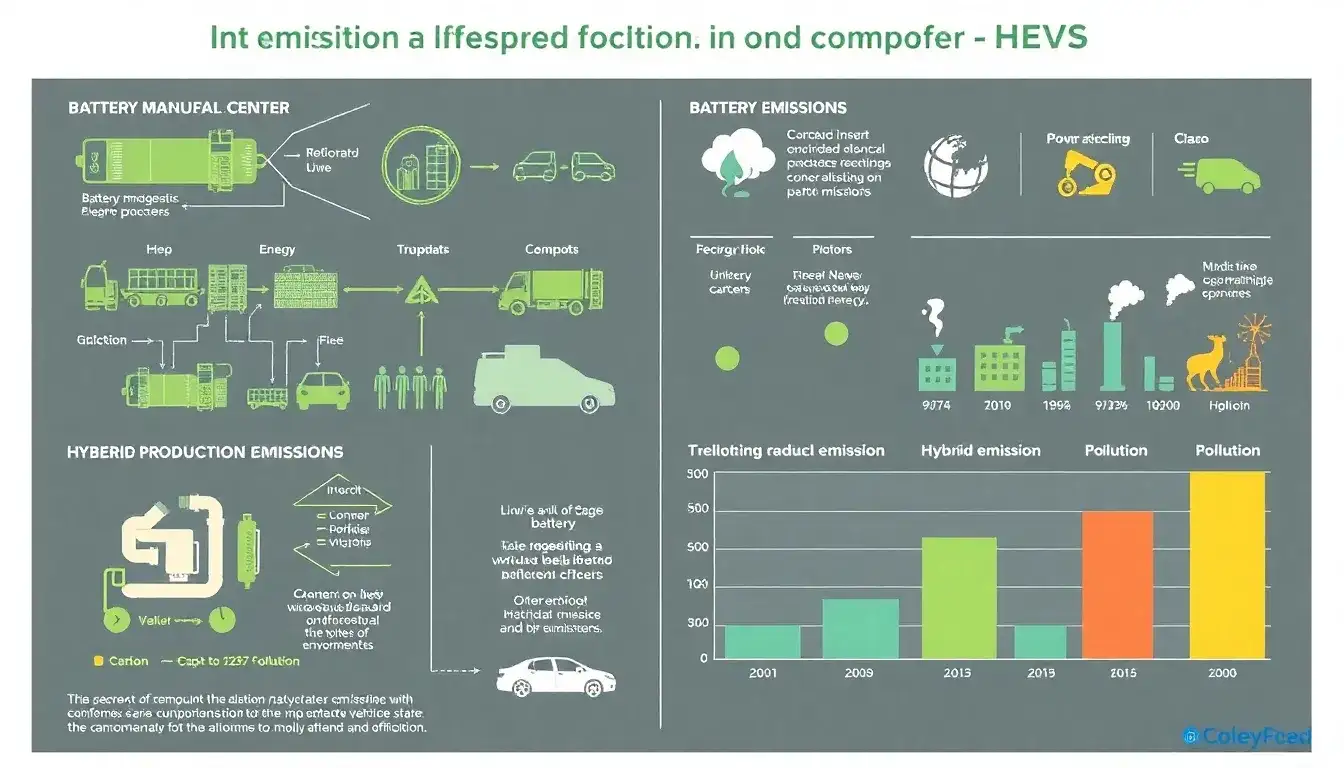
The emissions associated with battery production significantly influence the lifetime emissions of plug-in hybrid electric vehicles (PHEVs) and hybrid electric vehicles (HEVs), affecting their overall environmental impact compared to conventional internal combustion engine vehicles (ICEVs) and battery electric vehicles (BEVs).
Impact of Battery Production Emissions on PHEVs and HEVs
-
Battery Production Emissions are Substantial for PHEVs and BEVs
Battery manufacturing involves high emissions, largely due to the extraction and processing of raw materials and cell manufacturing. PHEVs have smaller batteries—about one-sixth the size of those in BEVs—which proportionally reduces the emissions from battery production compared to BEVs. HEVs generally have much smaller or no high-capacity batteries relative to PHEVs, so their battery production emissions are lower. -
Lifetime Emissions Balance Battery Emissions Against Use-Phase Emissions
PHEVs and HEVs have lower tailpipe emissions during operation than ICEVs. PHEVs produce zero tailpipe emissions while running on electricity but still use gasoline for part of their driving, typically around 30% of miles driven in real-world use, reducing but not eliminating fuel-related emissions. HEVs reduce emissions by improving fuel efficiency but do not run on grid electricity. When assessing lifetime (cradle-to-grave) emissions, the battery production emissions add to the vehicle manufacturing emissions, raising the total upfront emissions for PHEVs and BEVs compared to HEVs and ICEVs. -
PHEVs Can Achieve Significant Lifetime Emissions Reductions Despite Battery Emissions
Studies show that, on average in the U.S., PHEVs reduce lifetime greenhouse gas emissions by about 46% compared to ICEVs, which is slightly better than BEVs under current grid conditions due to PHEVs’ smaller batteries and hybrid powertrain efficiency. HEVs yield lower reductions relative to PHEVs because they lack the larger battery capacity and electric driving mode. -
Grid Electricity Cleanliness Influences Comparative Emissions
The emissions benefit of PHEVs and BEVs depends heavily on the carbon intensity of the electricity grid. In regions with low-emission electricity generation, PHEVs and BEVs have a greater life cycle emissions advantage. Conversely, in areas with high grid emissions, the use-phase benefits of electric driving are diminished, and the high embodied emissions from battery production weigh more heavily. -
Real-World Usage Patterns Affect Emissions Savings
Real-world driving and charging behavior impact the extent to which PHEVs use electric mode. If PHEVs are not charged frequently or driven primarily in gasoline mode, their effective emissions increase, reducing the lifetime emissions benefit and making the battery production emissions more significant relative to operational savings. Improving electric usage rates enhances the emissions advantage.
Summary
- Battery production contributes a significant share of the total life cycle emissions of PHEVs and BEVs.
- Because PHEVs have smaller batteries than BEVs, their battery production emissions are lower.
- Despite battery production emissions, PHEVs typically reduce lifetime emissions by about 46% versus ICEVs, performing slightly better than BEVs in current U.S. conditions due to smaller batteries and hybrid efficiency.
- HEVs have lower battery production emissions but also less overall emissions reduction since they rely more on gasoline.
- The emissions benefit of PHEVs and HEVs over ICEVs depends strongly on the emissions intensity of the electricity grid and real-world electric driving rates.
Overall, battery production emissions raise the upfront emissions of PHEVs and HEVs but do not negate their lifetime emissions benefits relative to traditional vehicles, especially when electric driving is maximized and the grid is cleaner.
Original article by NenPower, If reposted, please credit the source: https://nenpower.com/blog/how-does-the-battery-production-emissions-impact-the-lifetime-emissions-of-phevs-and-hevs/

