

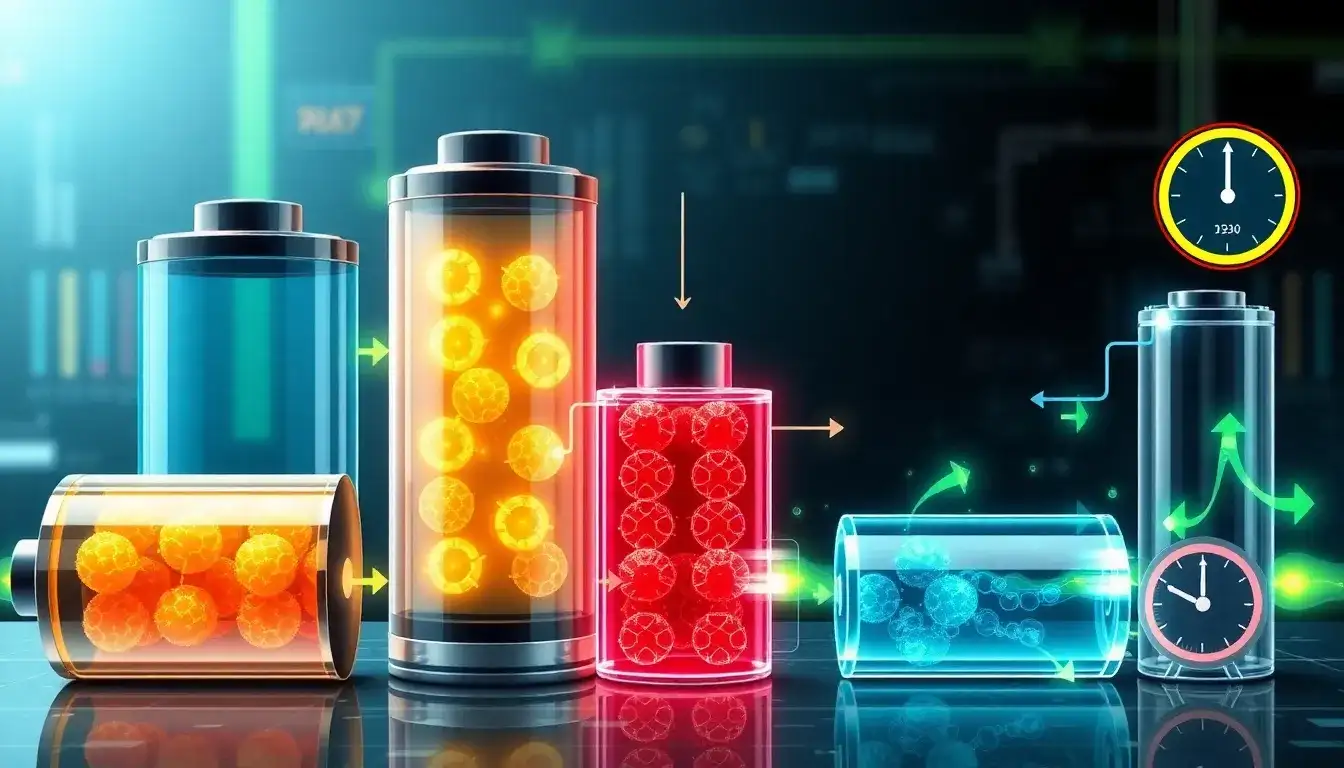
Battery chemistry significantly influences charging efficiency through the inherent electrochemical processes, charge acceptance characteristics, and thermal behavior during charging.
Effect of Battery Chemistry on Charging Efficiency
- Lithium-ion (Li-ion) Batteries:
Li-ion batteries exhibit one of the highest charging efficiencies among rechargeable chemistries, with coulombic efficiency (the ratio of charge extracted to charge input) typically exceeding 99% when charged at moderate currents and cool temperatures. Their energy efficiency can reach about 99% at low charge rates (e.g., 0.05C over 20 hours) but decreases at higher charge rates (e.g., around 97% at 0.5C and lower at 1C) due to increased heat generation and reduced charge acceptance. Ultra-fast charging and very slow charging reduce efficiency by causing losses via heat and self-discharge, respectively. Additionally, chemical side reactions such as thickening of the solid electrolyte interface (SEI) layer on the graphite anode or electrolyte oxidation on the cathode occur more at high currents, lowering efficiency and potentially affecting safety. - Lead-Acid Batteries:
Lead-acid batteries generally have lower charging efficiencies, around 85% compared to nearly 100% in lithium-ion batteries. This is due to the different chemistry that involves more significant energy losses during charge acceptance and conversion reactions. The charging process in lead-acid cells often includes more heat generation and gas evolution, leading to wasted energy as heat and recombination inefficiencies. - General Losses Across Chemistries:
About 10-15% of the electrical charge supplied to any battery is typically wasted as heat or chemical side reactions rather than stored. The exact amount depends on the battery chemistry, charge rate, temperature, and battery condition.
Additional Factors Related to Chemistry
- The internal resistance varies between chemistries and influences efficiency; higher internal resistance leads to more heat generation and lower efficiency during charging.
- Battery temperature, influenced by chemistry and charge rate, affects efficiency since elevated temperatures increase side reactions and efficiency losses.
- Battery age and cycling impact chemical stability; for example, Li-ion batteries may improve their coulombic efficiency slightly with cycling due to stabilization of the SEI layer, but aging eventually leads to increased resistance and decreased efficiency.
In summary, battery chemistry dictates how the electrochemical reactions occur during charging, influencing how much of the electrical energy is effectively stored versus lost. Lithium-ion chemistries offer superior charging efficiency due to their high coulombic and energy efficiencies under moderate charge rates and controlled temperatures, while other chemistries like lead-acid are less efficient partly due to their reaction mechanisms and internal resistance characteristics. Charging practices that consider chemistry-related limitations—such as controlling charge current and temperature—are essential to maximize efficiency and battery lifespan.
Original article by NenPower, If reposted, please credit the source: https://nenpower.com/blog/how-does-the-battery-chemistry-affect-charging-efficiency/

