

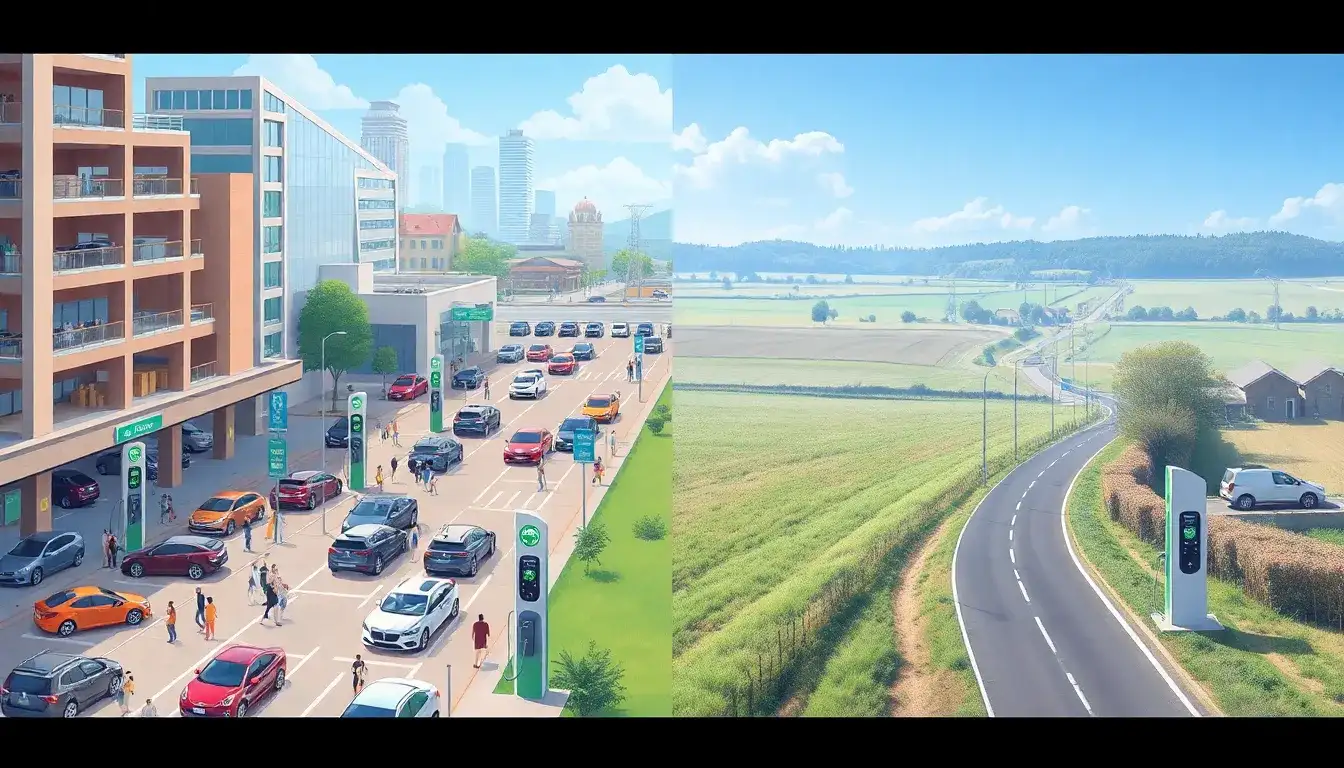
The availability of electric vehicle (EV) charging infrastructure differs markedly between urban and rural areas due to factors such as population density, usage patterns, economic viability, and geographic challenges.
Differences in Availability and Usage
- Urban Areas:
- Urban areas have a dense network of EV charging stations, which are used more frequently. For example, urban charging stations average about 0.844 charges per day, significantly higher than rural station usage at 0.176 charges per day.
- Approximately 60% of urban residents live within a mile of a public EV charger, highlighting the widespread availability in cities.
- Urban charging infrastructure benefits from better grid connectivity and higher local EV adoption rates, making installations more economically viable.
- Rural Areas:
- Rural areas have much sparser EV charging infrastructure, with only about 17% of rural residents living within a mile of a public EV charger, compared to 60% in urban areas.
- Public charging stations in rural areas are fewer and used less frequently, which challenges the economic case for installing and maintaining chargers given the lower population density and demand.
- Rural EV drivers often face “range anxiety” due to the scarcity of chargers and longer average travel distances, compounded by fewer fast-charging options, which makes recharging slower and less convenient.
Economic and Infrastructure Challenges
- Installation and upkeep of EV chargers in rural areas tend to be more expensive per user because fewer residents use each station, making it harder to recoup costs.
- Rural locations sometimes lack paved parking lots, which are required for EV charger installations under regulations, leading to additional site preparation costs that can be prohibitively expensive.
- Choosing the right locations in rural areas is critical but challenging—chargers must be accessible from major highways and travel routes to be viable, yet many rural roads are remote with low traffic volume, lowering station utilization.
Trends and Improvements
- Despite these challenges, rural areas are seeing faster growth rates in charging infrastructure compared to urban areas (34% vs 29% increase), largely driven by recent federal incentives such as tax credits from the 2022 Inflation Reduction Act aimed at boosting rural EV infrastructure.
- However, rural regions still account for only about 10% of all public EV charging stations nationwide, underscoring a continuing concentration of infrastructure in urban centers.
In summary, urban areas enjoy significantly more dense and frequently used EV charging infrastructure, supported by higher population density and grid capacity. Rural areas lag behind in availability due to lower population density, higher per-user installation costs, and logistical challenges, though recent policies are helping to improve rural charging access gradually. Range anxiety and economic factors remain key barriers to rural EV adoption linked directly to this infrastructure disparity.
Original article by NenPower, If reposted, please credit the source: https://nenpower.com/blog/how-does-the-availability-of-charging-infrastructure-differ-between-urban-and-rural-areas/

