

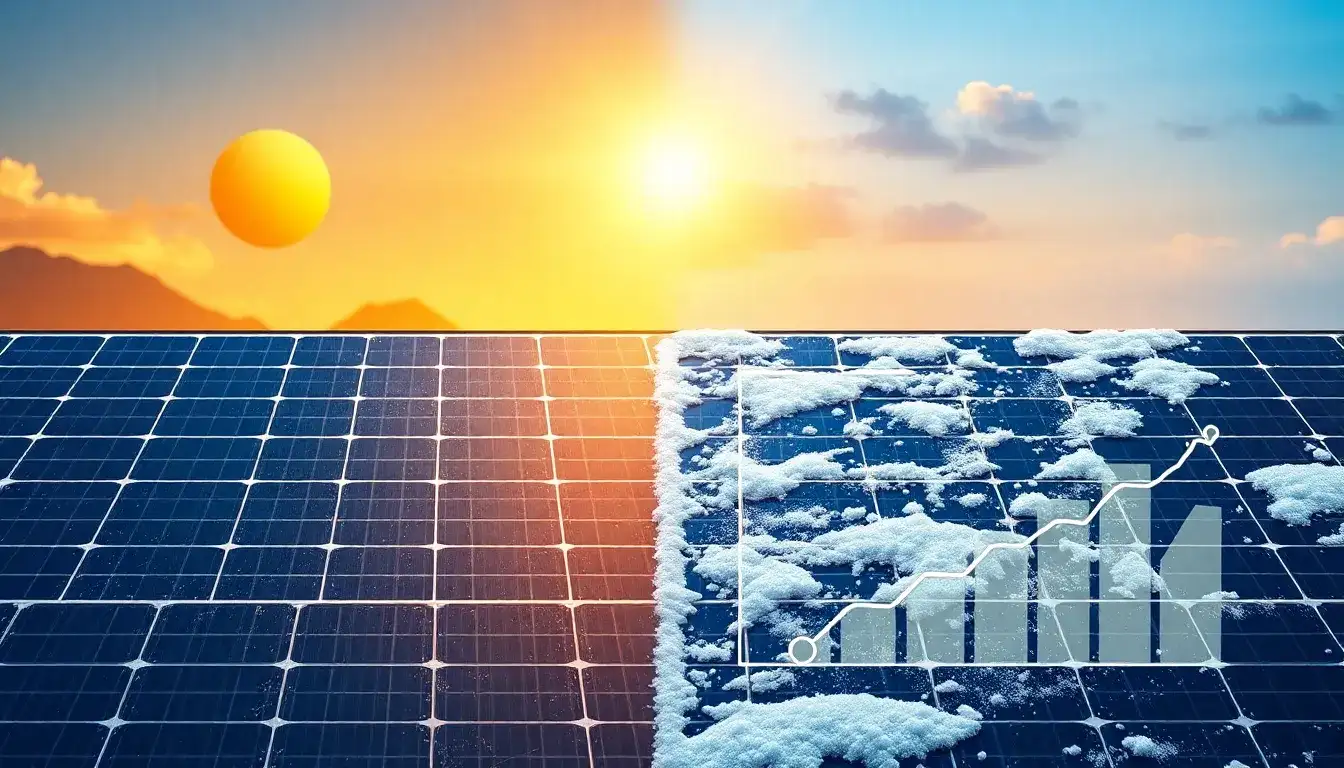
Temperature variation has a significant effect on both the efficiency and the long-term reliability of solar panels, influencing their power output and physical durability over time.
Impact of Temperature on Solar Panel Efficiency
- Efficiency Declines as Temperature Rises:
Solar panels are typically rated at a standard test condition of 77°F (25°C). For every degree Fahrenheit or Celsius above this baseline, their efficiency drops. The typical temperature coefficient for solar panels ranges from about -0.3% to -0.5% efficiency per degree Celsius increase above 25°C. For example, a solar panel may lose around 0.35% efficiency for each degree Fahrenheit above 77°F or 0.3% to 0.5% per degree Celsius above 25°C. - Physical Reason:
Higher temperatures increase the energy of electrons in semiconductor materials, reducing the bandgap and thus lowering the panel’s open-circuit voltage—the main factor reducing efficiency. While current slightly increases with temperature, the voltage drop dominates, leading to less power produced overall. - Real-World Effects:
On hot summer days, panel surface temperatures can reach 150°F (66°C) or higher, causing efficiency losses between 10-15% compared to rated output at standard test conditions. Conversely, panels perform better in cooler climates, sometimes generating 5-7% more power in cold conditions due to increased voltage. - Seasonal Considerations:
Despite a drop in efficiency on very hot days, longer daylight hours in summer can compensate. In winter, cooler conditions improve efficiency but fewer sunlight hours reduce total output.
Effects of Temperature Variation on Long-Term Reliability
- Material Expansion and Contraction:
Extreme and fluctuating temperatures cause internal materials in solar panels to expand and contract. This thermal cycling can wear down soldered connections and other internal components, potentially leading to micro-cracks and solder joint degradation over many years. - Durability Measures:
High-quality solar panels are designed with encapsulation layers, tempered glass, and robust aluminum or steel frames that help mitigate thermal stress damage, ensuring operational lifetimes of 25+ years even under wide temperature ranges (-40°F to 185°F). - Panel Types and Heat Tolerance:
Thin-film panels typically handle heat better due to lower temperature coefficients, while monocrystalline panels also outperform polycrystalline in high temperatures, making them preferable in hot climates. Choosing panels with low temperature coefficients helps maintain durability and efficiency in heat-prone areas. - Installation and Mitigation:
Proper installation promoting airflow behind panels reduces operating temperatures and thermal stress. Ensuring ventilation gaps and optimal angles can help panels cool down, reducing efficiency losses and material fatigue from heat.
Summary Table of Temperature Impacts
| Aspect | Effect of Temperature Variation |
|---|---|
| Efficiency | Decreases by ~0.3%-0.5% per 1°C above 25°C; improves in cool temperatures |
| Voltage | Open-circuit voltage drops with rising temperature |
| Current | Slight increase at higher temperatures, but less significant |
| Physical Durability | Thermal expansion/contraction stresses solder joints and materials over time |
| Operating Temp Range | Typically -40°F to 185°F (Panels built for wide range) |
| Recommended Panel Types | Thin-film, monocrystalline better in heat; low temp coefficient preferred |
| Mitigation | Installation ventilation, cooling, and panel spacing crucial |
Conclusion
Temperature variation affects solar panels by reducing their power output efficiency during hot conditions due to semiconductor physics, and potentially impacting long-term durability through thermal stress cycling. However, modern solar panels are engineered to withstand a broad temperature range and maintain functionality for decades. Choosing the right panel technology and ensuring good installation practices can mitigate many negative effects of temperature variation on solar panel reliability and performance.
Original article by NenPower, If reposted, please credit the source: https://nenpower.com/blog/how-does-temperature-variation-affect-the-long-term-reliability-of-solar-panels/

