

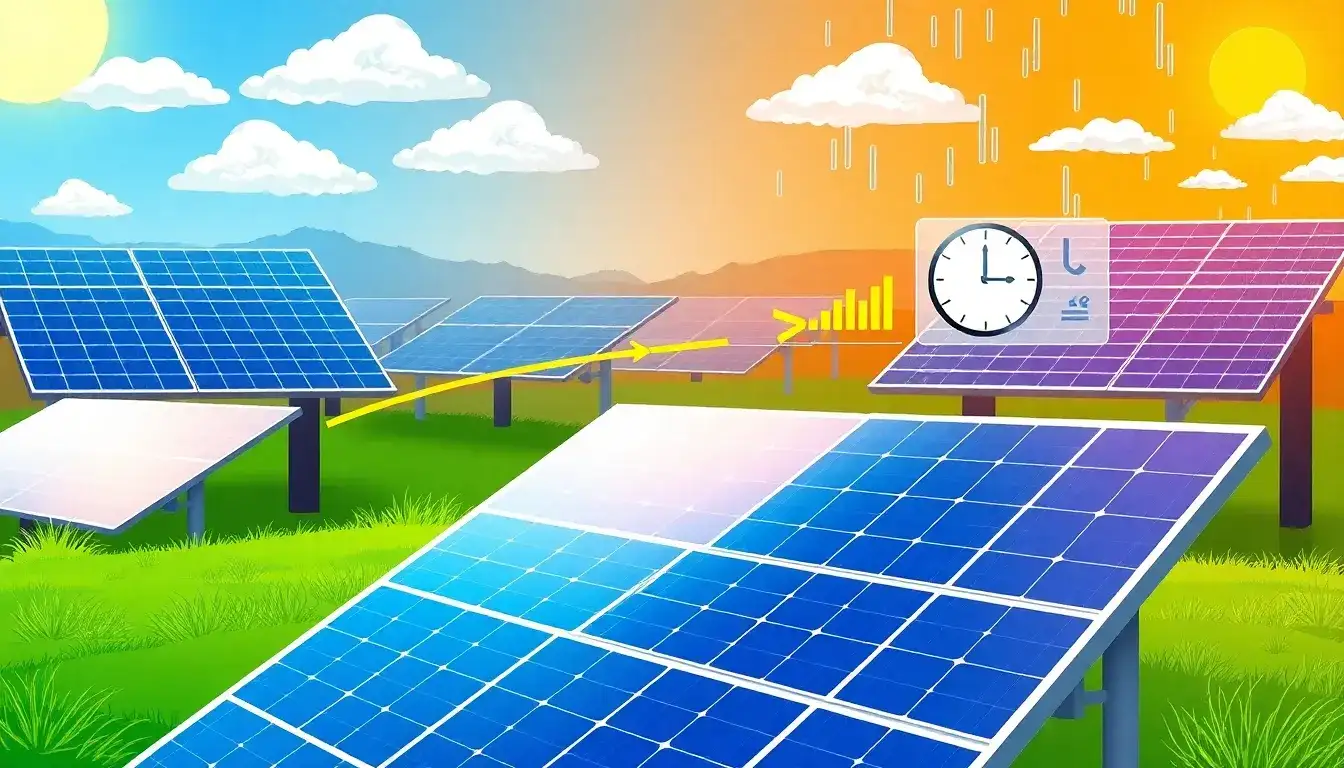
Solar panel performance over time is directly influenced by operating temperatures, primarily affecting immediate efficiency and long-term durability. Here’s a detailed breakdown:
Immediate Efficiency Impact
Solar panels are most efficient at 77°F (25°C), the industry testing standard. Above this threshold:
- Power output declines by 0.3–0.5% per °C (or ~0.2% per °F). For example, at 95°F (35°C), a 320W panel loses ~11.5W (3.6%).
- Voltage drops as temperature rises due to increased electron resistance and recombination rates.
- Current increases slightly but is outweighed by voltage losses.
In cold climates, panels may exceed rated output (e.g., +5–7% at 32°F/0°C), though snow coverage can offset gains.
Long-Term Durability
While extreme temperatures don’t inherently damage panels, thermal cycling (daily temperature swings) can stress materials over decades:
- Operating range: Most panels tolerate -40°F to 185°F without permanent damage.
- Degradation: Standard panels lose ~0.5–0.8% efficiency annually, accelerated marginally by prolonged high temperatures.
Mitigation Strategies
- Temperature coefficient: Choose panels with lower coefficients (e.g., -0.3%/°C instead of -0.5%/°C).
- Cooling: Install with airflow gaps or use active cooling in desert climates (e.g., evaporative systems improved output by 5% in one case).
- Snow management: Angle panels steeply to shed snow in cold climates.
Seasonal Considerations
- Summer: Longer daylight compensates for heat-induced losses.
- Winter: Peak efficiency in cold, sunny conditions, but shorter days limit total output.
By optimizing installation and component selection, temperature-related performance loss can be minimized over a panel’s 25+ year lifespan.
Original article by NenPower, If reposted, please credit the source: https://nenpower.com/blog/how-does-temperature-impact-the-performance-of-solar-panels-over-time/

