

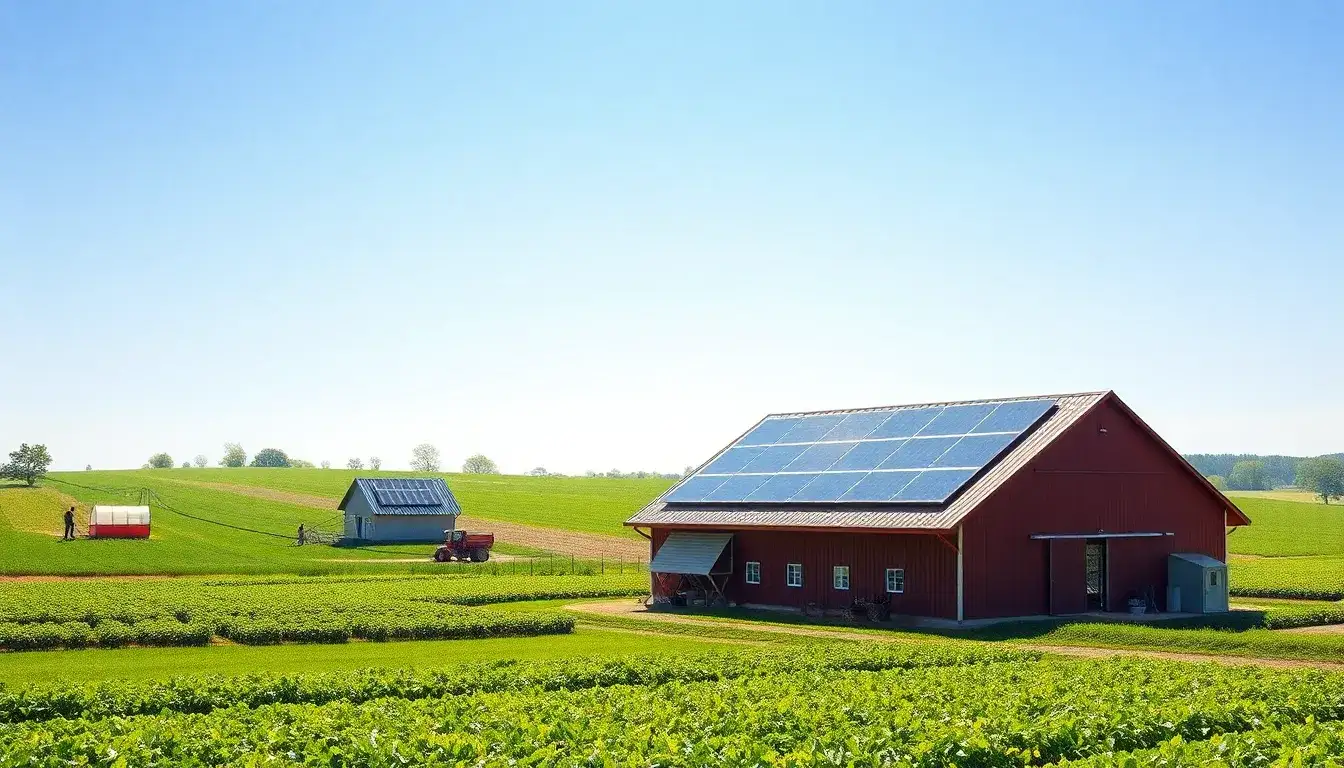
Solar energy contributes to increasing farm income primarily by enabling farmers to generate additional revenue through solar power production and land leasing while also reducing operational costs.
Ways Solar Energy Increases Farm Income
1. Income from Solar Power Generation
Farmers who install solar panels or develop solar farms on their land can generate electricity to be sold to the grid or utility companies. For example:
- A 1-megawatt (MW) solar farm can generate around 1.8 gigawatt-hours (GWh) annually and earn roughly $75,000 per year in revenue at current energy trading prices ($52 per megawatt-hour), though upfront costs are high, taking about 13 years to break even.
- Alternatively, using more conservative price estimates and a slightly lower production assumption (four peak sun hours/day), a 1 MW solar farm can generate around $40,000 to $43,500 annually. This variation depends on location, solar irradiance, and electricity market prices.
2. Leasing Land for Solar Farms
Farmers can lease unused or underutilized land to solar developers, earning steady rental income without the need to invest in solar infrastructure themselves. Typical lease payments range from $300 to $4,000 per acre annually. This method generates additional income without interfering with traditional farming activities.
3. Reduced Energy Costs
Installing solar panels allows farmers to offset or eliminate their own electricity costs, reducing expenses related to irrigation pumps, processing equipment, refrigeration, and lighting. Savings on energy bills directly improve net farm income, although exact figures vary by farm size and energy needs.
4. Diversification and Long-Term Financial Stability
Solar energy provides farmers with a diversified income stream that is less subject to agricultural market fluctuations or weather conditions. This can stabilize overall farm income and improve financial resilience.
Summary of Financial Impact per Acre and Farm Size
| Income Source | Income Estimate | Notes |
|---|---|---|
| Solar farm revenue (per 1 MW) | $40,000 to $75,000 per year | Depends on sunlight, market price, and costs |
| Solar farm income per acre | ~$1,770 to $3,540 per acre annually | Based on typical solar panel density |
| Land lease for solar farm | $300 to $4,000 per acre annually | Passive income for landowners |
Conclusion
Solar energy helps increase farm income by providing a sustainable, alternative revenue stream through electricity sales or land leasing and reducing on-farm energy expenses. Although initial investment costs can be substantial, the long-term financial benefits from solar energy can significantly enhance a farm’s profitability and economic stability over time.
Original article by NenPower, If reposted, please credit the source: https://nenpower.com/blog/how-does-solar-energy-contribute-to-increasing-farm-income/

