

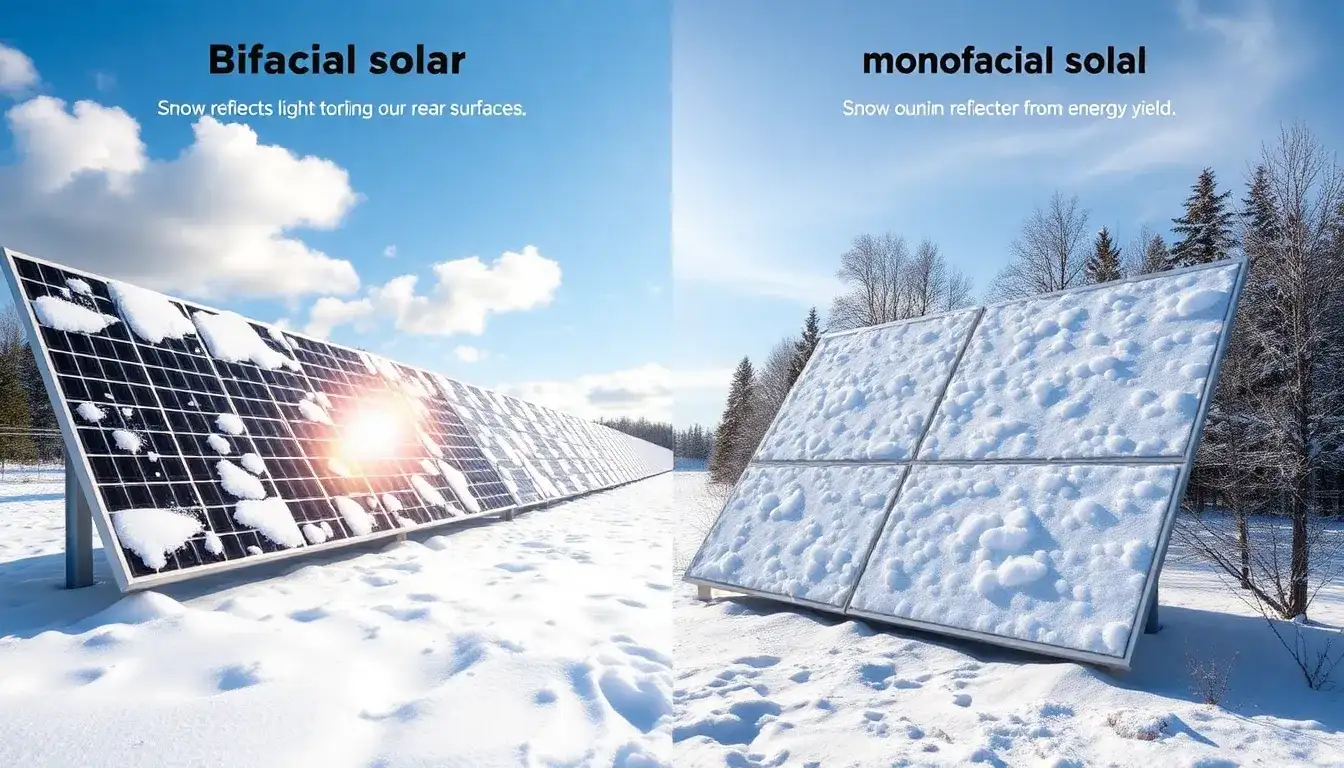
Snow influences the energy yield of bifacial and monofacial solar panels quite differently due to their distinct designs and how they harvest light.
How Snow Affects Monofacial Solar Panels
- Monofacial solar panels collect sunlight only from their front side.
- When snow covers these panels, it blocks sunlight from reaching the cells, causing significant energy losses.
- Studies have shown that in winter, monofacial panels can lose around 33% of their potential energy due to snow cover, and about 16% annually on average.
- Additionally, snow accumulation on the panel surface can persist longer on monofacial panels, prolonging these losses.
How Snow Affects Bifacial Solar Panels
- Bifacial panels capture sunlight on both their front and back surfaces.
- The back side can utilize reflected sunlight from the ground—especially effective when the ground is snow-covered because snow has a very high albedo (reflectivity), often exceeding 0.9 for fresh snow.
- This albedo effect can boost energy yield significantly in snowy environments.
- A detailed study with hourly data and image tracking of snow cover in Ontario, Canada, found that bifacial panels reduced snow-related energy losses drastically—from double-digit losses seen in monofacial panels to only about 2% annually.
- In winter, bifacial panels showed an average snow loss of only 16%, compared to 33% for monofacial ones, and they delivered a 19% energy gain over monofacial systems largely due to reflected light from snow.
- Bifacial gain (additional energy from rear-side collection) can be as high as 28.4% in winter months, nearly three times the gain during summer.
Additional Notes
- Bifacial panels also tend to shed snow faster than monofacial panels because their design and light capture characteristics promote quicker clearing.
- In some cases, reflected light can slightly “leak through” the backing of monofacial panels with white or light-colored backsheets, giving a marginal increase in output when snow is on the ground, but this effect is very limited compared to bifacial designs.
Summary Table
| Feature | Monofacial Panels | Bifacial Panels |
|---|---|---|
| Light collection | Front side only | Front and back sides |
| Snow coverage impact | High energy loss (33% in winter) | Low energy loss (~16% in winter) |
| Annual snow loss | ~16% | ~2% |
| Energy gain from reflected snow | Minimal | Significant (up to 19% gain in winter) |
| Snow shedding | Slower | Faster |
| Effect of snow albedo | Limited | Major contributor to increased yield |
Conclusion
Bifacial solar panels outperform monofacial panels in snowy environments by significantly reducing snow-related energy losses and leveraging the high reflectivity of snow to boost power generation. This makes bifacial modules the preferred choice for solar installations in regions with heavy winter snowfall.
Original article by NenPower, If reposted, please credit the source: https://nenpower.com/blog/how-does-snow-affect-the-energy-yield-of-bifacial-solar-panels-compared-to-monofacial-ones/

