

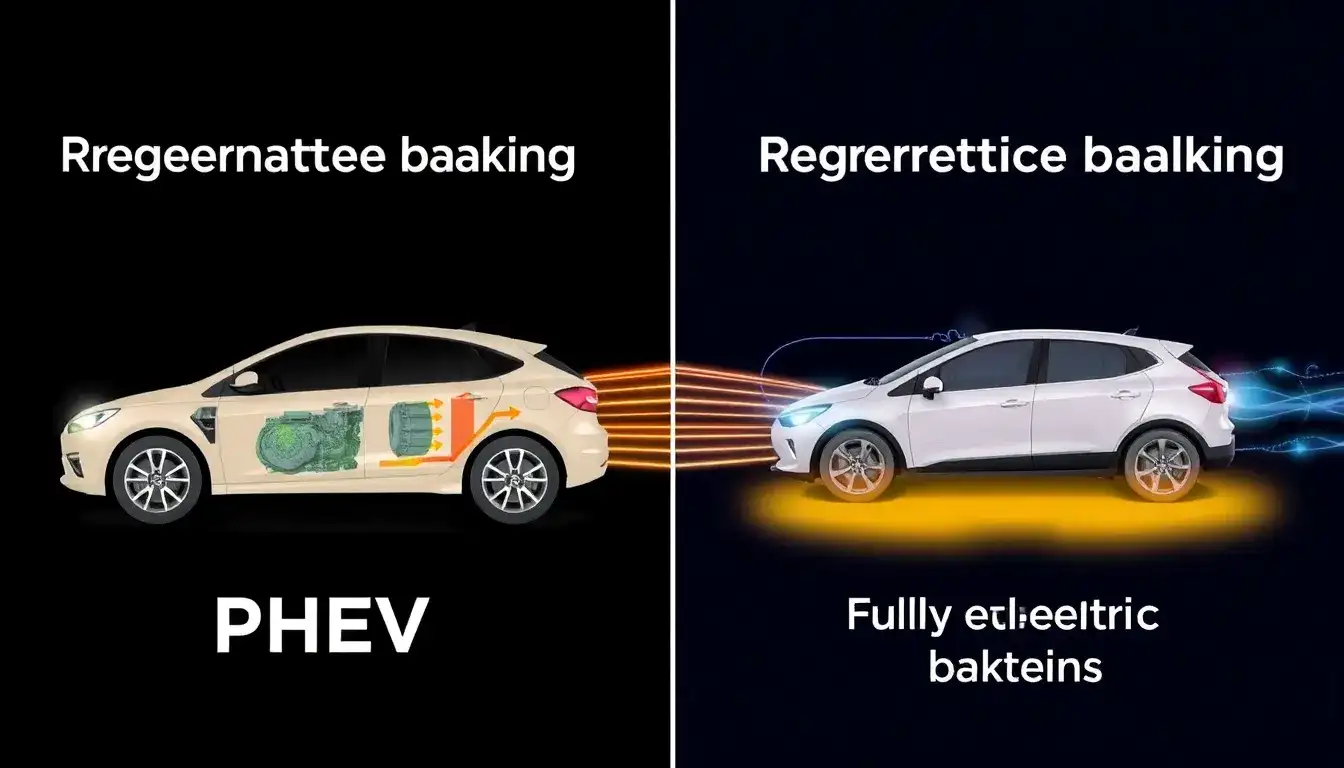
Regenerative braking is a crucial efficiency feature in both Plug-in Hybrid Electric Vehicles (PHEVs) and Fully Electric Vehicles (FBEVs), allowing them to capture kinetic energy and convert it into electrical energy during braking or deceleration. Here’s how they compare:
Regenerative Braking in PHEVs
- Functionality: PHEVs use regenerative braking to recharge their larger batteries, which are typically 10 to 20 times bigger than those in traditional hybrids. This process helps in maximizing electric driving range, allowing PHEVs to run on electricity alone for a certain distance before needing to switch to the internal combustion engine.
- Battery Capacity and Usage: PHEVs have larger batteries that store energy not only from regenerative braking but also from external charging. This allows for more extensive electric-only operation compared to traditional hybrids.
- Control and Efficiency: While PHEVs use regenerative braking similarly to FBEVs, the additional complexity of managing both electric and gasoline power sources means that the system must balance energy recovery with propulsion requirements from both power sources.
Regenerative Braking in Fully Electric Vehicles
- Functionality: FBEVs exclusively rely on electric motors for propulsion and exclusively use regenerative braking to recharge their batteries during braking or deceleration. This process can significantly extend the driving range by recovering some of the kinetic energy lost during stops.
- Battery Capacity and Usage: FBEVs have large batteries designed to be charged both from the grid and through regenerative braking. The energy recovered during braking is crucial for maximizing efficiency and extending range.
- Control and Efficiency: FBEVs typically provide drivers with options to adjust the level of regenerative braking force, often through controls like the “flappy paddles” on the steering wheel. This allows for more flexible management of energy recovery and can enhance driving experience in specific conditions.
Key Differences
- Primary Power Source: PHEVs can switch between electric and gasoline engines, while FBEVs rely solely on electric motors for propulsion.
- Battery Size and Charging: PHEVs generally have smaller batteries than FBEVs but can charge from both regenerative braking and external power. FBEVs rely more heavily on grid charging but use regenerative braking extensively to optimize efficiency.
- Regenerative Braking Application: Both types use regenerative braking to capture energy, but the integration with a gasoline engine in PHEVs can affect how this energy is utilized compared to FBEVs, which focus solely on electric efficiency.
In summary, while both PHEVs and FBEVs utilize regenerative braking effectively to improve efficiency, the integration with other power sources and the scope of electric-only operation differ fundamentally between these two vehicle types.
Original article by NenPower, If reposted, please credit the source: https://nenpower.com/blog/how-does-regenerative-braking-in-phevs-compare-to-that-in-fully-electric-vehicles/

