

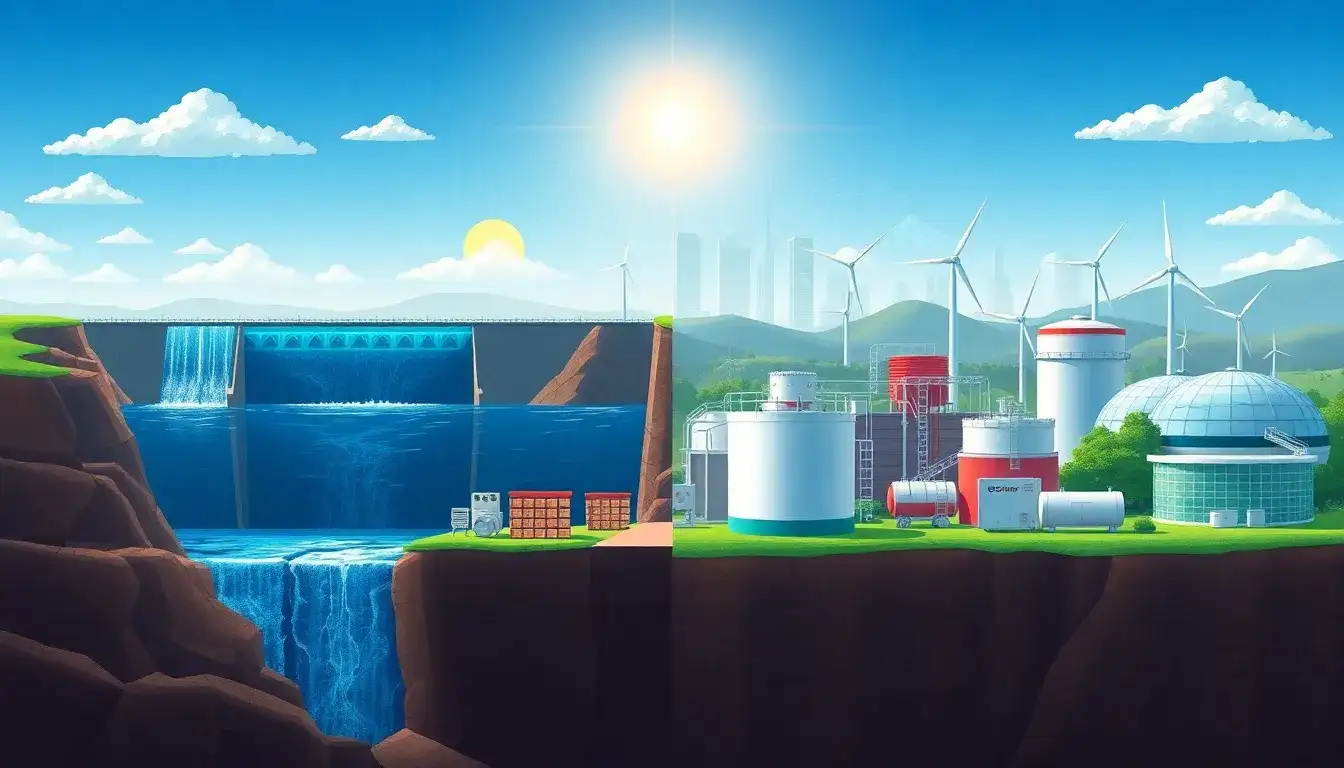
Pumped storage hydropower (PSH) remains the dominant solution for long-duration energy storage due to its scalability, efficiency, and cost advantages over alternatives. Here’s a comparative breakdown:
1. Capacity and Scalability
- PSH: Dominates grid-scale storage, accounting for >99% of global bulk storage capacity. Closed-loop systems (with two artificial reservoirs) achieve ~835 MW average capacity per site.
- Compressed-air storage (CAES): Limited by geological requirements (e.g., underground salt caverns) and smaller capacity per facility.
- Batteries: Lithium-ion (LIBs) and flow batteries prioritize short-duration storage; scaling to long durations requires prohibitively large installations.
2. Efficiency and Performance
- PSH: Achieves 70–87% round-trip efficiency, with rapid response to grid demand shifts.
- CAES: Lower efficiency (~40–70%) and higher greenhouse gas emissions (4× more than PSH).
- Batteries: LIBs reach 85–95% efficiency but degrade over time, reducing long-term viability.
3. Environmental Impact
- Closed-loop PSH: Reduces ecological disruption compared to open-loop systems (which connect to natural waterways). Emits ~25% of CAES’s greenhouse gases per energy unit.
- CAES: Relies on fossil fuels in some configurations, contributing to higher emissions.
- Batteries: Mining and recycling challenges for lithium/cobalt raise sustainability concerns, though flow batteries (e.g., vanadium) offer better longevity.
4. Cost and Lifespan
- PSH: Lower operational costs for large-scale storage, with decades-long lifespans.
- CAES: High upfront costs and limited site availability.
- Batteries: Higher per-kWh costs for long-duration storage, with replacement needed every 10–15 years.
Key Trade-offs
| Feature | PSH | CAES | Batteries |
|---|---|---|---|
| Scalability | Best for grid-scale | Moderate | Limited |
| Efficiency | 70–87% | 40–70% | 85–95%* |
| Emissions | Low (closed-loop) | High | Medium |
| Lifespan | 40–60 years | 20–30 years | 10–15 years |
*Battery efficiency drops at long-duration scale due to losses and degradation.
PSH’s combination of high capacity, longevity, and lower emissions makes it the leading option for long-duration storage, particularly in grids transitioning to renewables. CAES and batteries remain niche depending on site constraints or short-term needs.
Original article by NenPower, If reposted, please credit the source: https://nenpower.com/blog/how-does-pumped-storage-hydropower-compare-to-other-forms-of-long-duration-energy-storage/

