

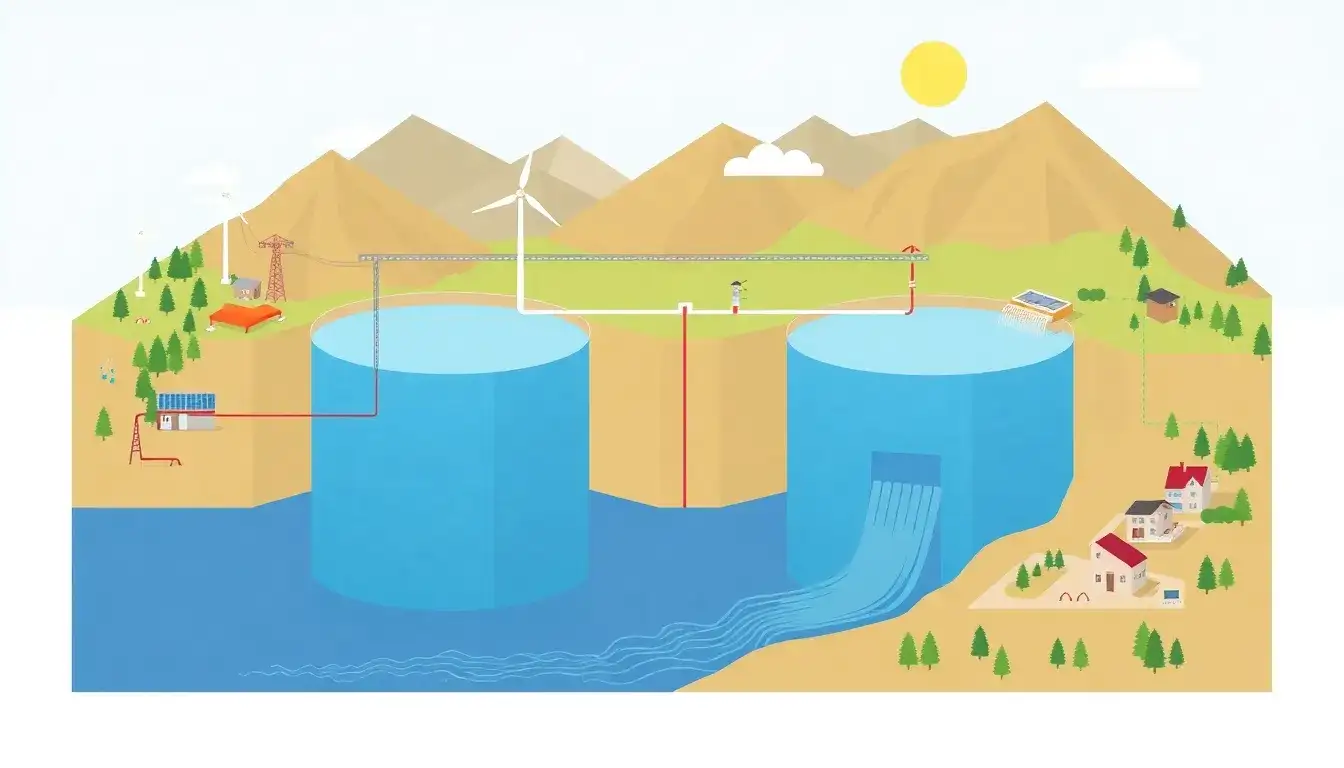
Pumped-storage hydroelectricity (PSH) is a widely used method for storing energy, particularly in supporting grid stability and balancing electricity supply. Here’s how it works:
Basic Principle
PSH involves two reservoirs at different elevations:
- Upper Reservoir: Higher elevation.
- Lower Reservoir: Lower elevation.
Operation
- Energy Storage (Charging Phase): During times of low electricity demand, excess power from the grid (e.g., from renewable sources like wind or solar) is used to pump water from the lower reservoir to the upper reservoir. This process is like “charging a battery,” as the potential energy of the water is increased.
- Energy Generation (Discharge Phase): When electricity demand is high, the stored water in the upper reservoir is released back into the lower reservoir. As the water flows down, it drives turbines, which in turn generate electricity. This is akin to “discharging the battery,” converting the stored potential energy into electrical energy.
Components and Types
- Turbines: PSH plants often use reversible turbine/generator units. These can operate both as pumps (during charging) and as turbines (during discharge).
- Open-Loop vs. Closed-Loop Systems:
- Open-Loop: Connected to natural water bodies, potentially replenished by rivers or streams.
- Closed-Loop: No connection to external water bodies; water is constantly cycled between the two reservoirs.
Benefits and Challenges
- Benefits: PSH enhances grid stability by providing rapid response to changing demand and acting as a buffer for intermittent renewable energy sources.
- Challenges: Requires specific geographical conditions (e.g., suitable elevation differences and water resources), and developing new facilities is costly.
Efficiency and Capacity
- Efficiency: Round-trip efficiency (the ratio of energy output to energy input) typically ranges from 70% to 80%, meaning more energy is consumed to pump the water than is generated.
- Capacity: PSH is the largest form of grid-scale energy storage globally, with significant capacity for expansion, especially in supporting renewable energy integration.
Original article by NenPower, If reposted, please credit the source: https://nenpower.com/blog/how-does-pumped-storage-hydroelectricity-work/

